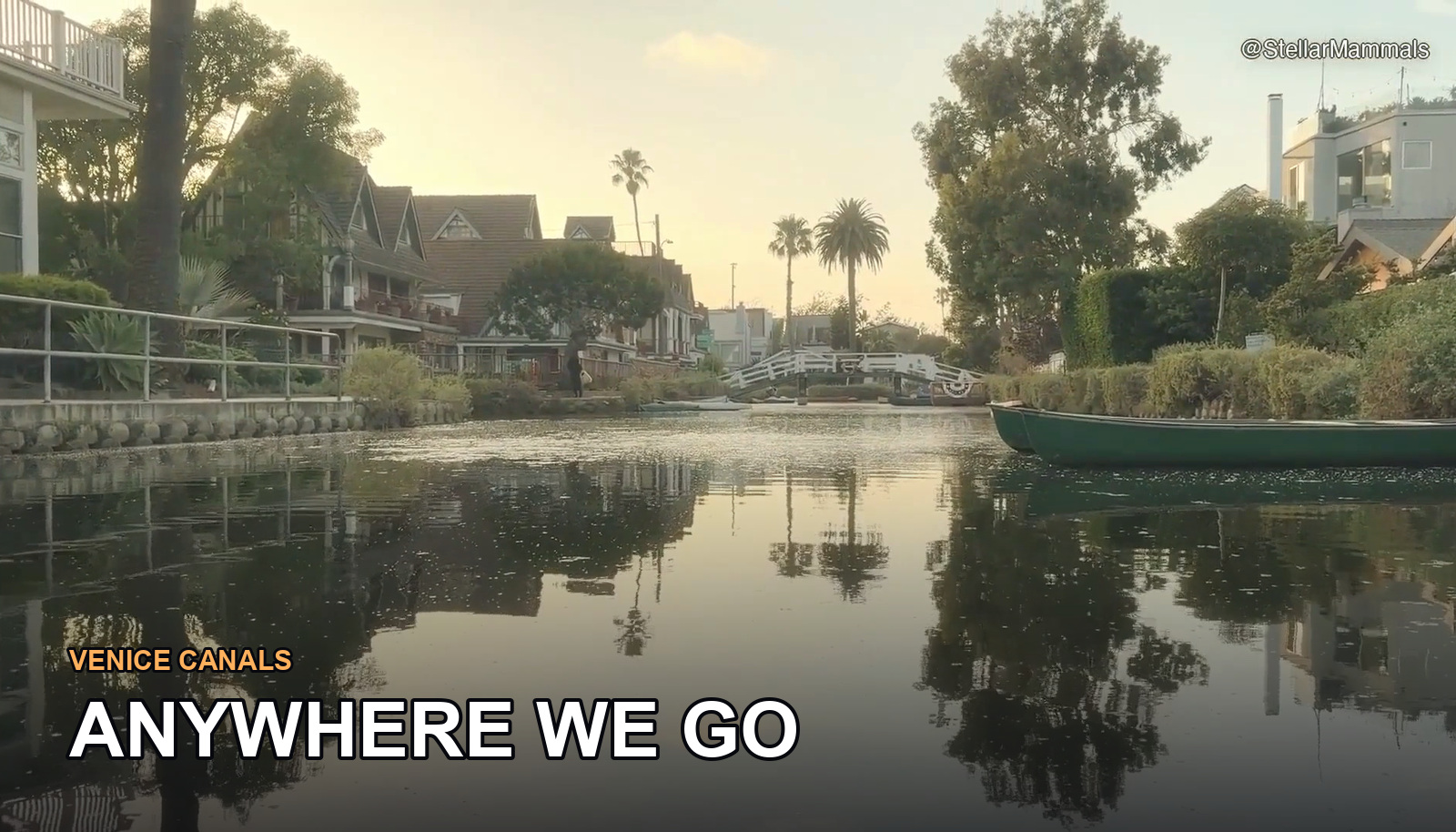
A party record made from the Venice Canals. A house record made a few blocks from the Venice Beach. Golden hour. Browns and purples of the Santa Monica Mountains. And those blues turning orange of Pacific sparkling waves🌴🌊🏄.
“Palm Tree Party” is my seventh album as Stellar Mammals and my third with trumpeter Jacob Burgdorf. It’s also my first record with a dedicated vocalist, LosA, singing across seven of the twelve tracks. Twelve songs, thirty-eight minutes, somewhere between jazz house and deep house. Creation was a lot of fun and done mostly in an apartment overlooking the Venice Canals in Venice Beach, California.
Listen on Spotify, Apple Music, Amazon Music, YouTube Music and all major streaming services. Everything in one place at StellarMammals.com/music.
Hope you enjoy!
Release Notes
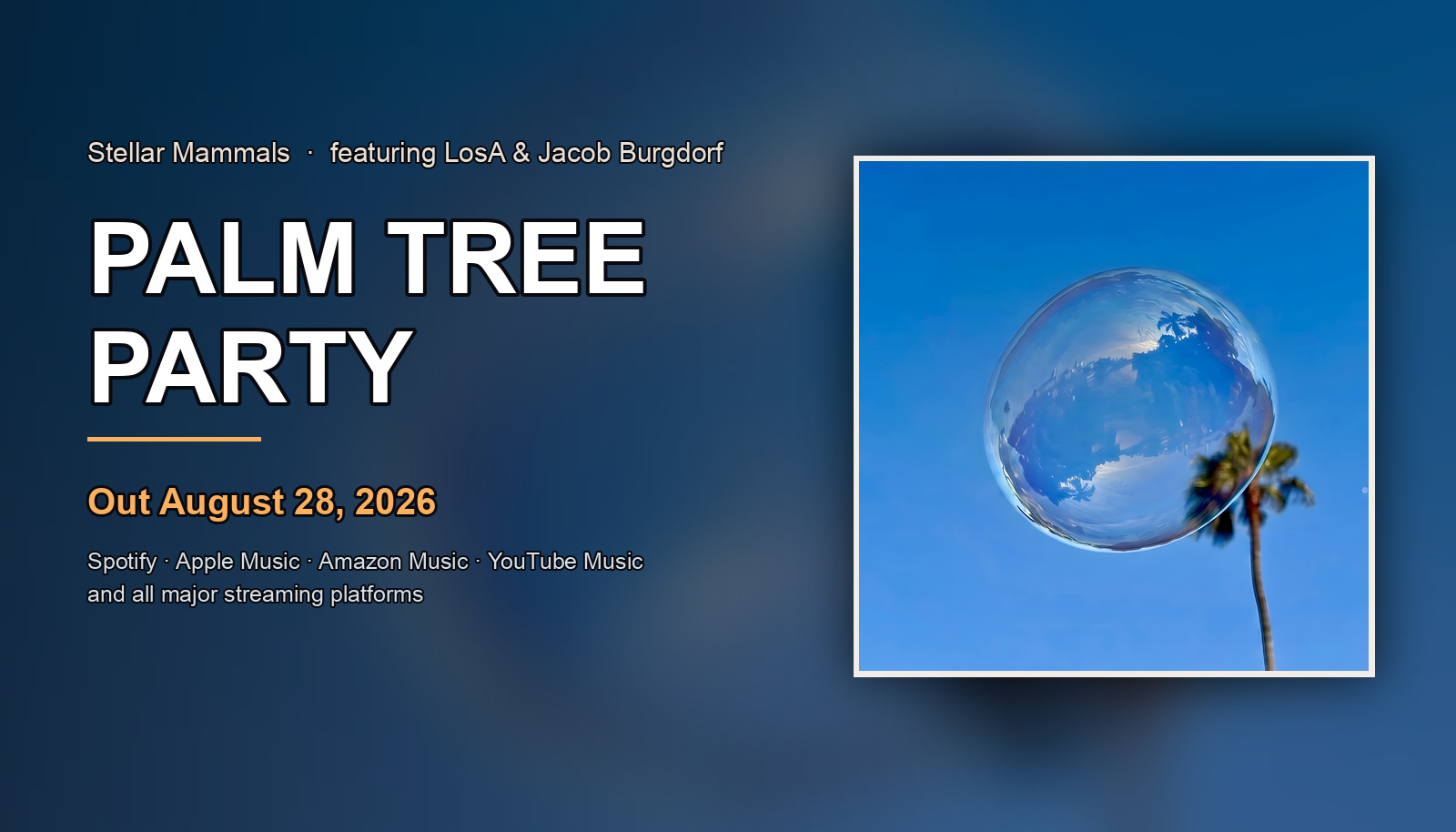
Released on August 28, 2026. Written, composed, performed, produced and mixed by Stellar Mammals, aka Mark Koester Trumpet on all twelve tracks by Jacob Burgdorf Vocals by LosA Mastered with LANDR. Cover photo and design by Mark Koester: a soap bubble over the Venice canals, with the whole neighborhood upside down inside it. Stellar Mammals Production 2026.
I’ve long aimed to release on prime-numbered days. Admittedly, August 28 isn’t prime, but 28 is a perfect number, equal to the sum of its own divisors, which felt like a decent trade for an album that took a year for me to admit it was finished.

Palm Tree Party Music Videos:
▶️ Watch the Palm Tree Party playlist on YouTube
- In Too Deep — lyric video
- Frisbee Flow State — official music video
- Anywhere We Go — lyric video, out August 30
- More to come: Last Breath House, Echoes of a Life That Could Have Been
Every video lives in the Stellar Mammals — Music Videos playlist. Find more art, music and videos at StellarMammals.com, and day-to-day on Instagram.
Track List
- Anywhere We Go
- In Too Deep
- Truth be Told
- Frisbee Flow State
- Beethoven at the Beach House
- Catalina Island
- Eagle Eat Eagle World
- I Want It All
- Joyous
- Marimba on Mars
- Echoes of a Life That Could Have Been
- Last Breath House
Singles: Frisbee Flow State (August 5) and In Too Deep (August 19).
Liner Notes from LosA
LosA wrote and sings the lyrics on seven of the twelve tracks. Here is where each one came from, in her words.
- Anywhere We Go - The original song was called “Jolly Toad,” so that gave me the imagery of mud, wandering a swampy forest with lilypads, and being lost in an Alice in Wonderland type of situation.
- In Too Deep - A more light-hearted dance tune about letting go and dancing! Interpreting a scenario where a relationship is fading away, but the music and environment make you want to try one more time, so “take my hand and dance,” and that you want to feel something again.
- Frisbee Flow State - Frisbee flow state!!
- Beethoven at the Beach House - Written with the imagery of a stormy night at a beach house party, taking a step away, looking at the moon and thinking about someone who isn’t there!
- I Want It All - The original title was “Oregon Orford Coast,” so I imagined a foggy, cold coastline, and watching the crashing waves below, realizing that you have to be at peace with yourself to move forward, and to get what you want!
- Joyous - Do you rememberrrrrr?!?!?
- Echoes of a Life That Could Have Been - Coming to terms with your fate.
LosA
Collaborators / Attribution
Collaboration is a gift. Thanks to:
- Jacob Burgdorf - trumpet and horn on all twelve tracks; co-writer on the record. Added bass, keys and other notes on multiple tracks. LA-based, Midwest-born. Find on Instagram
- LosA - lead vocals and lyrics on seven tracks, ukulele on Frisbee Flow State, marimba on Marimba on Mars, plus the field recording that gives Beethoven at the Beach House an actual party in the background. Find on Instagram and checkout her videos on YouTube.
- Sky Bartlett - bass on Anywhere We Go and Last Breath House. Find on Instagram
- Kris Cruz - early composition and production on In Too Deep and production help on Frisbee Flow State. LA-based producer and audio engineer. Find on Instagram
Artist and Producer Notes from Stellar Mammals / Mark Koester
About the Album
I’ve been making house tracks for several years, mostly as a way to experiment and have fun. Something to mess with over time. Intuitive and unintentional. I vaguely carried some notion of eventually doing a house album though I never expected or planned for this particular record.
What I did have was a pull that was hard to ignore: putting Jacob’s trumpet somewhere it hadn’t been yet. We’d made two albums together in the lofi and instrumental space, and his horn kept hinting at something else, something with more a four on the floor dance groove under it: House and Horns.
While unplanned, this album is also a deliberate turn. Six albums of instrumental music made mostly for focus and flow, and this time I wanted something you could move to, bop your head and dance.
By the fall of 2025, after finishing and releasing an album in the summer, the thing had a name and a shape. I went back through years of demos and found I’d been quietly making this record for a while already: a sketch from 2021, another started on my iPhone, a mid 2024 track, one written after a run on the Oregon coast. From there, I started building forward from that pile instead of from scratch.
Then LosA showed up and the album stopped being what we’d planned and became what it needed to be. House music needs a voice and she became ours. She’s the first dedicated vocalist I’ve worked with across a whole record, and putting a voice on seven of twelve tracks changed everything downstream: the arrangements, the space I had to leave, the mix, and even what the songs were about. The beats I’d written as instrumentals became actual songs.
Ironically, this album “Palm Tree Party” is named after a song that got cut but whose title was too good to leave behind. I made most of it in an apartment overlooking the Venice canals, a few blocks from the ocean, and I think it sounds like that: warm, a little loose, made by somebody who walks to the beach, blows bubbles, and isn’t too serious to have fun.
The making was a lot of fun. The finishing nearly broke me (more on that below).
Track Highlights from Mark
Anywhere We Go - This was the song on the record that I had already written off. It was a sketch from December 2021 that sat untouched for over four years, originally called Jolly Toad. It was headed for the trash. It was one of those tracks I liked but didn’t know how to move forward, and I’d stopped being able to hear it properly. What saved it was the moment I played it during a songwriting session with LosA and Jacob. We were looking for a song starter or demo from the old pile, my nearly cut list. That one lit them up. It got resurfaced. We reworked it, re-tracked a few parts, and I finished it. LosA named it and sings it, and the placeholder turned out to do more than hold a slot: she took the toad and built the lyric around mud, lilypads and being lost in a swampy Alice in Wonderland forest. I put it as the opening track because it opens wide, one of the two most dynamic tracks on the record, and it gives the album room to breathe before what comes after.
▶️ Anywhere We Go lyric video out August 30.
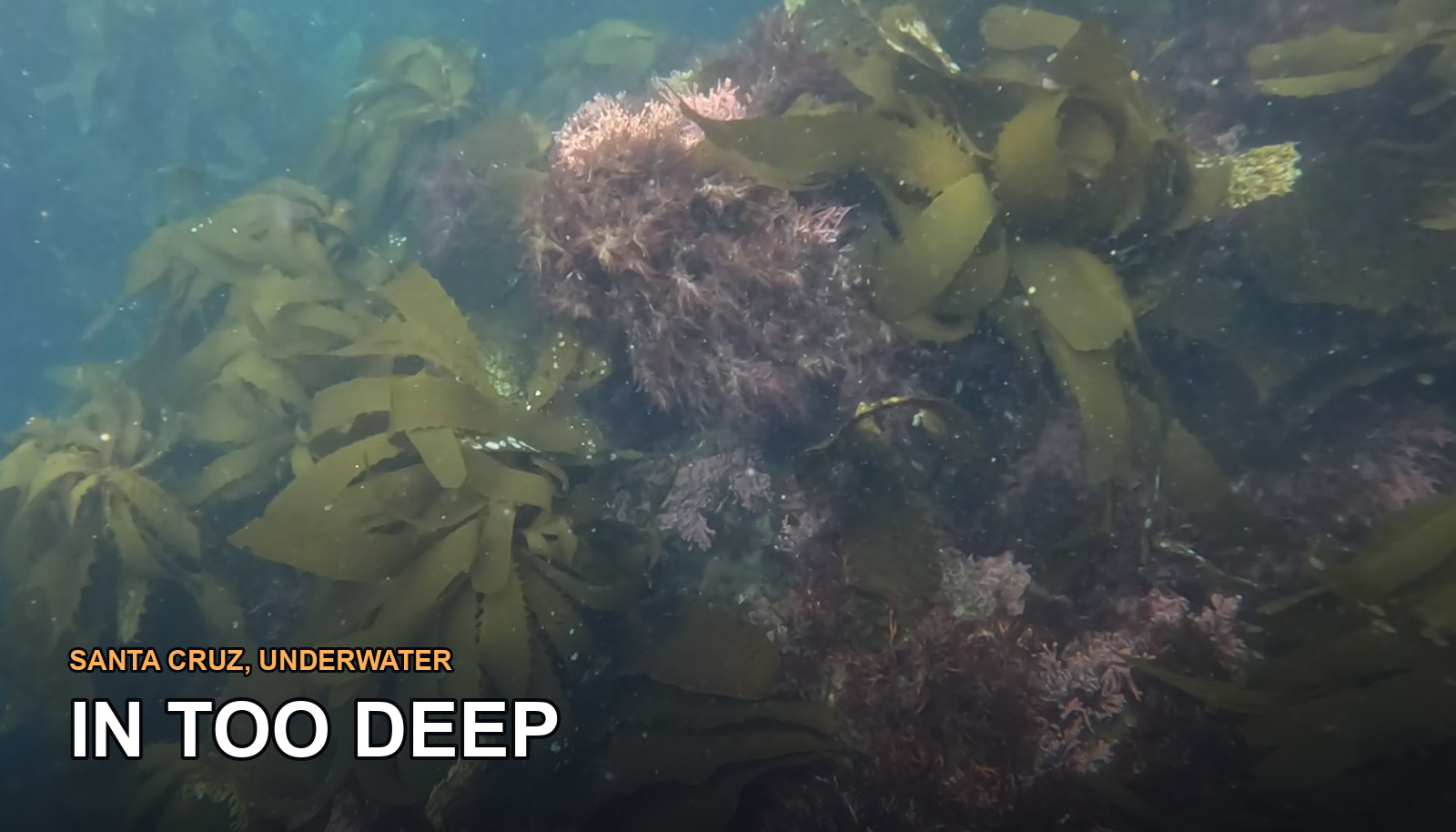
In Too Deep - The prototype, the problem child, and the second single. In Too Deep was the earliest song that pulled me to push to finish a house album. I started it with Kris Cruz a couple years ago. Thirty-seven project saves and ninety-two bounces over 923 days — this was also the song that fought me longest on the album. I struggled on the mix until I realized the two actual gaps were synth doubling and arrangement. The backing chords came off the Microfreak in mono; doubling them and panning left and right was what finally let it breathe. I inserted more transitions and added the automation it had been missing since 2024. One of my favorites, with LosA’s vocals and Jacob’s trumpet echoing her lead melody. The last artistic gap on the record, closed on July 17.
▶️ Watch the In Too Deep lyric video
Truth be Told - This is the nostalgic pause, the moment you step out of the club for a breather but the music somehow pulls you back. And so you’re dancing again, with a memory of other places, other selves, other dance floors. I wrote the demo and vocals early on and originally thought I’d cut the vocals, like I do on a lot of my instrumental tracks. But once Jacob recorded and reworked his transcendent trumpet, the remaining scratch vocals, treated and re-tracked, felt right. This track is an ode to my string-driven early tracks. Mixing it was mostly a hunt for one issue, and after that the track mostly called on me to leave it alone.
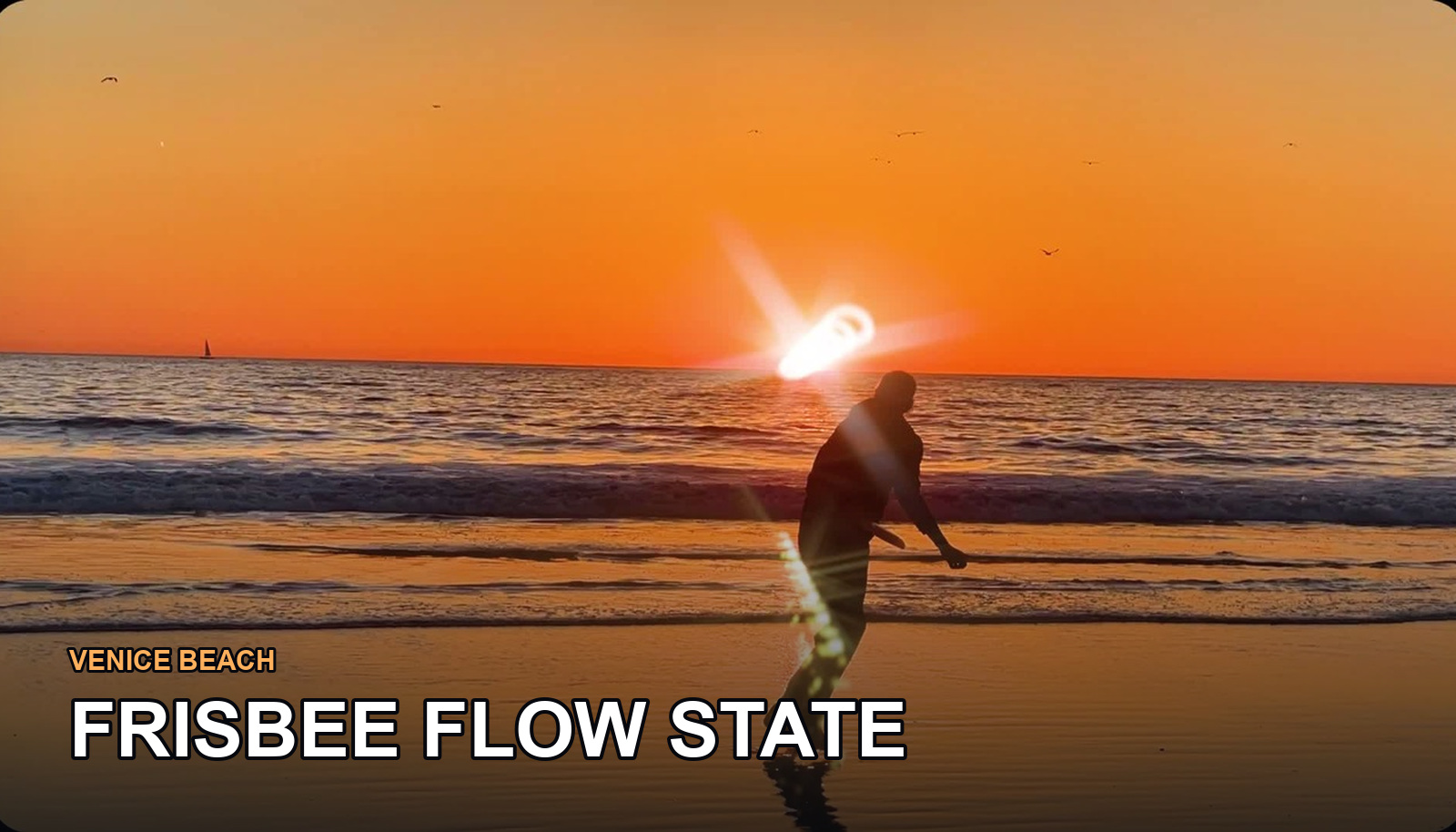
Frisbee Flow State - The lead single came together quickly in one of the first group sessions I had with LosA and Jacob. Not surprisingly we recorded it after a walk and frisbee session at sunset in Venice Beach. A great demo didn’t mean it didn’t take a host of revisions. The track I ruined and rebuilt the most times. This was the most-iterated track: thirty saves, sixty-two bounces, five parts grown to seventeen, 118 BPM pushed to 124. It also has the worst range-collapse story on the record (19.9 LU → 0.27 LU at its low point) and taught me nearly everything in the mixing section I document below. The music video was shot on Venice Beach with all three of us (and Olive the dog) and a frisbee, which is exactly as fun as it sounds.
▶️ Watch the Frisbee Flow State music video
Beethoven at the Beach House - The album’s oldest progeny, a sketch from May 28, 2021. This track is proof that you can make music a lot of ways (started this on an iPhone) and that I’ve been playing around with the House genre for a while. It sat in the vault for 1,874 days. Now a 1:42 sunset interlude with a real party happening in the background courtesy of LosA’s field recording. Also the cleanest finishing arc on the album. The production state and sound selection were strong enough that the mix was polish rather than rescue, and it went from produced to mixed to mastered to locked in a single evening.
Catalina Island - An instrumental that was written after Jacob, myself and some friends hiked the Transcatalina Trail. I nearly cut this track due to mixing issues. It’s on the album because a diagnostic saved it: once I found that the drum loop driving it was capping the entire mix, I rebuilt the groove from a drum machine and one-shots and the whole song opened up. Intuition was ready to cut this track. An auditing tool’s data talked me out of it. I kept it simple and made the mix flowy. It’s sometimes impossibly hard until it suddenly isn’t.
Eagle Eat Eagle World - Jacob and I crafted the core idea for this in just one or two sessions. From a mixing and final production perspective, it was the least resistant song on the album by nearly every measure: fourteen project saves, and it hit a perfect 8/8 scorecard on the first self-mix pass in just 45 minutes. It’s also the cleanest master on the record and has the tightest stereo image. Worth saying plainly: your revision count measures how hard a track fought you, not how good it is. Eagle barely fought at all.
I Want It All - “Ripping the seams from inside out…” One of the moodiest tracks on the album, and the longest at 4:16. Born as “Orford, Oregon Coast Jam” while traveling in the Pacific Northwest and I wrote it after a hilly run, seeing the cliffs, the waves and good vibes handed me the gift. This track also suffered from a drum loop that capped its mix ceiling. The loop itself measured a crest factor of 11.32 dB, the most squashed source material anywhere on the album. The groove felt like it carried too much of the song’s identity to swap out. On a lark, I rebuilt the drums anyway and the dynamics came back. It also carries one of the highest bounce-to-save ratios here — forty-one renders against twenty-one saves — which I’ve come to read as a doubt meter: this is a track I second-guessed a lot. LosA sings on it, and the working title reached her too, so she wrote to a foggy, cold coastline and the crashing waves below. Jacob’s horn slides in epically.
Joyous - Inspired by jungle trips and stays in Central America, this song was deliberately slowed down into something more adjacent to Organic Electronica than House. LosA added the lyrics and vocals that gave it soul and heart. This song luckily had decent drums when it came time to mix. I kept the short, dense, active arrangement, recognizing that it didn’t need to be (and likely never could be) the widest or most dynamic track on the record. That was fine. I stopped trying to make it one and I let it be done.
Marimba on Mars - The original demo was recorded after seeing an acoustic of Weezer live on a rooftop bar in Venice Beach, near the pier. Formerly “Welcome to the Gathering,” and the last track on the album to reach the finish line: mixing began on July 19, and the title didn’t land until August 8, three weeks before release. It’s one of the darkest things on the album spectrally and functions as the valley before the ending. LosA, Jacob and I opened it up in a session together and gave it a bouncy new bassline and the marimba that gifted us a name, it arrived as an alternate render nobody planned.

Echoes of a Life That Could Have Been - I wrote and recorded the original demo for this song in just two sessions. The lyrics started from a letter I imagined Anne Boleyn, Queen of England from 1533 to 1536, writing before her execution, and the turbulence of a moment like that. It’s a heavier origin and theme than the party vibes of a palm-tree album probably warrant, but it’s the song that earned its place in the back half. Having honed my mixing skills in previous weeks, it’s the track where my checklist and self-mixing finally clicked and I was done in about 45 minutes. It carries the most words (my own and LosA’s echoing additions): “I have chased ghosts through the halls of this place, echoes of a life that could have been”.
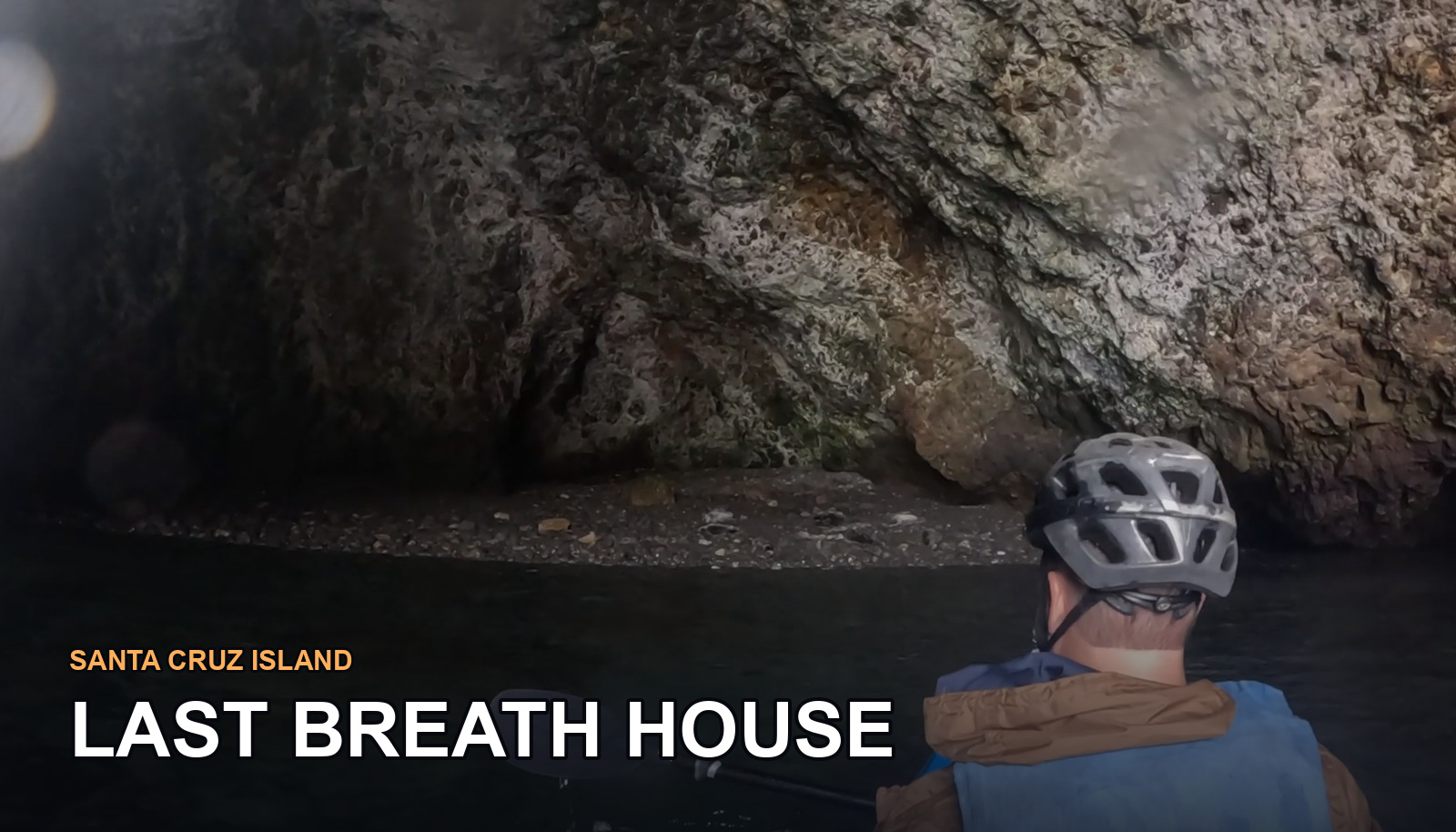
Last Breath House - “You are lost in a universe of self. The self lost in the self.” Another track that felt more gifted than created. I wrote the original version of this song in two short sessions (music and lyrics). Jacob added the fun dancing keys and added his signature horns. Sky played bass, and I sang. The closer, and an intentional exhale rather than a finish. After eleven tracks of party, this is the walk home.
Here are top lessons, learnings and observations making and finishing another album.
Your Previous Album Isn’t Going to Write the Next One
Creating art can be hard, and it can feel hard. This album challenged me and reminded me of a line from the writer John McPhee — that your last piece is never going to write the next one for you. In this case, my previous albums weren’t going to write, produce or finish this one. I had to show up and do the work.
I have to remind myself that every album I make (and most artists feel some version of this I believe) will at some point feel like this might be “the hardest album I’ve worked on yet.” That feeling is real, and it still shouldn’t stop you from continuing on.
Artist-to-artist: The struggle is real. The choices not always obvious. And you maybe eventually stop trusting yourself, your ears, your vibe, your energy and will want to give up. You might stop caring and wanting to finish. Psychologists sometimes call this an action crisis, and it’s normal. It isn’t that you lack the skills, or can’t do it, or have lost the goal — it’s that your momentum inevitably slows. Your felt sense of progress stalls and you get stuck in the middle, a nearly predictable moment when your confidence mysteriously wanes and the path ahead turns opaque. The worst part is that from inside it you can’t tell whether you’re in a long middle or a desperate end, whether to push or to turn around, and no amount of staring at the project resolves that.
You can’t look up books or online videos for the answer. You have to look in and accept that the path to making and finishing art is nonlinear and a bit quirky. Some creative decisions aren’t obvious and you’ll debate them endlessly, but at any given moment only a few moves are actually available to you. Pick one of those. Make the decision, make the move, and keep working through them one at a time. Embrace stages. Accept that sometimes it’ll feel like you are going backwards. Keep moving.
You just gotta keep moving. We don’t make original art in a paint-by-numbers manner and the so-called best practices might not work for you. Experiment. Write your own finishing music guidebook. The twists and turns are real. Journal. Take notes. Take a break. Come back. Keep going.
You Can’t Finish What You Haven’t Decided
One of the best lessons I’ve learned with finishing music that we finish songs, we finish a song, then we tackle and finish the next. Personally, I’ve used a host of practices to organize, manage and finish tracks. Historically on previous albums I have used a spreadsheet. For this album, I built my tool and software called Playback Pilot. It’s a local-first, file based music project management app built by a producer for music producers and I used it extensively through my finishing arc. I’ve written more about why I’m building it, and the problem isn’t just mine. In a survey we ran, producers finish less than half the music they start, and there’s a follow-up on what the ones who do finish are actually doing.
Initially, I used it during the post-demo stage and reworking state when I had a lot of initial demos and tracks. It’s good to have a lot of demos but a lot can be intimidating too. By my estimate, I eventually reached something like ~40 active tracks in the candidate pool for this album. That was too many and they were at various stages – some were pretty complete songs, other just a simple idea in need of more voices and some felt nearly worth tossing out. All of them were not yet done.
So the first thing I primarily did was relisten and sort them. Here is a video how me using Playback Pilot to navigate this decision loop of tracks being in and out:
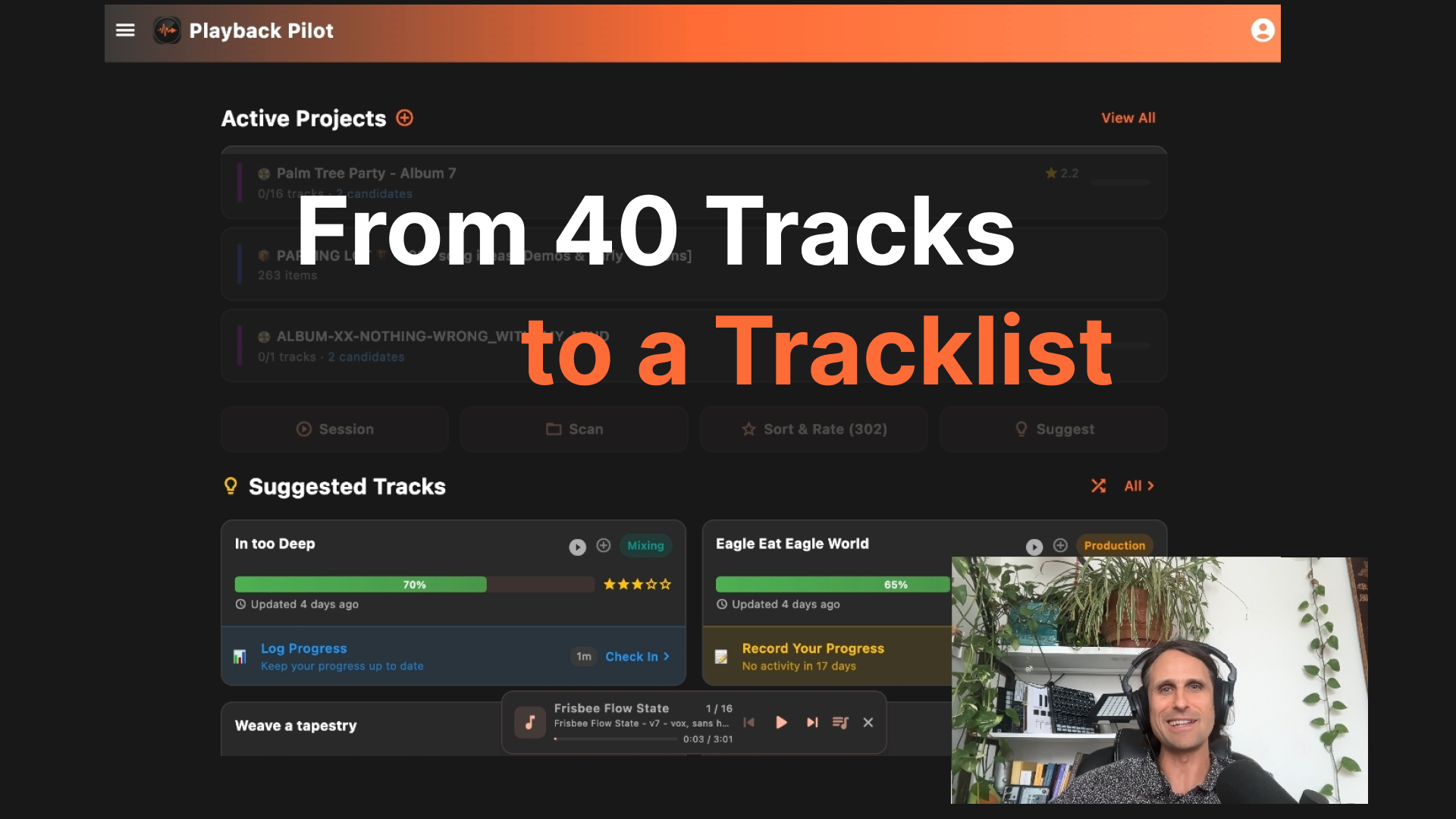
Once you’ve imported a folder or catalog, each project or album gives you a list of your tracks as Candidates. Then one of your first available move, besides opening it up in your DAW (which should be your default), is deciding if a track is on Tracklist or Cut. So I used the audio player to listen to different versions of the audio and select the best. Along the way, as I auditioned and rehearsed the tracks, I took notes: gaps, issues, what I liked and didn’t, and ideally a menu of next actions and todos.
This is where the artist-as-selector mentality needs to enter. Don’t worry about some imagined end state. Just notice what you notice and leave yourself breadcrumbs for future music production sessions.
Notes or todo’s make it easy to just show up and do it. Let me share a little secret. Finishing most things depends on closing loops in a certain sequencing. You don’t finish an album. You take a thousand small and medium steps over multiple weeks, months or years to fully finish. The most important move is the move that takes your music forward.
To fully finish you have to and get to finish in a bunch of small ways. Celebrate the small wins. Just keep going.
After that, I recommend you articulate your producer pipeline and workflow steps.
The other thing this bought me was a place for other people’s notes to land. When Jacob and I did a listen-through and he had thoughts on three tracks, those notes went somewhere I’d actually find them two months later instead of into a text thread I’d never scroll back to. When LosA came over for a session, we worked off the list.
And getting from ~40 down to 12 is not an administrative act. It’s the hardest creative work in the project, because every cut is an admission that something you spent real hours on isn’t good enough or doesn’t fit this record. Making it a visible decision with a status attached, rather than a vague feeling I kept postponing, is most of what got it done.
The Mixing Gap and the Album’s Choice Point
In the spring, I hired a mix engineer for the two tracks I thought were closest to done: Frisbee Flow State and In Too Deep. This felt like the grown-up move. Stop trying to do it all. Don’t be precious or particular. Get help. Get it done. Hire a professional and ship the record.
So, I did hire a mix engineer, and I was initially really excited when I got something back a week or so later. As a whole and on multiple levels, the mix work on the first pass on that first track was really solid and noticeably better than my own pre-mix version. The vocals were more present and the trumpet sounded sharper. Unfortunately, it also felt off. It sounded flat and lifeless. The work was decent and probably usable but the issues called at me in a way that was hard to explain and identify.
The reality was that I got a deliverable but I didn’t get an audit, a conversation or a clear back and forth on what the mix engineer identified as problems nor the corrections he made. We iterated through several revisions but in the end it just didn’t get to what I was hoping for. As a music producer, I could hear that gaps remained, but I had no map of what they were, no formal vocabulary to call it and no way to know which of them were mix problems and which were my own production, arrangement or composition problems that no mixer could have fixed. I’d bought an output when what I really needed was information.
So, I was at a fork. I could accept the work and move the project forward. I could outsource the rest of the album, accept that the audio engineer was the professional, live with the result and finish, or I could skill up and and learn how to mix the album myself.
Ultimately, I chose the second option. I debated myself for several days and even recognized at that moment that it would cost me time, lead me to languish and hinder me towards actually finish. I might claim it was a brave artistic choice or about quality, but it was mostly a stubborn one. I would grit it out.
It did cost me months. It was solitary, unglamorous, frequently maddening work. I had to train my ears and buy new gear. I had to collect reference tracks and do dedicated deep listening sessions. I had to set up audio analysis tools and figure out the sonic characteristics for similar songs and artists in my genre target of deep house and jazz house. In short, in order to get my tracks to fit the genre and to reach a sound my ears demanded, I had to become a mix engineer and mix my own album: vocals, trumpet, arrangement dynamics, drum balances, all of it.
Six Things I Learned Mixing My Own Album
I’d been making music and albums for years without ever really mixing one. Here is the short version of what I found during months learning to mix and master.
1. Watch your limiter because it’s lying to you and your ears.
Based on a tip from Four Tet, I’ve had a limiter sitting on my master bus for years. A limiter is a form of compression. It also protects your speakers and ears too. It’s been on nearly every production session, and it made rough ideas sound finished and also was hiding every problem I needed to see: kick transients, bass and kick colliding, and whether I had any headroom left. Every decision I made was filtered through this artifact of a limiter on the master. It makes your mix sound loud which tricks you to think it also sound good
The fix is embarrassingly simple: when you’re making mix decisions, the master bus should be empty. If you want it louder, turn the monitor knob up.
2. Regular Deep Listening with Right Headphones.
Deep listening is a good practice on its own. Pick a song you love (or a reference track for the project), and sit and listen to it for 20 minutes or an hour. No phone, no distractions. Just noticing. If pulled, write down what you hear and what it’s doing. You will hear things on tracks you’ve heard a hundred times but never noticed.
I mix in a small apartment, so while I produce and jam on ADAM T5V monitors, I mostly mix on headphones. My long-time pair is the Sony MDR-7506: closed-back, mid-honest, and what I know best. Partway through this record I bought a pair of open-back Sennheiser HD 600s, and they became the most-trusted source for anything involving sub-bass or stereo image. I sign off on every track across five system in order: HD 600, MDR-7506, HD 280 Pro, AirPods, then a phone speaker. If it survives all five it translates.
Beyond the gear, mixing sessions merit a bit of preparation. Ensure you are well-rested and can focus. I recommend and feel like is also good to calibrate your ears, headphones and space when you’re mixing. I do this by starting most mixing sessions with some deep listening.
3. Build a reference library, and actually measure it.
You can’t hit a target you’ve never heard properly. So I built one. I collected about two dozen tracks in and around my genre: Tour-Maubourg, berlioz, Folamour, Chaos in the CBD, Jitwam, a Frankie Knuckles remix. I did dedicated deep listening sessions on each with open-back headphones, then ran every one through an audio analysis audit to get its actual numbers.
I noticed two things that surprised me.
Loudness and dynamic range are not the same target. Almost every house record I admired and studied is mastered loud, somewhere between −8 and −13 LUFS. I’d assumed that meant they were squashed like mine were. They weren’t. They were loud and still had dynamic range, six to eleven LU. I never had a loudness problem. I had loudness that crushed everything else.
berlioz’s “deep in it” became my target. I listened to this track a lot and it became, with some caveats, the best reference for my album. It sits way darker than I expected, with a spectral center around 1,090 Hz where I’d been drifting toward 3,000. Put next to Tour-Maubourg’s brighter, more dance-floor tracks, those two references framed the whole sonic space I was aiming at: a corridor running from about 1,300 to 3,000 Hz, dark enough to read as deep house, bright enough that the horns still cut.
That corridor turned out to be the most useful thing the whole exercise produced. Horns and cymbals push a mix bright, so my instinct all along had been that a house-and-horns record would live at the top of it or above. The references said the opposite: the jazziest thing I was listening to was also the darkest.
Eleven of the twelve tracks on the finished album landed inside that corridor. The one that didn’t is Frisbee Flow State, at 3,530 Hz — the brightest and least dynamic thing on the record, and also the track I released first as a single. Whether that was instinct or accident, the most radio-shaped song on the album is the one that led.
Once I had a target and could record and hear similar songs in the corridor, “does this sound right?” turned into a question I could actually answer, both with my ears and with measurement tools.
4. Get audio analysis tools and use them.
Once the references had numbers, I could give myself targets, not master targets but mix-prep targets, which are a different thing. For my genre that landed at roughly −16 to −18 LUFS, at least ~5 LU of range, crest above 18 dB, spectral center between 1,300 and 3,000 Hz, and left/right within 0.30 LU.
That last one is the most objective rule I found: every House reference I measured landed between 0.00 and 0.31 LU. The adjacent genres are looser; a couple of pop-dance masters drift to 0.40 and 0.50. So it’s a target for this kind of record rather than a law of mastering. My own tracks were running well outside it.
Here is how I score and visualize my House and Horns Mixing Scoreboard:
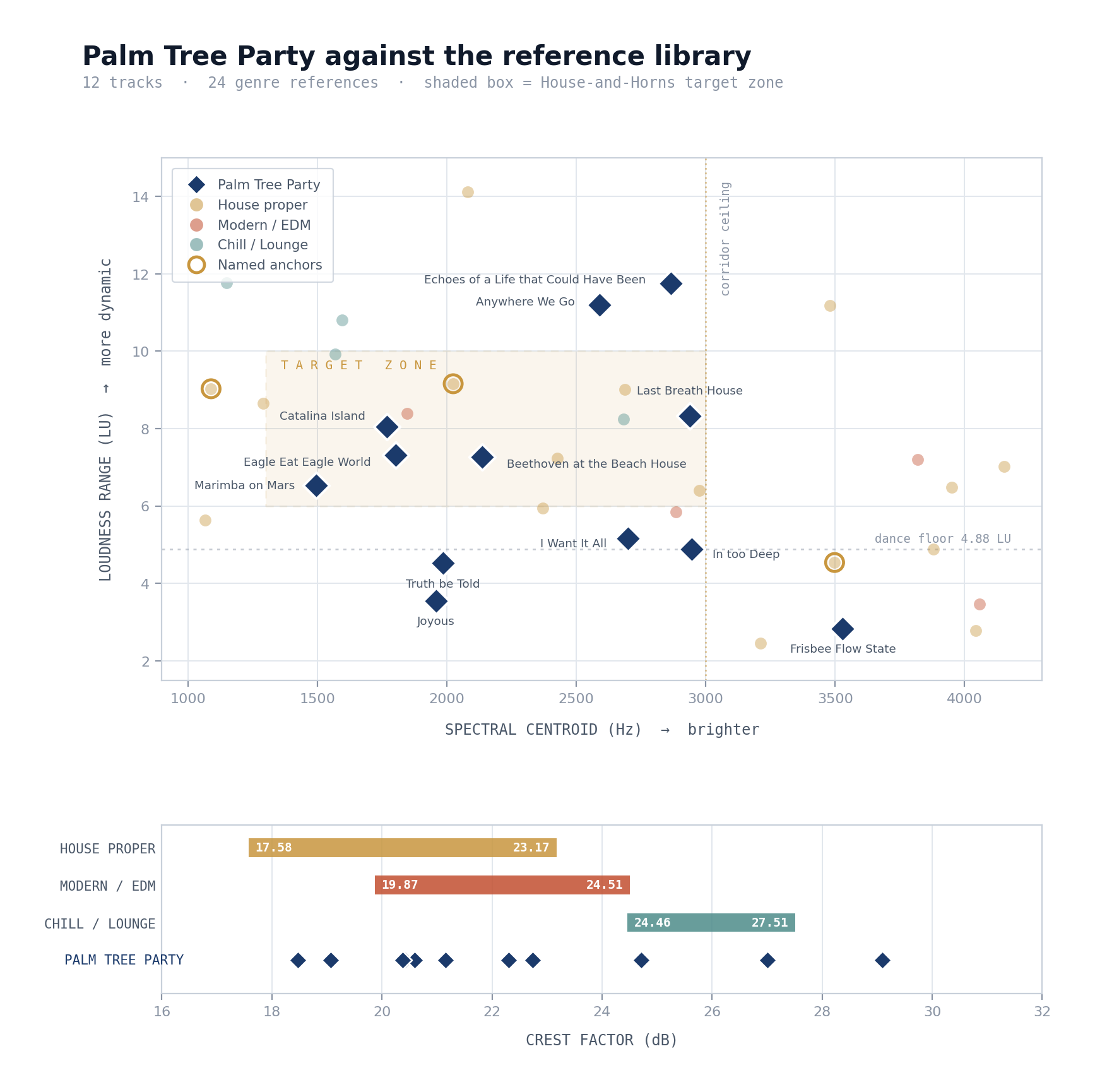
Every track on the record, measured and plotted against the reference library built while making it. The shaded box is the target zone the references defined. Top: brightness against dynamic range, where eleven of twelve sit inside the 1,300–3,000 Hz corridor, with only Frisbee Flow State out to the right. Bottom: crest factor against the three genre tiers, where the album’s spread runs wider than any single tier.
Then I measured every bounce I made against that scorecard, and the pattern was brutal. Frisbee Flow State had lost 99% of its dynamic range somewhere in production, before any mix engineer ever touched it. Range collapse is close to one-directional. Mixing claws back a little, mastering basically can’t. So it’s a production-stage problem, and I’d been creating it on nearly every track without knowing.
From there the work became a loop. Turn the limiter off. Group the session into a few buses and do a round of gain staging, meaning just setting the volume levels sensibly. Render a fresh bounce. Re-measure it. Make the next fix. Bounce again.
With reference tracks on one side and measurements on the other, I could finally self-mix a track end to end, over multiple rounds, and know whether each round had actually helped.
The toolkit for this is smaller than you’d think. I use the standard, entirely free analysis VSTs that come with my DAW. The paid versions do a few more things, but the basic ones tell me everything I needed here, and I’d rather put the money toward production tools I actually reach for.
5. Your drum loop might be the ceiling.
One of the stranger things I learned came from Catalina Island, a track I was ready to cut. I liked the vibe of the song and wanted Jacob’s trumpet to shine, but no matter what I did to the mix, the dynamics were dead and everything was flat. A step-by-step sonic forensic analysis revealed the culprit: a single Splice drum loop. The loop was already super compressed, mastered and squashed to such an extent it became the structural ceiling for the entire song. I couldn’t get the mix to budge. Once I silenced those drums, the mix and dynamics underneath breathed four times wider. I had to rebuild the groove from one-shots and the track went back on the album.
The bigger lesson: when a mix problem survives every fix you throw at it, stop assuming the problem is your moves and check what you fed in.
6. Make a mix checklist and reuse it.
Mixing was slow at first, but I got better. The gaps became more obvious to my ear, and the fixes turned out to be fairly predictable in most cases.
My first self-mix session took three hours to get one track where I wanted it. Over about two weeks of regular practice, a first pass on a track was taking me forty-five minutes.
My ears did not improve that much in two weeks. What happened is that after the first session I wrote down a checklist, the order I’d done things in: gain staging, then kick and bass, then the leads, then reverb and space, then automation, then bounce and measure. The next session I just followed it. Then I amended it. Then I followed it again. Rinse and repeat.
Mixing can feel like a skill or an art you either have or you don’t. A lot of it is training, patience, and a sequence you follow.
NOTE: There’s a longer, more technical version of all this — the measurements, the loop findings across multiple tracks, and the mix finishing system I built around them. But that’s a separate write-up for producers.
The Machinery of Finishing
Learning to mix gave me the skill. What actually got the album finished was building a way to know and say when a track was done. Because the gap between done and released is mostly just you. If you can give yourself a gate or series of them you need to hit, then once a track has passed those gates, you should call it it done and be done.
Alongside the mixing work I setup an audit tool that measures a bounce and scores it against targets I’d pulled from reference tracks in my genre. That turned finishing from a feeling into a gate: a track was done when my ears said yes and the numbers said yes. Not one or the other. When they disagreed, the disagreement was the actual information. It’s how I found both the limiter problem and the drum loop.
The payoff came in July, and it looked like luck but wasn’t. The album sat at zero tracks locked on July 11. On July 12, a single 2 hour 40 minute session took it to eight. Two more sessions on the 15th and 17th finished the last four. Zero to twelve in six days.
That sprint was only possible because the scaffolding already existed: the audit tool, the reference library, the session checklist, the delivery standard, all built slowly over the prior months, during a stretch where it felt like I was making no progress at all. The fast part is always downstream of a slow part nobody sees.
Album 8 inherits all of it. That’s the thing I most wanted at the start of this record and didn’t have: not more talent or more hours, but a sense of what the next rep is.
Collaboration
Jacob Burgdorf plays trumpet on all twelve tracks. This is our third album together, and he contributed over 60 recorded horn takes across the record, tracked largely in a push between February and May, including one March session that landed lead lines on three songs in a day.
It’s Jacob’s horn work that truly made this the house-and-horns project. His playing is the thread that makes a house record sound like this house record — without it these are competent deep house tracks, and with it they’re something I haven’t heard elsewhere.
LosA is a new addition to my music and changed what the album became. Seven tracks have her voice on them, and she wrote the lyrics she sings. The title for Anywhere We Go out of one of her own lyric, having spent most of its life as “Jolly Toad,” my Adjective-Animal generated name placeholder. Her title is obviously better. She also recorded the party ambiance that turns Beethoven at the Beach House from an interlude into a scene. Her vocal melodies, musical sense and vibes are one of a kind and grateful for her help on this album.
Honored mentions:
- Kris Cruz was involved in an early version of In Too Deep with me back in January 2024 and came back at the very end to help me get the top end right on Frisbee Flow State.
- Sky Bartlett played bass on Anywhere We Go and Last Breath House.
Creativity, Production and Time Tracking
I take a data-driven, time tracking approach to a lot of my life. Tracking my time and setting weekly targets shows me where the hours actually go and holds me accountable to input as part of tangible creative output. On this album, more than any before it, that data also changed what I did.
From the release of Forwards & Towards to the day the last track locked, I tracked 211 hours of album-specific music production across 364 days, almost exactly a year, over 251 sessions, averaging 4.1 hours per week. It’s the biggest and slowest-cooked record I’ve made.
Activity breakdown:
- Reworking & Finishing: 38%
- Jamming & Song Writing: 33%
- Review & Planning: 25%
- Practice & Learning: 4%
- Release & Admin: 1%
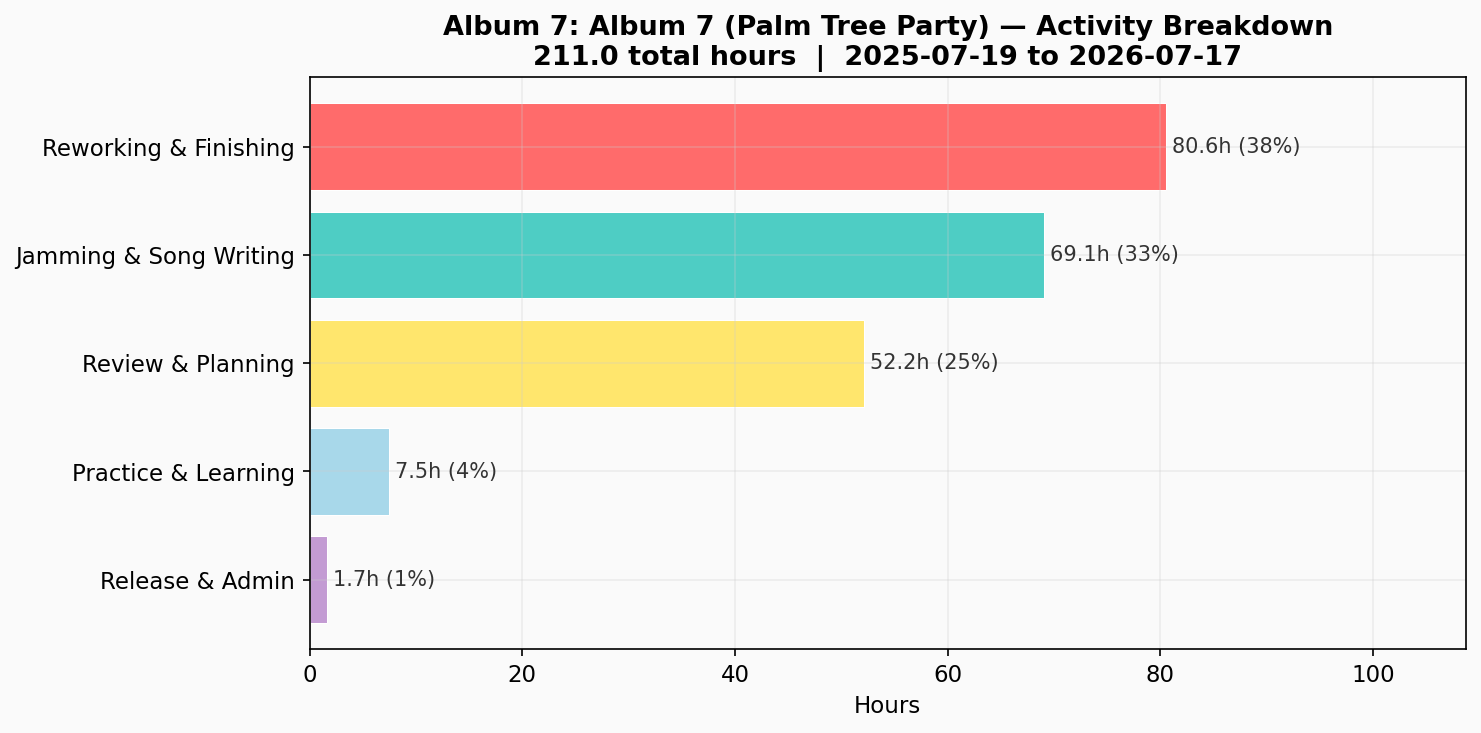
211 hours across 364 days. Reworking and finishing took the largest share, with review and planning close behind.
Set against Album 6 (52% jamming, 32% reworking, 10% review), the inversion is the headline. Reviewing and relistening alone was a quarter of the project. That’s not overhead — that’s the evaluative half of the work, and I’d never budgeted for it before.
Effort density: 211 hours across 268 Ableton project saves is about 47 minutes per save; across 362 audio bounces, about 35 minutes per bounce. That’s the rhythm of the ears-plus-data loop: make one change, print it, check it, decide.
Revisions: 268 project saves and 362 renders across 12 tracks, a median of 21 saves per track, about 13% more iteration per track than Album 6. The spread is instructive: In Too Deep at 37 saves, Eagle Eat Eagle World at 14. Both are finished. Only one of them fought me.
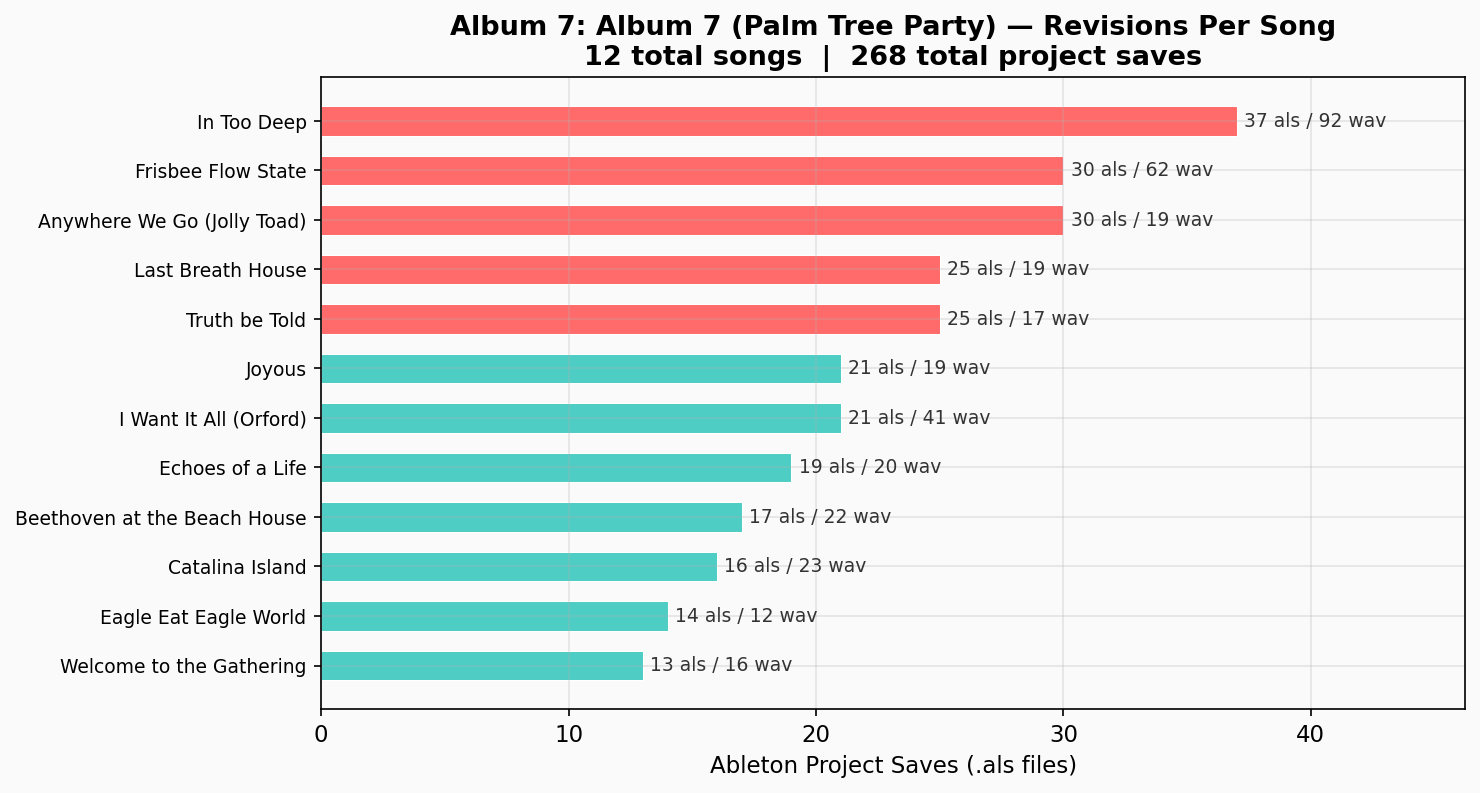
Each bar is the number of Ableton project saves: every arrangement change, mix tweak or new idea getting its own version.
Collaborators: of my own 211 hours, about a third was collaborative. Counted as studio presence, Jacob was there for roughly 43 hours, LosA about 9, plus sessions with Sky and Kris. The shape matters more than the totals. The writing phase of this album was genuinely two- and three-handed, and the finishing phase was almost entirely solo. The “66% solo” average hides both halves.
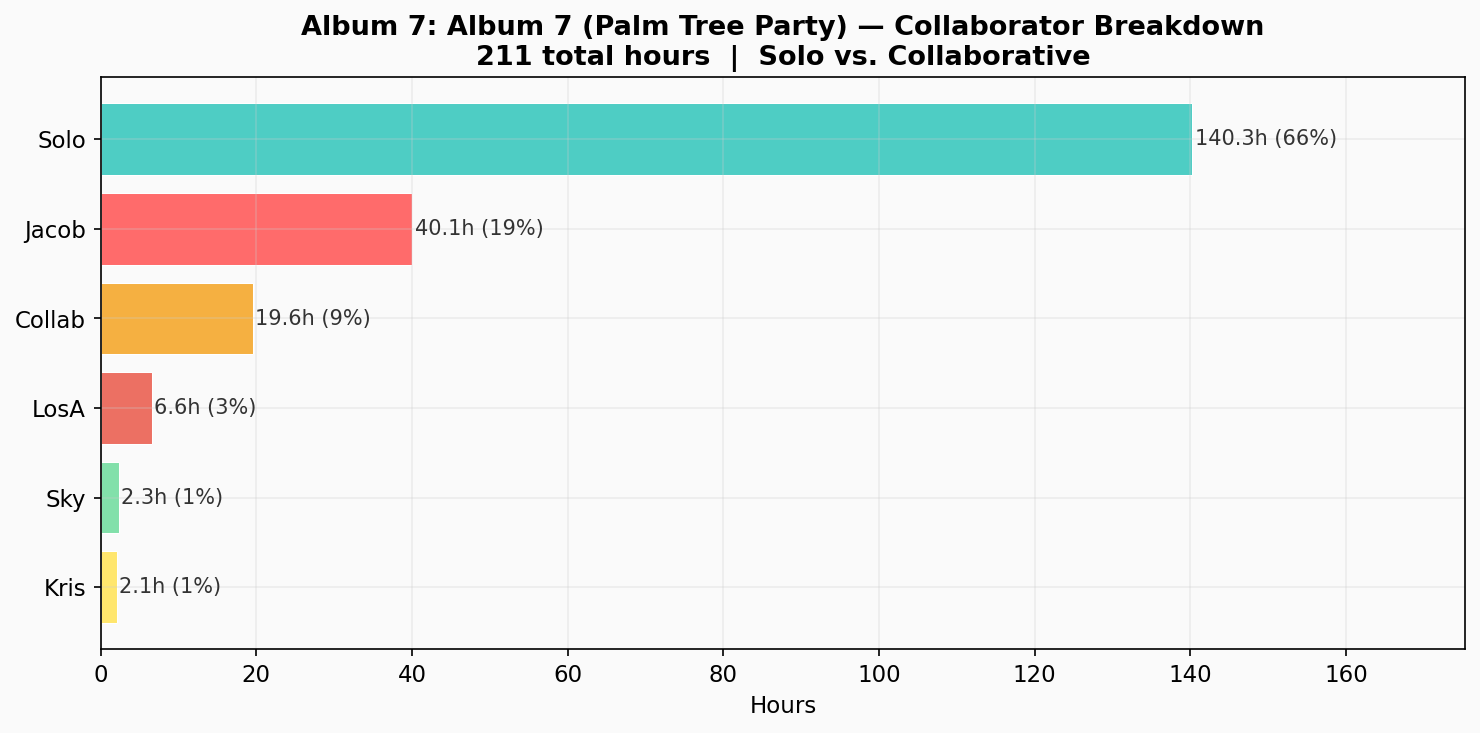
How my own hours partition, with each session counted once, so joint sessions with two or more people land in Collab rather than over-crediting any one person.
The five-year excavation: I reconstructed the album’s real chronology from 172 timestamped Ableton saves. The oldest material goes back to May 2021, but 71% of all saves happened in 2026, peaking at 30 in April alone. Songs sat in the vault for years. Beethoven for 1,874 days, Anywhere We Go for 1,614. Then the whole record resolved in a few months. That’s the pattern of every album I’ve made, only more so.
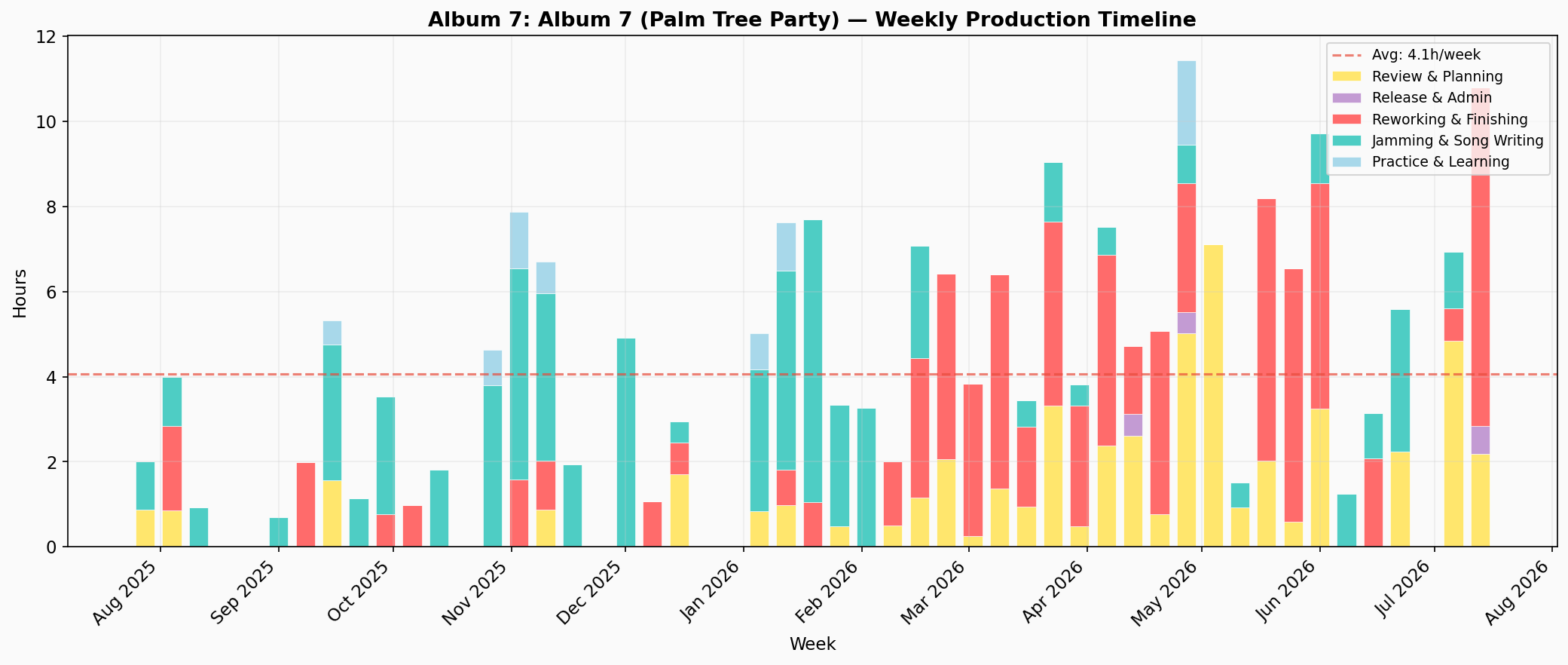
The weekly rhythm across the year: a slow build through the writing phase, then the concentrated push where the mixing and finishing work happened.
One gut-check the data gave me: twelve of thirteen songs grew in part count and not one got trimmed. Most started as five-part sketches and ended between eleven and seventeen; Frisbee and Echoes both tripled. I like dense productions, so some of that is craft. But “finishing = adding layers” is the opposite of how finishing is usually described, and I want to watch on Album 8 whether that reflex is a choice or a way of deferring one.
Album comparison:
| Album | Total Hours | Period | Pace |
|---|---|---|---|
| #3 Cosmic Coastlines | 125h | 19 weeks | 6.5h/week |
| #4 Stardust and Dreams | 123h | 28 weeks | 4.4h/week |
| #5 Chop Wood, Carry Water | 155h | 23 weeks | 6.7h/week |
| #6 Forwards & Towards | 158h | 42 weeks | 3.7h/week |
| #7 Palm Tree Party | 211h | 52 weeks | 4.1h/week |
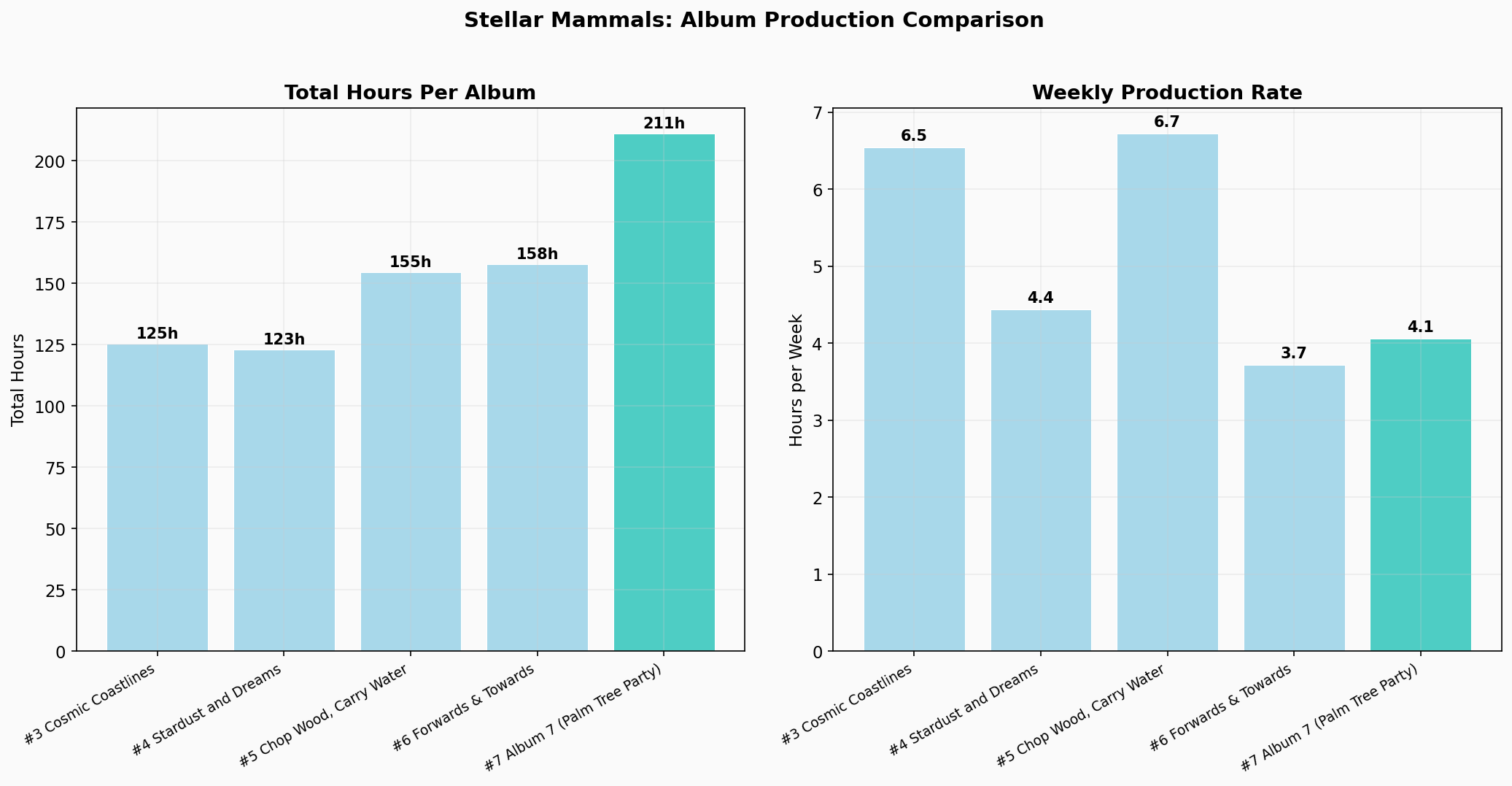
The most hours of any album I’ve made, and the longest run, a full year, at a pace only slightly above the slowest.
On Finishing
The part I still find hard to reconcile is the arithmetic. Two hundred and eleven hours produced thirty-eight minutes of music.
Our effort means a great deal to us as makers and almost nothing to anyone listening. Nobody hears the 92 bounces of In Too Deep. Nobody hears the loop I replaced on Catalina. They hear a song and decide whether they like it. That’s the correct arrangement, and it took me a few albums to stop being faintly annoyed by it. Just make the art. Trust your process. Keep going.
What I’ve landed on is this: finishing isn’t a musical quality. It’s a mindset — an accepting, a contentment, a being-okay-with.
Part of that is deciding which game you’re actually playing. Any long project hands you a few of them at the same time: the artistic one, the deadline one, the story you tell about it after. I never really ranked mine, so there was always one I was still losing, and no moment where I let myself stop.
There’s a naive version of goals where the finish line is a place you arrive and the emotions there are all good ones. Long-arc projects don’t work like that. They move through phases, and they don’t offer a clean end. They offer finishing points, moments that either move you to the next stage or sit in your way like obstacles, weighing you down with ambiguity. I hit a lot of those this year and mistook several of them for the end. Getting the album done meant giving myself the added weeks and months for the mix work and everything else pulling at my time, until I was actually in the right space to be finished. Once I was, it finished fast.
Which is why the real feeling on July 20, when the last track locked and I called the album musically done, was relief rather than arrival. That’s what I felt and that’s ok. Winning the goal and claiming the ending are two different things, and I’m not sure I’ve ever been good at the second one.
I love these songs. I’ve loved them for months — I just knew they weren’t finished, and I couldn’t have told you exactly why until I honed my skills, built the tools to hear it and gave myself breaks to find what was missing. Now I’ve made the final moves, I have my own satisfaction in finishing and recognizing the winding journey. I’m content in the effort and the persistence and in not letting go through the ups and downs.
I don’t control the reception. That part was never mine. But I made a house album spanning jazz house and deep house with a lot of personal gems and fresh ideas in it, and I’m proud of it.
Hope you like it. Turn it up. Smile and dance.
About Stellar Mammals
Stellar Mammals is a creative project centered on instrumental positivity music for any number of situations, moods and selves, historically lofi and hip-hop leaning, with ambient and cinematic moments, and now, with Palm Tree Party, we are taking a turn toward house and dance music.
Checkout our recent work:
- Forwards & Towards
- Chop Wood, Carry Water
- Stardust and Dreams
- Cosmic Coastlines
- Symbolic Wonderlands
- Take Life Chill
Along with creating the music and art, I’m pretty open about the journey and process. You can read an assortment of notes, blog posts and reflections on music production and creativity on my blog. Start with From Zero to Album: My Personal Music Production Learning Journey.
About the Artists
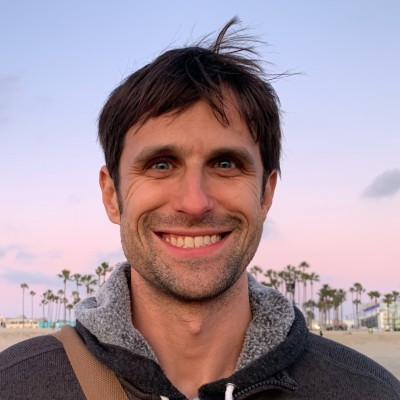
Stellar Mammals is a Venice Beach-based producer and technologist. His full catalog of music, projects and videos is online at StellarMammals.com. He is available for contact, performance, licensing, collaboration, music production and projects at StellarMammals@gmail.com.
Jacob Burgdorf is an LA-based trumpeter, musician and music teacher, originally from St. Louis, Missouri. Check him out at BurgdorfMusic.com and on Instagram.
Got a comment or question? Send me an email or reach out on social media.
AIDA (AI Disclosure Acknowledgement): All music was written, composed, performed, produced and mixed by the credited artists. Mixing was done by Mark Koester. Mastering was done with LANDR. Liner notes were written by Mark. Album art is an original photograph taken in Venice, California, while canoeing and bubbling, treated and titled by the artist. AI tools were used to assist with production data analysis and proofreading and editing these notes.