
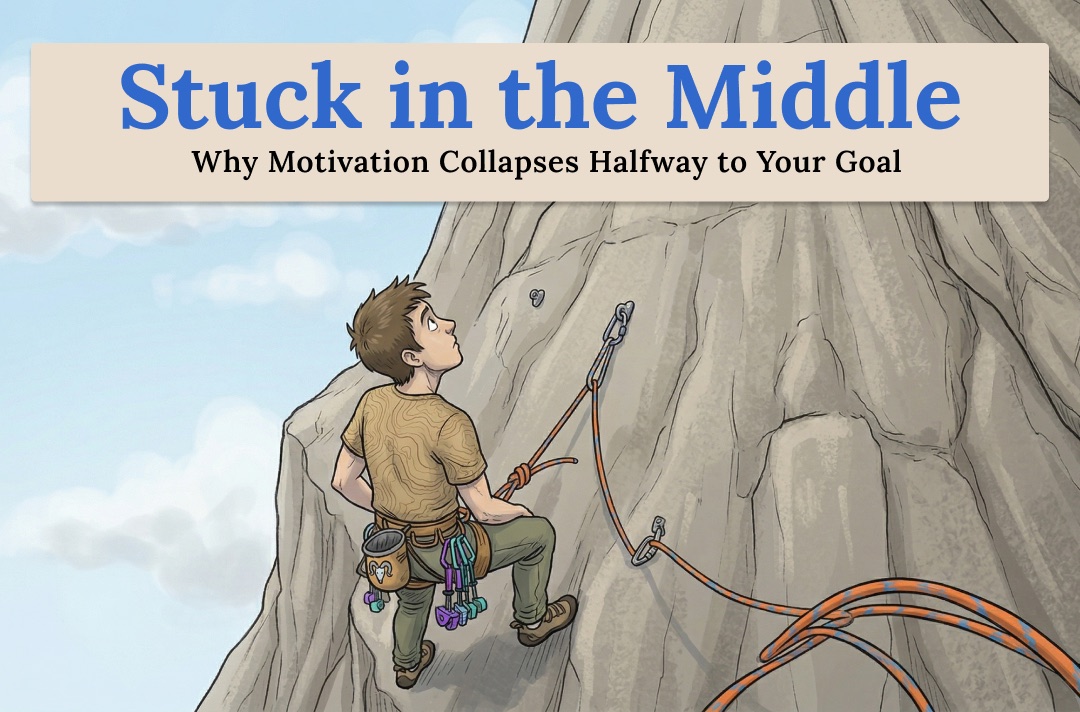
Even though I had finished dozens of songs and released 6 albums, I dreaded working on my latest music album. I didn’t even want to open Ableton, my music production software. I couldn’t get myself to do even the simplest acts to make progress — reviewing, diagnosing, or basic reworking of tracks. I was stuck.
I was 25 hours and ten weeks into my next album, averaging barely 90 minutes a week, with multiple weeks of nothing. The beginning had been exciting. I’d spent a fun first month jamming and creating new demos — 30+ tracks already. But somewhere around August, I stalled. My weekly music hours dropped to almost nothing. My album tracking spreadsheet hadn’t changed in months. Months had passed with little or no progress, and I found myself pulled into other interests. I stopped checking my spreadsheet, stopped reviewing my session logs, stopped looking at the data entirely. I’d later learn this is what psychologists call the ostrich problem — avoiding progress information on goals we care about.
Have you ever gotten stuck halfway through a goal you cared about?
If you’ve ever pursued a goal with real passion and energy and then hit a wall — not at the beginning, not at the end, but somewhere in the murky middle — you know the feeling. The thrill of starting is gone. The finish line is nowhere in sight. You doubt yourself. You wonder if it’s worth it. You stall.
It turns out there’s behavioral research that explains exactly why we lose motivation in this murky middle. The problem isn’t willpower, lack of skills, or fatigue. It’s something more fundamental — a predictable pattern in how our brains perceive progress. Researchers call it getting stuck in the middle.
In this post, I’ll explore why motivation collapses at the midpoint of our goals, the behavioral research behind it, and practical strategies for designing your way through the valley. This is the companion piece to my earlier post on the ostrich problem where we explored why we avoid checking our progress. This post is about that valley — why it exists, what it feels like, and how to climb out.
The Classic Theory (and Why It’s Incomplete)
Pursuing goals often seems like a straightforward process. We imagine the pursuit of goals as a linear pull toward the finish line: the closer we get, the more motivated we are to finish. In psychology, this idea is called the goal-gradient hypothesis and was first proposed by Clark Hull in 1932. Hull observed that rats in a maze ran faster as they approached the food. The closer the reward, the harder they pushed. It makes intuitive sense, and decades of research have confirmed the basic pattern in humans too.
But if this were the whole story, why do we seem to inevitably get stuck? Why does it seem like after making considerable progress and sticking to a habit, we stumble, reach a lull, and lose steam? Strangely, this doesn’t happen at the beginning or the end — but somewhere in the middle. If motivation simply increased as we approached our goal, this shouldn’t happen. Something else must be going on.
Think about training for a marathon. Getting started feels exciting — the first several training runs are really affirming. You’ve got a new routine and you’re making tangible gains. The last few weeks before race day bring a new level of focus, excitement, and even adrenaline. But somewhere around week 8 of 16, you’re just… running. The novelty has worn off and race day is still months away.
The U-Curve: Every Goal Has a Crux
We tend to think of goals like hiking up a mountain: just keep walking uphill until you reach the summit. But a better metaphor, especially for the middle, is rock climbing. You’re on the wall. You can’t see the top or the bottom clearly. The next handhold isn’t obvious. Your body is in between positions, uncomfortable, and you aren’t sure of your next move. You’re not lost. You’re stuck.
In climbing, the hardest move on a route is called “the crux.” It’s almost always in the middle, not at the top. Experienced climbers expect this and prepare for it. By contrast, most goal pursuers don’t anticipate or prepare for the middle. We underestimate the difficulty of the middle, because we assume that we’ve already figured out the basics and have some progress to show.
Behavioral research suggests every goal pursuit has a crux too.
Motivation during goal pursuit doesn’t follow a linear path. Instead, it follows a U-shaped curve. Motivation is highest at the beginning and end, lowest in the middle.
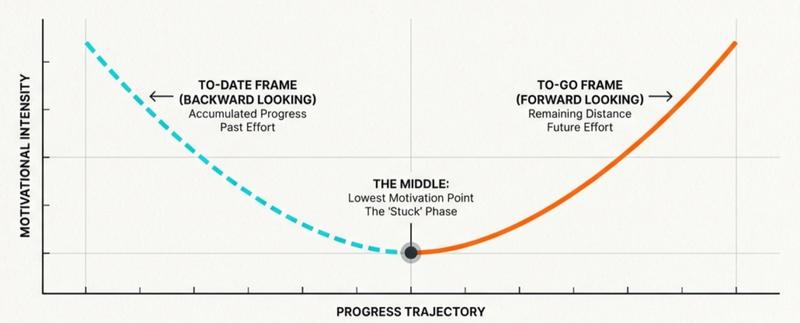
The motivation U-curve: highest at the start and end, lowest in the middle. (Based on Bonezzi et al., 2011)
Whether it was training for a marathon or working on an album, this parallels my own lived experience midway in pursuit of these goals. It’s at the midway point where I lose momentum, emotions shift, and my path ahead becomes cloudy. I just never could put my finger on what was going on or even why. In 2011, Bonezzi and colleagues discovered why.
Motivation comes down to how we measure progress and, in particular, which reference point we use for comparing how much progress we are making (or not making). We adopt one of two reference frames:
- To-Date Frame (Looking Backward): This is our starting reference point when we’re early in a goal. Each step feels meaningful, because we are close to where we started and comparative progress is noticeable. If we just started training for a marathon, each day we run feels like significant improvement. Early in our goal pursuit, the to-date frame heightens our motivation, and we can say with confidence, “Look how far I’ve come!”
- To-Go Frame (Looking Forward): This is the frame of reference when the finish line or end point of our goal is what is pulling at us. For marathon training or even during a race, each step feels like we are closing the gap of the remaining distance, and we say to ourselves, “I’m almost there!”
Imagine you’re reading a 500-page book. When you reach page 51, after reading 50 pages, it feels like real progress. It’s a 1:50 ratio. By contrast, when you read page 201, after 200 pages, this feels like nothing. And, in fact, it’s a meager 1:200 ratio. You are reading the same page in both cases. But the perceived value of a page read and your progress has shifted. It doesn’t feel like you are making quite the same amount of progress.
For the to-date frame, each unit of progress feels smaller and smaller compared to the pile. Your motivation slowly decays. For the to-go frame, each unit of progress dramatically reduces the percentage of the remaining distance, and motivation can surge as we near the target — much like the final sprint toward the finish line or the final pages of a book.
Humans naturally adopt the closest standard of reference. At the beginning of a goal, the starting line is closest, so we use a to-date frame. Near the end, the finish line is closest, so we switch to a to-go frame. It’s at the midpoint where we stall. We’re far from both reference points. Looking back, our progress feels tiny compared to what we’ve done. Looking forward, the finish line is still far away. Neither frame provides motivational fuel. This is the valley — the U-shaped motivation curve. It’s during this transition between frames of reference that we get “stuck in the middle.”
Getting stuck at the midpoint of a project or goal isn’t a failure of willpower, personality, or character. This is the crux — for climbers and for goal pursuers alike. You’ve reached a point of demotivation and uncertainty, equidistant between the start and the finish. It’s a natural progression where two reference frames on progress collide, and neither one works. It’s not that the work is hardest at the midpoint — it’s that our perception of progress is at its weakest. Both the push and the pull have gone quiet.
What the Middle Feels Like: Torn Between Continuing and Quitting
“Don’t turn left,” were the words I repeated to myself as I passed the midway point of my first marathon. I had only started running about a year before the event, and this first marathon took place in my hometown at the time. I was filled with emotions of gratitude, surprise and positivity as I met a small group of my neighbors with a banner and cheering me on at the midpoint, just a few blocks from my house. But as I turned the corner and headed slightly uphill, my heart sunk a bit and a wave of fatigue and uncertainty struck me. The finish line was still two hours away and I was tired.
Have you ever been halfway through something important — a project, a degree, a creative work, a relationship — and doubted yourself and felt the pull to quit and walk away? Not necessarily because you couldn’t do it but because the goal just felt… empty?
Psychologists call this an action crisis. An action crisis is the state of being torn between continuing to pursue a goal and giving up entirely. It’s a feeling of ambivalence. You aren’t fully quitting nor are you totally committed to pushing through either. It’s a limbo state that consumes energy and sucks at you emotionally.
An action crisis develops from two sources: decreased attainability (you’re not sure how to keep going) and decreased desirability (the goal doesn’t feel worth the remaining effort). Both hit hardest at the midpoint.
At my album 7 midpoint, I’d argue that I was less blocked by desirability since I still wanted to do it. Instead, I was stalled by attainability. I had over forty candidate tracks but no idea which to finish. I also doubted certain abilities (imposter syndrome) and doing another album felt more like another obligation in a period of too many obligations.
I was still vaguely saying that I was working on my next album but I really wasn’t. Besides not doing any form of meaningful reviewing or reworking, I had stopped checking my album tracking spreadsheet. The midpoint is also when monitoring goal progress feels least rewarding — which is exactly where I was, like an ostrich sticking my head in the sand.
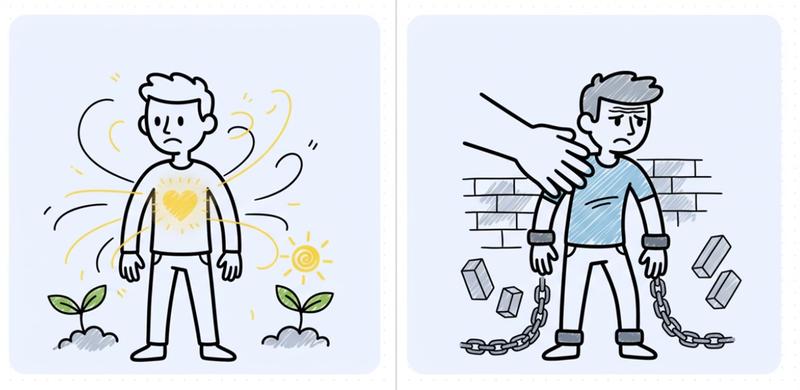
Whether you experience an action crisis often comes down to why you’re pursuing the goal in the first place. Researchers distinguish between “want-to” goals — chosen freely because they reflect your authentic values — and “have-to” goals — pursued in response to external demands or internal pressure. Have-to goals are more prone to action crises and your uncertainty and lack of value-alignment typically makes them harder to overcome. By contrast, want-to goals resist action crises.
This isn’t just good explanation or theory. In controlled experiments, 75% of participants naturally switched their progress-monitoring frame right at the midpoint, confirming that the U-curve isn’t a choice but an automatic cognitive shift (Bonezzi et al., 2011). We adopt different reference points to monitor progress at different stages, and our motivation shifts as a function of the perceived marginal value of our progress.
Interestingly, researchers found this pattern is goal-specific, not personal. In a separate study tracking personal goals, 87.1% of the variance in whether someone experienced an action crisis depended on the specific goal, not the person (Holding et al., 2017). Regardless of your personality type, if you actually care and value a specific goal or project, then you have a higher probability of overcoming these obstacles and pushing through the feeling of being stuck in the middle. It’s the goal and your relationship to it that matter more than some character flaw or self-limiting belief about persistence or failure.
Which raises a practical question: if getting stuck in the middle is normal and even predictable, how can we prepare for it and navigate it the same way a climber prepares for the crux on the way up a wall?
Two Valleys, Two Solutions
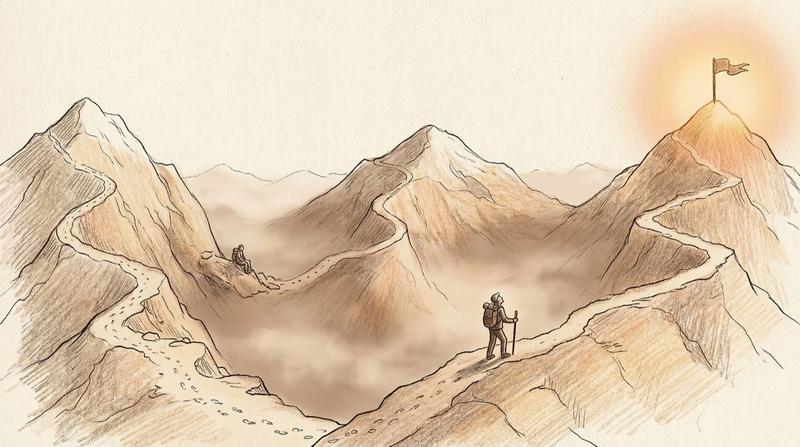
Failure is obvious. Progress, or lack of, is quiet, subtle and often hard to detect. While I was examining my time logs and journal entries for my latest album, I discovered not just one valley but, in fact, two distinct valleys, and each required a different kind of intervention.
My first valley (Aug-Oct, 10→26h, 1.6h/wk) was characterized by low engagement, minimal reviews and a general lack of effort. It wasn’t fun either. You can’t move a goal forward without putting time and energy into it. And you rarely can use willpower alone to work on something you aren’t enjoying. Fortunately, this first valley was broken by returning to Los Angeles and the social energy of collaboration. My primary music collaborator Jacob showed up, and three Saturday sessions anchored November. While the burst was mostly jamming and song-writing, rather than reworking and revisions, it rebuilt momentum and excitement for the material and built up even better initial tracks for the album project overall. It wasn’t work; it was fun.
My second valley (Dec, 47→56h, 1.7h/wk) coincided with a December work push and end-of-year travels. I definitely needed a break and some time to reflect. As January and a new year started, this particular “stuck in the middle” valley was broken by a more explicit realization that I needed structure, a schedule, and time commitments. Instead of generic “Music Production,” I named my sessions (“Album 7 Reworking”). I did regular planning check-in’s and project reflections, so each week had clearer intentions. I also set weekly time goals and got more consistent on when and where each week I’d work on the album. I scheduled time with collaborators for recordings and solo time for music production. Using my tracking spreadsheet, I implemented revision sprints V0→V1→V2 where I reviewed tracks, made cuts, took notes and revised song by song.
Looking back, I’d distill what worked into a few principles:
- Make it social. Feedback, collaboration and accountability can get you out of your head, break isolation, and make it fun again. When you are stuck, schedule time with a friend to share what you are going through and break the lull with community.
- Shrink the middle. You are going to get stuck, but by breaking goals into sub-sprints, you’re never far from a fresh start or motivating finish. By breaking up the work, you’re effectively designing for natural cycles for planning, reflecting and doing.
- Reframe early. Remember to switch to a to-go framing before any natural midpoints. This can help you overcome the emotional lull, avoid falling into a rut, and identify a better progress indicator. “3 tracks left” feels more motivating than “7 tracks done.”
- Design monitoring for the midpoint. You should check in more frequently during the middle, not less. We often invest a lot of energy into goal setting and planning but forget to reflect later on, often resulting in burying our head in the sand and not seeking out information that can actively help us in our goal pursuits. Name your sessions. Add planning check-ins. Design unique ways to make the path your own. One’s ability to reflect on what you are feeling, reframe obstacles into opportunities and keep going is what separates endless starters from productive finishers.
- Track your progress in visible and fun ways. Emotions are a big part of any goal pursuit or creative challenge. I rate my album tracks with hotdog emojis instead of five stars. I know it sounds silly, but it makes rating feel playful instead of judgmental. Check-in’s and progress tracking doesn’t have to be heavy or complex. Change the emotional frame from judgment to play. Make check-in’s simple and routine, and you’ll improve your chances at sustaining progress-enhancing efforts.
Read the wall before and as you climb. Good rock climbers don’t depend purely on strength and skill to survive the crux. Instead, they plan rest positions and pause and assess at these challenging midpoints, before committing to these critical moves. Like rock climbers, goal pursuers need to read the wall as they climb it and know that the middle is coming. By designing your monitoring, setting up your milestones, and positioning your support, you can navigate the crux instead of being stopped by it.
Hour 121: Reading the Wall
For my next album, I’m at hour 121 now. On average my past albums took around 160 hours, so I’m about 25% away from being finished. I’m producing 5+ hours a week of focused reworking, which was 0 hours/week during my stuck periods. The tracklist is nearly settled at 16 tracks (v4). v5 coming together: 7 songs are being mixed, 9 are in a final push in recording/production phases, and ~38 tasks remain.
The middle wasn’t one valley. It was two, and each demanded a different approach to break through. The first time, a friend showed up, renewing my confidence, carrying some of the creative load, and providing meaningful feedback and accountability. The second time, I restructured the work and the path ahead, so each week was contributing an impactful area and navigating the project through multiple revisions and multiple phases of “done.” Neither one was about willpower. It was about showing up and making progress.
The research calls this the motivation U-curve, a predictable collapse at the midpoint where neither looking back nor looking forward provides fuel. It’s compounded by action crises, where attainability and desirability both waver, and our goals feel empty and our passion decreases. This is made worse by the ostrich instinct — we stop monitoring progress exactly when monitoring matters most. But the data also show that this faltering middle is largely goal-specific, not a personality flaw. If you care deeply about your goal, you shouldn’t blame yourself, your willpower, or lament how impossible the goal appears. Instead, recognize it as a natural phenomenon and design your own solution and path forward.
Every goal pursuit will hit a valley, a stuck in the middle lull, a crux. You’ll get frustrated, you’ll doubt yourself and the meaning of your goal, and even consider retreating and quitting. The question isn’t if you’ll hit it, because you will; but whether you’ll recognize it, read the wall and keep climbing.
References
- Bonezzi, A., Brendl, C. M., & De Angelis, M. (2011). Stuck in the middle: The psychophysics of goal pursuit. Psychological Science, 22(5), 607-612.
- Holding, A. C., Hope, N. H., Harvey, B., Marion Jetten, A. S., & Koestner, R. (2017). Stuck in limbo: Motivational antecedents and consequences of experiencing action crises in personal goal pursuit. Journal of Personality, 85(6), 893-905.
- Hull, C. L. (1932). The goal-gradient hypothesis and maze learning.
AIDA (AI Disclosure Acknowledgement): This blog post was researched and written by the author. AI tools (Claude Code) were used to assist with editing, structural organization and clarity. Illustrations were generated with NotebookLM/Gemini. Cover image was generated with Gemini and edited by the author.