
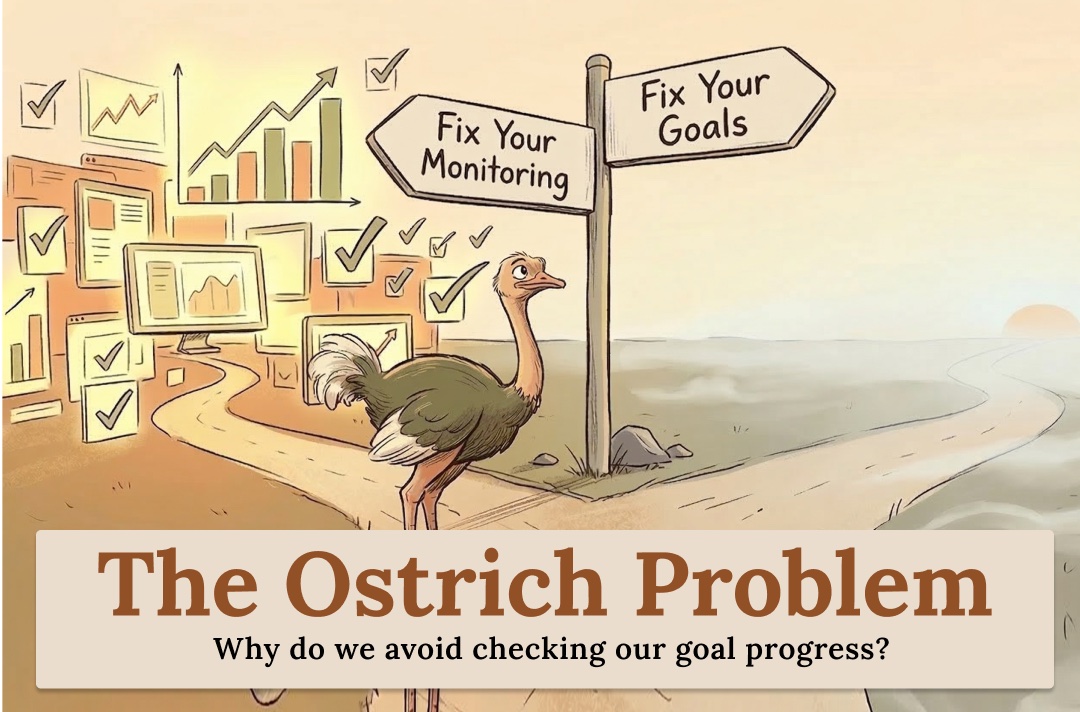
What metric are you currently hiding from?
I knew going into my marathon race that I wasn’t really ready. A knee injury had disrupted my training for weeks. The course for the Xichang Marathon in southern Sichuan, China, was at 5000 feet / 1500 meters of altitude, and the terrain turned out to be much hillier than I’d assumed too. Despite that data screaming at me to adjust my expectations, I just didn’t. I was so attached to this idea of myself as a sub-fourhour marathon runner, I ignored every single warning sign, and the results were an absolute disaster.
The first half went fine. I hit 21 kilometers in about two hours, right on pace. Then the cramps came. Severe calf cramps made the second half nearly un-runnable. Those last 21 kilometers took me three hours. And I finished in 5:09, over an hour off my goal, humbled and hobbling.
Why do we avoid the information that could help us succeed?
In my post-race notes I wrote: “the training and conditions of my body matter more than any false sense of my deserved expectations.” In my training logs and pre-race journaling, the information had been there all along. All those warning signs, the hilly course, the injury, the missed training runs, they were all there before the race even started. I just had chosen not to look or ignore what the information should have been telling me. Why did I bury my head in the sand? Why didn’t I want to check in-on or own up to my lack of preparedness and progress? Why didn’t I want to adjust my race day goal?
Tracking your progress towards your goals is essential for achieving them. In fact, psychologists believe that monitoring goal progress is one of the most effective behavior change techniques we have. In fact, tracking goal progress is believed to have just as much impact on goal achievement as setting goals themselves. Unfortunately, many people — including myself, as that marathon made painfully clear — both avoid checking how we are doing in pursuit of our goals and adjusting based on that data.
There are a lot of ways to get information about the status of a goal or project, like checking your phone’s screentime or looking at your wearable’s step count. Unfortunately, we often ignore and steer clear of these check-ins that might accurately tell us how close or far away we are from our intended goal or outcome. Behavioral researchers and psychologists have labeled this as the “ostrich problem.” Named after the myth that ostriches bury their heads in the sand to avoid danger, this phenomenon describes the tendency to avoid monitoring one’s goal progress.
But not all avoidance is the same. Sometimes you’re hiding from data that scares you — your ego protecting itself from uncomfortable truths. Other times, the avoidance is a signal that the goal itself has gone stale. Understanding which kind of avoidance you’re dealing with is the key to knowing whether to fix your monitoring or fix your goals.
In this post, I’ll examine the research and psychology behind the “ostrich problem” — why our self-motives conspire against progress monitoring and what the consequences are when we look away. Drawing on my own confessional examples from marathon running, music production, and a book project that became its own ostrich problem, I’ll explore how avoidance can sometimes be a useful signal rather than just a failure of discipline. Finally, I’ll share strategies to overcome the ostrich problem and get better at goal monitoring through self-tracking, structured reflections, and regular check-ins.
What is the Ostrich Problem?

Examples of Self-Tracking Avoidance. Image: NotebookLM.
Ostrich Problem (definition): The tendency to avoid monitoring one’s goal progress.
There are two critical challenges we all typically face when it comes to pursuing our goals:
- How to translate goals into actions?
- How to close the gap between where we are and where we are hoping to get to in our goal pursuits?
Beyond just setting a goal, many factors go into the pursuit of one’s goals. According to the Self-Regulatory View of Goals, goals are better explained and framed as multi-stage goal pursuits. From goal setting comes goal striving and goal pursuit. It’s easy to have a dream or set a goal, but often our planning and actions are lacking.
Fundamentally, our goal behaviors end up displaying a number of cognitive, behavioral and emotional processes that can prevent us from goal-aligned behavior, often termed the intention-behavior gap. These cognitive processes can vary over time and differ according to the situation and our larger life and goal context. They can result in missing our targets and failing at our goals in large and small ways. And they can make us feel lousy too.
Difficulties with progress monitoring are an important explanation for the issues many people experience when translating goals into action. Related to the larger issues in the science of goals connected to self-regulation, understanding why we often stop seeking information on our goal progress and figuring out strategies to maintain goal tracking can provide a helpful approach to improve our goal pursuits, including how we feel about our goals.
Monitoring goal progress describes the periodically noting and checking-in on our goal-related behavior or its outcomes, including comparing these perceptions with where we want to be (Carver & Scheier, 1990). Checking goal progress is one of the more effective behavior change techniques available. As one group of researchers put it, “the real ‘work’ of goal striving involves monitoring goal progress and acting on discrepancies” (Harkin et al., 2016). Put simply, you reach goals through daily check-ins and following through on where we see gaps and opportunities to act to close those gaps.
The evidence for the power of tracking your progress is strong. In the largest meta-analysis on the topic, Harkin et al. (2016) found that progress monitoring had a small-to-medium effect on goal attainment (d+ = 0.40), which is comparable to the effect of setting goal intentions themselves (d+ = 0.36, per Webb & Sheeran, 2006). This suggests that effective goal striving requires not only deciding on an appropriate goal (“What do I want to achieve?”) but also regularly comparing ongoing behavior to that goal (“Where do I currently stand?”). When self-monitoring is combined with other techniques like intention formation, specific goal setting, feedback on performance, and review of behavioral goals, the effects are even stronger (Michie et al., 2009).
In practical terms, a person who monitors their progress has about a 61% chance of outperforming someone who doesn’t — versus the 50/50 you’d expect by chance. The simple act of tracking is nearly as powerful as the act of deciding what you want to achieve.

Figure: A framework showing how monitoring may lead to changes in behavior. Source: Webb & De Bruin (2020).
And yet, despite knowing this, many of us simply don’t do it. We don’t want to check in or monitor our goal progress — and we often reject the information even when we do encounter it. Webb, Chang, and Benn (2013) coined the term “ostrich problem” to describe this tendency: in many instances, people “bury their head in the sand” and intentionally avoid or reject information that would help them monitor their goal progress.
The evidence is striking:
- Linde et al. (2005) found that 20% of people enrolled in a weight loss program reported having never self-weighed prior to the program. You enroll in a program dedicated to changing a specific metric, but you refuse to step on the scale to establish the baseline for that exact metric.
- Regular self-monitoring among people with diabetes is uncommon despite its medical importance (Evans et al., 1999; Harris et al., 1993). People with diabetes know that blood glucose monitoring is medically necessary but they still avoid it because checking the numbers forces them to repeatedly confront the painful reality of their condition.
- A National Savings and Investment Survey (2012) revealed that of Britons who worry about their finances daily, only 10% monitor their finances at least once a month. You worry about money every day but can’t bring yourself to look at the numbers once a month.
- Similarly, despite rating relevant goals as important, few people keep track of how much they have eaten (Polivy, 1976), how many alcoholic drinks they have consumed (Hull, 1981), or the environmental impact of their behaviors (Shepherd & Kay, 2012).
This avoidance on checking our progress feels universal. Whether it’s social media or money matters, how many of us avoid checking our screen time or repeatedly ignore warnings that we are over our screen time limits? How many folks don’t want to check their credit card balances after Christmas or following a trip?
So, even though we have ways to check and likely know it would be good to check, why do we not check our progress? Why does this happen? Why do we avoid the very information that could help us succeed?
Why Do We Avoid Checking Progress? The Four Self-Motives
We choose to feel good now over actually being good later.
We don’t avoid tracking because we don’t care. We avoid it because we care too much.
According to Webb et al.’s (2013) framework, the ostrich problem stems from a conflict between four different self-motives that influence whether and how we monitor our goal progress:
- Self-Assessment: The desire to obtain accurate knowledge about our current goal progress. This is the most obvious motive — the urge to ask “How am I doing?” to inform both our self-understanding and our goal pursuit.
- Self-Improvement: The motivation to grow and better ourselves, which can trigger the desire to seek out information that reveals where we need to develop.
- Self-Enhancement: The drive to maintain a favorable view of ourselves. This is where the conflict begins — we want to see ourselves positively and avoid information that might reflect poorly on us.
- Self-Verification: The need to confirm and validate our existing beliefs and self-concept. We may avoid progress information when we believe it will be inconsistent with our view of ourselves (Swann, 1983).
The first two motives — the inner auditor and the inner coach — both want us to look at the data. They’re the voices in our heads saying “Check the spreadsheet”, “Step on the scale” or “Review your latest draft.” But then the conflict arises. Self-verification is our deep need to confirm our existing beliefs about ourselves. If I think of myself as a great runner — a sub-four-hour marathoner — I really don’t want to look at data that contradicts that identity. Anything against it feels like a threat to my ego. And self-enhancement takes this even further: it doesn’t just avoid the bad news, it actively protects a favorable self-image. Even an idealized version of myself feels authentic and true, which makes it harder to see the cracks and contradictions. My ego shields me from emotional discomfort — and from reality.

Figure 1. The ostrich problem within a model of self-regulation. Source: Webb, Chang, & Benn (2013).
As one researcher put it regarding diabetes self-monitoring: “self-monitoring of blood glucose throws it in your face … you must admit again and again that you have diabetes” (Candib, 2008, p. 1263). When we expect that we’ve performed poorly, we simply don’t want that information confirmed.
The ostrich problem isn’t about apathy. It’s an active, defensive move executed by our own ego. Our self-enhancement motive swoops in to protect our self-esteem from the reality of our poor progress. I wanted to see myself as a sub-four-hour marathoner. Looking honestly at those training logs would have destroyed that self-image before the race even began.
I see the same pattern in myself as a music producer. Even though I have already written, produced and released 6 albums and nearly 4 hours of music, I struggle to finish, and I’ve been stuck for months on my seventh album project. Jamming and making new demos is the fun part. Making new songs feels easy, creative and collaborative. It’s tempting to look at my accumulation of 48 demo candidates and partially completed tracks as a sign of success and progress. I’m a do-er and the raw material is there. But tackling my next album is hard and requires a different level of engagement and cognitive effort which I avoid.
Here’s what makes this avoidance so telling: I know the monitoring system works. On my previous album, Forwards & Towards, I used a tracking spreadsheet, logged my time, and tracked revisions through 158 hours and 8-9 revision phases to completion. The spreadsheet was central to finishing. But for Album 7 I wasn’t updating it or even looking at it. We will look at this pattern in more detail in the next section, but the short answer was that Album 7 wasn’t a goal I was committed to yet and I was in a period of goal dissolution.
When I finally forced myself to do a creative audit in February 2026, the numbers were humbling. I’d logged 81 hours across 31 weeks. This was a solid amount of time but I was only at the halfway mark compared to the ~145 hours my finished albums typically take. My activity breakdown told an even more revealing story: 65% of my time was still in jamming and songwriting and only 18% of my time was on reworking and finishing. On my completed albums, the reworking phase accounts for 30-45%. The median song had just 4 Ableton project saves, compared to 11-19 on my finished albums. I hadn’t really entered the finishing phase. In fact, the big push hadn’t started yet. Knowing that, I realized that I wasn’t as close to the finish line as I thought. I was actually at the mid-point — stuck in the middle, a goal phenomenon I’ll explore later in this post.
But here’s the thing about my music audit: even though the data was humbling, it was also clarifying. Once I finally looked, I could see exactly where I stood and what the path forward required. The avoidance hadn’t protected me from anything — it had just delayed the reckoning and kept me stuck. I suspect we avoid monitoring precisely because we know, on some level, what the comparison will reveal. Psychologists call this self-deception: being motivated to consciously disavow something that we know unconsciously (Greenwald, 1997).
This gets even harder when your self-identity is tied to the goal. You see yourself as an athlete, a writer, a musician — and the data threatens that identity. But not all avoidance comes from the same place. Sometimes you’re hiding from data that scares you. And sometimes, as I discovered with my own music, you’ve stopped looking because the goal itself has quietly changed. For example, after finishing a complete album, I wasn’t feeling called to tackle another finishing phase; I wanted to play and explore. I wasn’t avoiding it; I was disengaging in a creatively healthy and necessary way.
Not all goal tracking avoidance is a problem. Sometimes it’s a signal to reflect and change your goal’s parameters and update your goal pursuit journey. Knowing the type of avoidance matters, and that’s what I want to explore next.
Is the Ostrich Problem Always a Problem?: When Avoidance is a Signal

Ego protection vs. stale goal: two different kinds of avoidance. Image: NotebookLM.
Are you really afraid of what the numbers will say, or have you, on some subconscious level, maybe stopped caring about the finish line altogether?
The four self-motives framework explains why we avoid monitoring — but I’d argue it doesn’t tell the whole story. Sometimes a total avoidance of checking on our goal progress stems not primarily from self-deception or ego protection, but from a goal target that is no longer meaningful, timely, or situationally coherent.
According to Control Theory (Carver & Scheier, 1982), the self-regulation feedback loop depends on a comparator that measures the gap between your current state and a reference value (your goal). But this only works when the reference value itself is appropriate and you actually care about it. Information is only meaningful and useful to check-on when compared to a relevant standard. When the goal has gone stale, the act of monitoring feels pointless or even painful.
A goal could be stale because your life circumstances have changed, your priorities have shifted, or you’ve simply outgrown it. This isn’t goal failure but a call for goal disengagement and reprioritizing your goals. You stop monitoring your goals, not because you are afraid of the bad news, but because deep down you probably already know the goal isn’t achievable or meaningful to you. When your reference target or goal goes stale or no longer relates, the measuring stick is quite literally broken.
Thinking back on my Xichang Marathon, this was a classic ostrich problem. I still desperately wanted to run under four hours. The goal was alive. I just didn’t want to see what my training logs and injury history were telling me about my readiness. As I wrote in my post-race notes: “I probably aimed for an incorrect time and pace target” and “I didn’t plan well for the altitude or set a realistic goal.” The data was there. I avoided it because I was afraid of what it would say about me and my fitness. That was ego protection — the self-enhancement motive at work.
But my music tells a different and more nuanced story — one where avoidance wasn’t a single moment but an arc. Goals aren’t static. They ebb and flow. Interest surges, recedes, and sometimes comes back transformed. And the type of avoidance changes with each phase.
The ebb. After spending months finishing my sixth album “Forwards & Towards” — writing most of the songs, doing all the production, navigating tedious mastering and last-minute modifications — I was more relieved to be done than excited about what came next. As I wrote in my journal that July: “I’m definitely feeling the need to take a few steps away from album or finishing phase.” And that’s exactly what I did. There was no Album 7 goal. I didn’t set one up, didn’t create a tracking spreadsheet for it, didn’t even think about it. My summer was spent on a road trip from LA to Washington — hiking, camping, exploring — and my music time dropped to two and a half hours for the entire month. I wasn’t avoiding that number. I wasn’t hiding from it. I just didn’t care. I wanted to jam, explore new tools, and think about live performance. I’d naturally shifted from “finish albums” mode to “make music for fun” mode, and my time logs reflected this shift.
This ebb felt natural and appropriate — not like failure but like creative rest after a big push. By September I was writing in my journal: “Music is less important to me at the moment.” By October, my music time had settled into what one monthly review called a “restorative hobby-level rhythm.” Imagining a finished Album 7 felt flat. Not scary. Not impossible. Just irrelevant. The absence of tracking wasn’t avoidance. It was the absence of a goal worth tracking.
The flow back. But the interest didn’t stay gone. Once I was back in my home studio in Venice Beach and no longer living out of a suitcase, the creative energy gradually returned too. Jam sessions with my collaborator Jacob picked up. By December I was thinking about curation — “I should focus on picking 5-10 top projects, take some review notes, and rework them.” By January the momentum was building. Album 7 was reforming as a real goal, not because I forced it, but because the pull came back on its own. Even if I wasn’t sure I had the time to fully commit, it felt good to care about finishing again and working to release more music.
The end of November also ironically coincided with an app idea I started building called Playback Pilot, designed to help music producers organize their projects and track their progress toward finishing albums. It was a problem I was facing myself. So what better way to procrastinate productively — instead of finishing my own album, I built a tool to solve the ostrich problem for myself and other producers struggling to finish.
The avoidance returns. But unfortunately once Album 7 became a real goal again, so did the avoidance. I had 48 track candidates and a spreadsheet I wasn’t opening. That’s the classic ostrich problem from the previous section: goal alive, data avoided, ego protected. The same goal had moved through an entire arc — from active pursuit to honest dissolution to creative rest to gradual re-engagement — and the type of avoidance shifted with each phase. During the ebb, there was nothing to avoid. During the flow back, there was plenty to avoid — and I did. I wasn’t putting in the hours. I wasn’t finishing.
Not every lull in monitoring is the ostrich problem. Sometimes the interest genuinely recedes, and that’s not failure — it’s honest self-awareness. In the multi-stage model of goal pursuits, this is the evaluation phase — and one valid outcome of evaluation is letting a goal go. But our dreams and goals have a way of coming back, and when they do, we are often excited and energized by possibilities, but we can end up back in the same pattern and temptation to bury our heads in the sand. The question is whether you can recognize which phase you’re in or what type of avoidance you are manifesting.
So how does one tell the difference?
- If imagining yourself achieving the goal still excites you but checking your progress fills you with dread — that’s the ostrich problem. You care about the goal but you likely aren’t actually making progress. This is a call to arms to fix how you monitor your goals and likely adjust ways to use your self-tracking as a tool to set shorter-term targets and monitor those.
- But if even imagining a certain achievement feels flat or irrelevant — the goal may need updating. If you are setting a goal but don’t really care about it, and it’s just getting kicked forward week to week, month to month with nothing really to show for it, it’s time to fix your goals.
There’s another useful distinction from the research worth noting. Webb distinguishes between two forms of the ostrich problem: (1) avoiding monitoring entirely and (2) seeing the data but rejecting or dismissing it. These are not the same thing, and I think they map to different underlying issues. When you avoid checking in altogether — when you don’t open the spreadsheet, don’t step on the scale, don’t look at your training log — that might be a signal that the goal has gone stale. You’re not afraid of the data; you’ve just stopped caring enough to look. But when you do check in and then dismiss what you see — “that was a bad week,” “those numbers don’t count,” “I’ll make it up next month” — that’s more likely ego protection. You still want the goal. You just can’t face where you actually stand.
Before jumping to the strategies ahead, it’s worth pausing to ask which kind of avoidance you’re dealing with. The strategies that follow are designed for the classic ostrich problem — when the goal is still alive but you’re hiding from the data. If your avoidance is telling you the goal itself needs updating, the first step isn’t better monitoring. It’s an honest conversation with yourself about what you actually want.
I recommend you try a couple weeks of data-driven weekly review where you explicitly set aside time to track some metrics, review the data, and reflect on the past week and week ahead. This is one of my most empowering practices, and it has helped me consider my goals, purpose, and evolving priorities. Additionally, even a single reflection or journaling session might help you navigate and figure out which situation you’re in. For example, check out the guided reflection journey “Manifesting My Future Self” from the Stay Reflective app.
Cases and Consequences of the Ostrich Problem

The chocolate wrapper effect: visibility changes behavior. Image: NotebookLM.
The consequences of avoiding progress monitoring are significant. At its core, monitoring goal progress helps people identify discrepancies between their current and desired states that warrant action (Carver & Scheier, 1982; Fishbach et al., 2012). When we avoid monitoring, we lose the ability to identify both the need to act and the most appropriate way to do so.
Research provides some vivid illustrations of how monitoring (or its absence) shapes behavior:
The chocolate wrapper study. Polivy et al. (1986) found that female dieters ate fewer chocolates during a taste test when they were asked to leave their wrappers on the table (making it easy to see how many they’d eaten) compared to those asked to put wrappers in a wastebasket. Simply making progress visible changed behavior.
The progress bias. Huang et al. (2012) found that people who are far from achieving a goal tend to exaggerate their progress, while people close to achieving a goal downplay it. Interestingly, these biased views of progress actually serve to maintain motivation, but they also illustrate how our minds actively distort the feedback we do receive. You could argue that this kind of self-deception is actually adaptive and helpful. Is the ostrich problem sometimes a feature, not just a bug?
The monitoring tax. Self-tracking takes effort and attention. Active forms of progress monitoring, like keeping a food diary, consume regulatory resources that may be needed for other tasks (Muraven et al., 1999). While passive tracking tools might be easier, for it to be beneficial you need to be reviewing and looking at the data and progress. The monitoring part itself can feel effortful and draining, giving us yet another reason to avoid it or lose the habit.
Getting stuck in the middle. Bonezzi, Brendl, and De Angelis (2011) found that motivation doesn’t simply increase as we approach our goal. Instead, people tend to be most motivated when they are either far from or close to their goal — and least motivated in the middle. This “stuck in the middle” effect occurs because we shift how we frame progress: early on we look at how far we’ve come (“to-date”), but later we switch to how far we have left (“to-go”). At the midpoint, neither frame provides much motivational fuel. This is likely exactly when the ostrich problem hits hardest — when progress feels ambiguous and checking in feels least rewarding. I explore the ‘stuck in the middle’ phenomenon in more depth in my companion post, Stuck in the Middle: Why Motivation Collapses Halfway to Your Goal.

Figure: How frame of reference influences perceived value of progress and motivation. Note the combined U-shaped curve when you switch frames. Source: Bonezzi, Brendl, & De Angelis (2011).
Beyond avoiding monitoring altogether, people also tend to reject progress information even when they do encounter it (Sweeny et al., 2010):
- We dismiss data that contradicts how we see ourselves. For example, I saw myself as a sub-four-hour marathoner, so I ignored every training log that said otherwise.
- We look away from information that would demand unwanted action. Specifically, checking my Album 7 spreadsheet meant confronting over 60 hours of finishing work that I wasn’t ready to commit to.
- We downplay data that suggests poor progress. In my own case, it’s easier to count demos than to count revisions.
- We avoid information we expect will make us feel bad — which is why 20% of people in a weight loss program never stepped on a scale.
In other words, we have no shortage of psychological reasons to look away, even when the data is right in front of us.
This is why Harkin et al. (2016) found that recorded monitoring — actually writing down or logging your progress — had larger effects on goal attainment than unrecorded monitoring. It is not enough merely to glance at the data; you have to face up to what it shows. The act of recording forces a confrontation that passive awareness doesn’t. A number in your head is easy to dismiss. A number in a spreadsheet stares back at you.
So how can we get better at navigating and dealing with the ostrich problem?
Strategies to Overcome the Ostrich Problem
The good news is that understanding why we avoid monitoring makes it possible to design strategies that work with our psychology rather than against it. As a self-tracker and data-driven goal pursuer, I’ve tried many experiments to better know myself and use that data to overcome where I get stuck. Here’s what has actually worked for me — and why the research supports it.
1. Lower the bar to look. The monitoring tax is real — checking in takes effort, and effort is a reason to avoid. The antidote is to make monitoring as frictionless as possible. Break larger goals into smaller, measurable milestones so that each check-in is more likely to show progress than failure. And wherever you can, let technology do the tracking for you. Passive tracking — step counters, wearables, time trackers, automated word counts — collects data without draining your willpower. A meta-analysis of pedometer studies found that pedometer users increased their physical activity by 26.9% over baseline, and having a specific step goal was a key predictor of success (Bravata et al., 2007). The less effort it takes to see where you stand, the harder it is to justify not looking.
For several years, I’ve kept a “goal scoring” tracker where each week I set 2-3 priority objectives and a host of smaller ones. Limiting myself to a few must-win’s is a forcing function. At the end of each week I score them and calculate a weekly goals score, giving me a simple way to measure progress and overall goal vitality. The act of scoring can be quick — maybe just five minutes — but it leads me to confront what I actually did versus what I said I’d do. It also means each week I’m holding myself accountable primarily to these “big win” targets, the weeks where I see lack of progress and failures on my big targets are often where my deepest reflections come from, since it’s either my approach, my caring or some combination that are falling apart.
2. Make checking in a habit, not a decision. The biggest enemy of monitoring is making it optional. If progress checks require a conscious decision each time — “Should I look at my spreadsheet today?” — the answer will often be no, especially when you suspect the news is bad. The solution is to build monitoring into your routine so it happens automatically.
A data-driven weekly review is the single most effective practice I’ve found for this. Every week, I set aside 20-40 minutes to review my time tracking data, check my goal scores, and reflect on what happened and what’s ahead. There’s no perfect way to do this — my process has evolved over years. But the core questions stay the same: Did I follow through on my intentions? If not, what got in the way? What do I want to focus on next week? When checking in is just “what I do” on Sunday evening, the psychological barrier drops considerably. Weekly Reviews are often where I explicitly notice the ebb and flow patterns. If I notice that a blog post or album project hasn’t been touched in several weeks or pushed forward as a goal without progress, it is a good time to diagnose and ask whether that’s avoidance or honest deprioritization?
3. Make progress visible and recorded. Visibility changes our behavior. In the chocolate wrapper study, participants who saw the wrappers changed their behavior. I strongly believe that the same principle applies to goals and tracking progress. Create progress charts, dashboards, or trackers that make your trajectory concrete and tangible. Like the wrappers on the table, visible evidence of progress (or its absence) can shape our behavior.
This is why I do year-in-data reviews — annual posts where I visualize my reading, time usage, running, and other tracked data. It’s also why my music producer spreadsheet uses color coding and revision counts: a row of red cells is harder to ignore than a vague sense that “I should probably work on that track.” And it’s why journaling and structured reflection prompts matter, because they force me to process progress information in writing rather than letting the self-enhancement motive filter it out. As the research showed, recorded monitoring outperforms unrecorded monitoring. A number in your head is easy to dismiss. A number on a page stares back at you.
4. Make it social. Pursuing goals alone makes avoidance easy, because there’s no one to notice when you stop checking in. Harkin et al. (2016) found that progress monitoring had larger effects on goal attainment when information was reported or made public than when kept private. When someone else is expecting an update, avoidance becomes harder. The social support can buffer the emotional sting of disappointing results too. This can be a formal accountability partner, a friend, a collaborator, or even a public commitment like a blog post. Regardless of how you do it, you are trying to link a goal pursuit with a social relationship and even a regular interaction with that person.
As I struggled to push forward with finishing my seventh album, I came to realize that I could and should use collaborators as an engine to help me make more progress and to act as an accountability mechanism too. Each week as I push to make my own progress, I also try to schedule at least one session with a collaborator to make it social, fun and a shared venture. This very blog post is also a form of public accountability, since it represents me facing up to the ostrich problem in the many ways it manifests in my own goal pursuits and life.
5. Reframe your relationship with the data and progress. This might be the hardest strategy to admit, but it’s the most important one. The ostrich problem is ultimately driven by our ego’s need to protect a favorable self-image. The antidote is learning to see feedback not as a verdict on your worth or value, but as simply useful information.
When I finally did my Album 7 creative audit, the numbers were humbling. I had a lot of demos but fewer tracks were close to done than I had thought. It was also clarifying. I could see what was needed more concretely for where I was stuck: an end-to-end review and note-taking session on all of my tracks, and several focused sessions with collaborators to record their parts. The data and my reflections on the state of the album showed me exactly where I stood and what the path forward required. I could move out from being stuck in the middle and start moving towards a series of finish lines. The data wasn’t a judgment. It was a map.
Conclusion
I need to make a little confession: this blog post started as a chapter in a book I was writing about goal tracking and the science of goals. I haven’t finished the book. That book has become its own ostrich problem.
Here’s the arc: In the spring of 2021, I took my brother’s book writing class. I researched hard — interviews, academic papers and personal stories — and I managed to submit a ~24k word manuscript in June. It was a very rough draft but it had the bones and many key ideas. Then I got a concussion, struggled with motivation and mood swings, and lost my self-esteem. A new job enveloped the bulk of my days, and music took over as my creative outlet. For years I avoided even opening the manuscript. The meta-irony writes itself: I wrote a book about tracking goal progress that I stopped tracking progress on. Was it ego protection, goal misalignment, or both at different times?
Book avoidance has taught me that rarely is a hard project or goal pursued or achieved in a straight, linear path. I thought I’d write the book in one push, but five years later I’m still circling back to it. How you feel about your goal pursuits will evolve, forcing you to rethink your approach, your strategies and even your self-identity. Once I pulled my head out of the sand, I still had to decide if that goal still mattered to me. The fact that I keep coming back (“I shouldn’t avoid my old manuscript” — Nov 2024, “I should simply try again” — Aug 2024) tells me the goal isn’t dead. It’s alive but scary. That’s a classic ostrich problem, not goal dissolution or abandonment. I still care. I still want to move forward with writing about goals, tracking progress and the nuanced reality of the pursuit. I’ve named it, and it’s now time to start writing again.
The ostrich problem is universal. Even someone who studies goal tracking, builds self-tracking tools, and writes about the science of goals isn’t immune. I’ve struggled with my goals for years. It’s precisely why we need systems, habits, and more clear-eyed self-reflection. The self-regulation feedback loop only works if you feed it data — and our egos will find every reason not to. The underlying principle across all of the strategies above is the same: don’t rely on willpower to overcome the ostrich problem. Design systems and habits that make monitoring so easy and automatic that when your ego tries to look away, the data is already in front of you.
Following my disastrous Xichang marathon, I wrote: “I have weaknesses that I need to work on the process of learning and improving BEFORE I should start thinking about certain performance and outcome goals.” That failure sent me into the academic literature on goal psychology — which is partly how this post and others on goals exist. While I’m no longer training for marathons, I’ve continued to run and completed several more races, mostly for fun and just to stay healthy, active and alive. But my approach to monitoring has fundamentally changed. Before each race, I review my training logs, level of fitness, and race conditions to set a realistic pace and plan an adaptive race strategy. During the race, I listen to my body, check my heart rate, and adjust accordingly. This two-level approach to progress check-ins — honest preparation before, responsive monitoring during — is what right-sized monitoring actually looks like. The goal isn’t perfect data. It’s enough data to keep the feedback loop running, and enough self-compassion to act on what it tells you.
If you take one thing from this post, let it be this: the next time you notice yourself avoiding a check-in — not opening the spreadsheet, not stepping on the scale, not looking at your training log — pause and ask yourself why. Are you afraid of what the data will say? Or have you stopped caring about the goal altogether? The answer to that question can determine your next move.
- If the goal is alive, fix your monitoring — set up the systems, build the habit, make it routine.
- If the goal has gone stale, give yourself permission to let it go and redirect your energy toward what actually matters to you now.
Either way, the first step is the same: pull your head out of the sand and check your progress.
References
- Candib, L. M. (2008). Obesity and diabetes in vulnerable populations: reflection on proximal and distal causes. Annals of Family Medicine, 5(6), 547-556.
- Carver, C. S., & Scheier, M. F. (1982). Control theory: A useful conceptual framework for personality-social, clinical, and health psychology. Psychological Bulletin, 92(1), 111-135.
- Conn, V. S., Hafdahl, A. R., Brown, S. A., & Brown, L. M. (2008). Meta-analysis of patient education interventions for adults with chronic illnesses. Journal of Nursing Scholarship, 40(1), 52-58.
- Harkin, B., Webb, T. L., Chang, B. P. I., Prestwich, A., Conner, M., Kellar, I. et al. (2016). Does monitoring goal progress promote goal attainment? A meta-analysis of the experimental evidence. Psychological Bulletin, 142(2), 198.
- Huang, S. C., Zhang, Y., & Broniarczyk, S. M. (2012). So near and yet so far: The mental representation of goal progress. Journal of Personality and Social Psychology, 103(2), 225-241.
- Michie, S., Abraham, C., Whittington, C., McAteer, J., & Gupta, S. (2009). Effective techniques in healthy eating and physical activity interventions: A meta-regression. Health Psychology, 28(6), 690-701.
- Muraven, M., Tice, D. M., & Baumeister, R. F. (1999). Self-control as a limited resource: Regulatory depletion patterns. Journal of Personality and Social Psychology, 74(3), 774-789.
- Polivy, J., Herman, C. P., Hackett, R., & Kuleshnyk, I. (1986). The effects of self-attention and public attention on eating in restrained and unrestrained subjects. Journal of Personality and Social Psychology, 50(6), 1253-1260.
- Sweeny, K., Melnyk, D., Miller, W., & Shepperd, J. A. (2010). Information avoidance: Who, what, when, and why. Review of General Psychology, 14(4), 340-353.
- Webb, T. L., Chang, B. P. I., & Benn, Y. (2013). ‘The ostrich problem’: Motivated avoidance or rejection of information about goal progress. Social and Personality Psychology Compass, 7(11), 794-807.
- Webb, T. L., & De Bruin, M. (2020). Monitoring interventions. In M. S. Hagger, L. D. Cameron, K. Hamilton, N. Hankonen, & T. Lintunen (Eds.), The handbook of behavior change. Cambridge University Press.
- Bonezzi, A., Brendl, C. M., & De Angelis, M. (2011). Stuck in the middle: The psychophysics of goal pursuit. Psychological Science, 22(5), 607-612.
- Bravata, D. M., Smith-Spangler, C., Sundaram, V., Gienger, A. L., Lin, N., Lewis, R. et al. (2007). Using pedometers to increase physical activity and improve health: A systematic review. JAMA, 298(19), 2296-2304.
AIDA (AI Disclosure Acknowledgement): This blog post was researched and written by the author. AI tools (Claude) were used to assist with editing and structural organization of the draft. Inline illustrations were generated using Google NotebookLM and Gemini, with minor editing by the author. Cover image was generated with Gemini and edited by the author.