
What kind of writer am I? Am I a product builder who writes or a writer who builds products?
I started my personal blog over 18 years ago and have published over 350 posts. But my writing and publishing cadence had become inconsistent over the last couple of years — long gaps between posts, half-finished drafts piling up, and the familiar guilt of knowing I should be writing more but struggling to start and not showing up to write consistently.
So I designed a 7-week sprint to change that. The rules were simple: write consistently across two blogs — markwk.com for personal essays and book reviews, and playbackpilot.com for my music production startup. Track everything. Publish as I go. The core theme tying it together was one I’d been circling for years but had surfaced most acutely in recent months: the psychology and practice of finishing.
I’m currently building an app for music producers, who struggle to finish and stay organized, called Playback Pilot. Our initial survey completed by nearly 500 producers showed that 79% of creators share the same finishing problem and many blamed it on internal factors. In order to explore my own finishing problem across multiple domains and write articles on these interconnected topics, I decided to write it out.
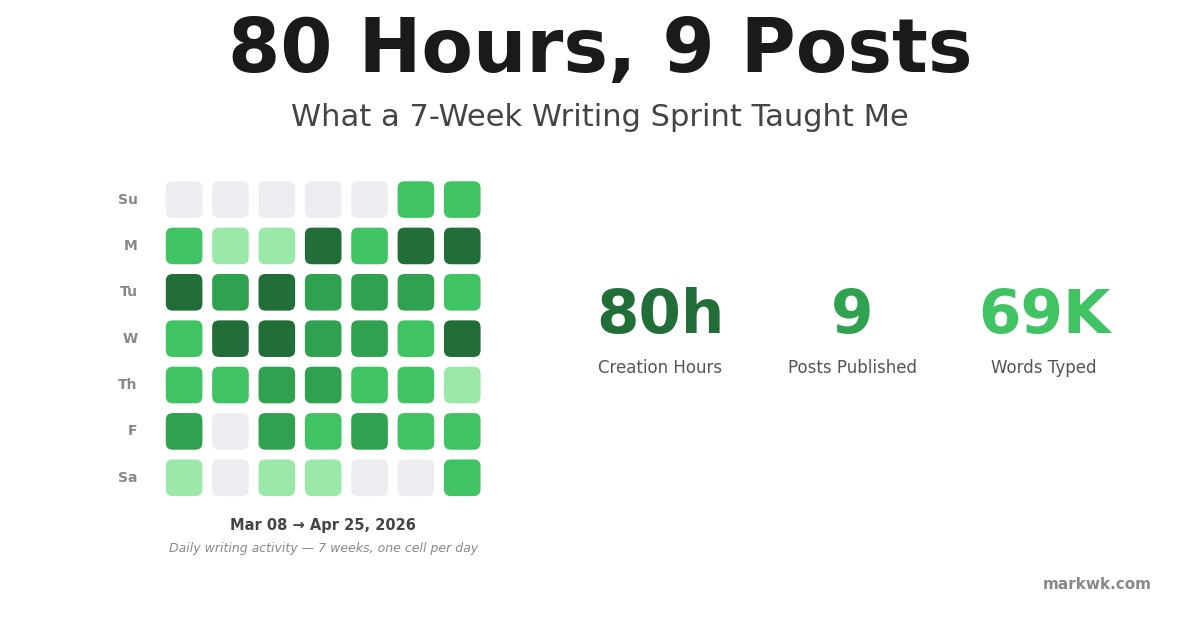
The writing wasn’t easy — most creative work rarely is — but the results were encouraging: in 7 weeks, I logged 80 hours of creation time, published 9 posts across two blogs, and typed 69,000 words. Every target I set was exceeded.
Here’s what I learned, what the data revealed, and discoveries that surprised me.
The Experiment: Campaign-based Goal Tracker for Writing
My long-term intention is to develop a weekly writing cadence (an article per week) and eventually publish a full-length book on goals and tracking progress. Rather than start with that overly ambitious goal, I cut the goal in half and took a short-term experimental approach. I framed it as a campaign or sprint. The benefit of a sprint is that it is specific and explicitly time-bound. A sprint has obvious start points, mid-point check-ins and an end. This gave the goal pursuit a shape and directionality and offered me a chance to reflect at the start, mid-way through and now at the end through this blog post.
From March 12 to April 25, 2026, I set out to write at least 40 hours and publish 9 posts over 7 weeks. I write primarily using plaintext markdown files. I tracked my input (time, typed words) and my output (wordcount, blog), and I used some python code to glue together a simple goal tracker so I can monitor the campaign and see progress week to week during my weekly review. Arguably, the most important component was a simple tracker doc where I logged my intentions, writing principles, what I’d published, what was next, and what I’d cut or deferred. It served as a planning tool, running journal and made my progress visible.
Admittedly, this can feel like a lot of technology pieces to an outsider. But most of these passive tracking tools can be setup in an hour or two, and the immediate and long-term value is a continuous stream of passively tracked data on your writing behavior. You can track your progress day to day and over time. The specific code I wrote for the goal tracker was additive glue that help me automate and monitor. Goals aren’t linear. Nothing replaces the act of checking in on your progress, noting what is working, being honest and open-minded and iterating.
So, how did it go?
The Numbers
| Goal | Target | Actual | % |
|---|---|---|---|
| Creation Hours | 40h | 81.0h | 202% |
| Published Posts | 9 | 9 | 100% |
| Words Typed | 45,000 | 69,220 | 154% |
Here is a week-by-week breakdown:
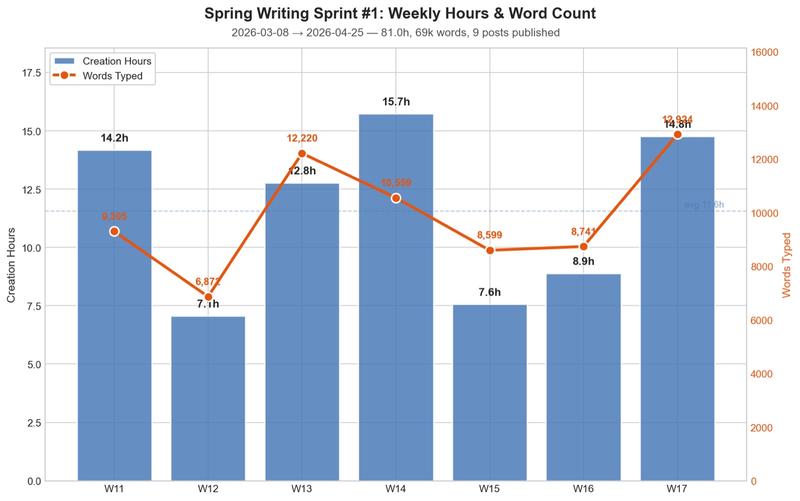
This chart shows the ups and downs of my writing journey. Interestingly, there were strong peaks at the start and end, which are typical of most goals and reminds me of my quick starts when I do a marathon race or the acceleration as I near the finish line. As a working professional, it was impossible to carve out a perfect schedule to write and publish. These ebbs and flows reveal my natural pace and the constraints I faced certain weeks or days.
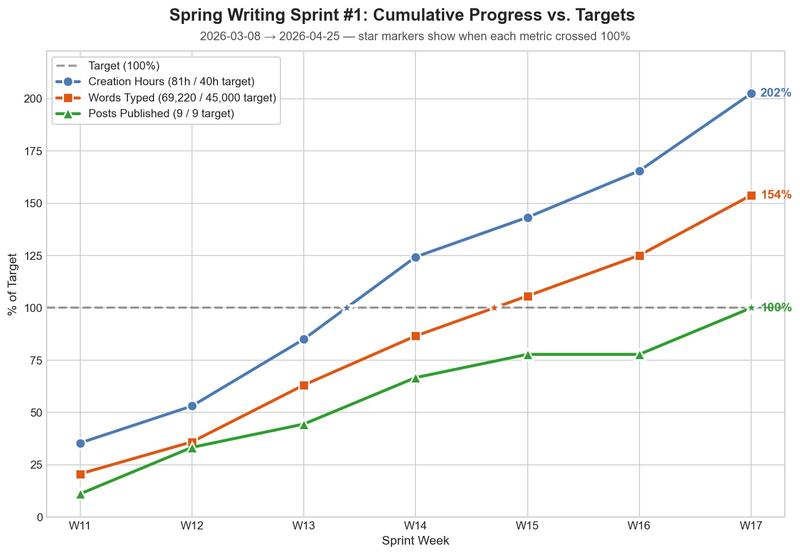
The timeline above shows the rhythm — the ups and downs of each week. This chart shows the trajectory: despite the messy week-to-week variation, every metric climbed steadily and crossed its target. Hours and words are leading indicators; published posts are the lagging outcome. Consistent, imperfect effort compounds into result.
What I Published
While I largely stayed true to my intention of writing about finishing problem for creatives, my actual output varied as did the time needed to research, write and publish each post:
| Post | Blog | Type | Hours | Words |
|---|---|---|---|---|
| The Ostrich Problem | markwk | Research | 9.1h | 7,045 |
| Why I’m Building PlaybackPilot | PBP | Founder | 3.7h | 1,443 |
| Is What I Am Doing Useful? | markwk | Book review | 3.1h* | 4,500 |
| Unfinished Symphony | PBP | Data-driven | 4.3h | 3,350 |
| Stuck in the Middle | markwk | Research | 10.0h | 3,184 |
| Album Management Walkthrough | PBP | Video + blog | 4.3h | 206 |
| Cut Your Goal in Half | markwk | Book review | 2.3h | 2,094 |
| Quiet Workarounds | PBP | Research | 12.0h | 4,055 |
| I Forgive Myself, Now I Can Work | markwk | Book review | 4.7h | 2,881 |
| Published total | 53.5h | 28,758 |
*Sprint hours only. The Courage to Be Disliked review also had 2.5 hours of prior review work logged in late 2024 and early 2025, bringing the true total to 5.5 hours across 16 months.
Not all of the sprint’s hours went to published posts. I also spent 11.9 hours on drafts that didn’t get finished during the sprint — posts on health and exercise, the data-driven writer’s life, the visibility problem, and the Progress Principle book review. Another 9.4 hours went to journaling and 6.2 hours to planning. In a sprint about finishing, it’s worth noting honestly: some things didn’t get finished. Those drafts aren’t dead — they’re parked, and several are near the top of Sprint 2’s queue.
What Worked and What I learned
The benefit of a short goal pursuit cycle is that it offers a chance to try some things and see what works and what doesn’t. Overall, I’d say structuring this as just a few week sprint took a lot of the pressure off. By picking a few specific posts that were my must-win’s meant those got prioritized but didn’t have to happen all at once. Also, by leaving gaps and managing based on energy level and what pulled by interest, several unexpected blog posts emerged organically.
1. The ultradian sweet spot
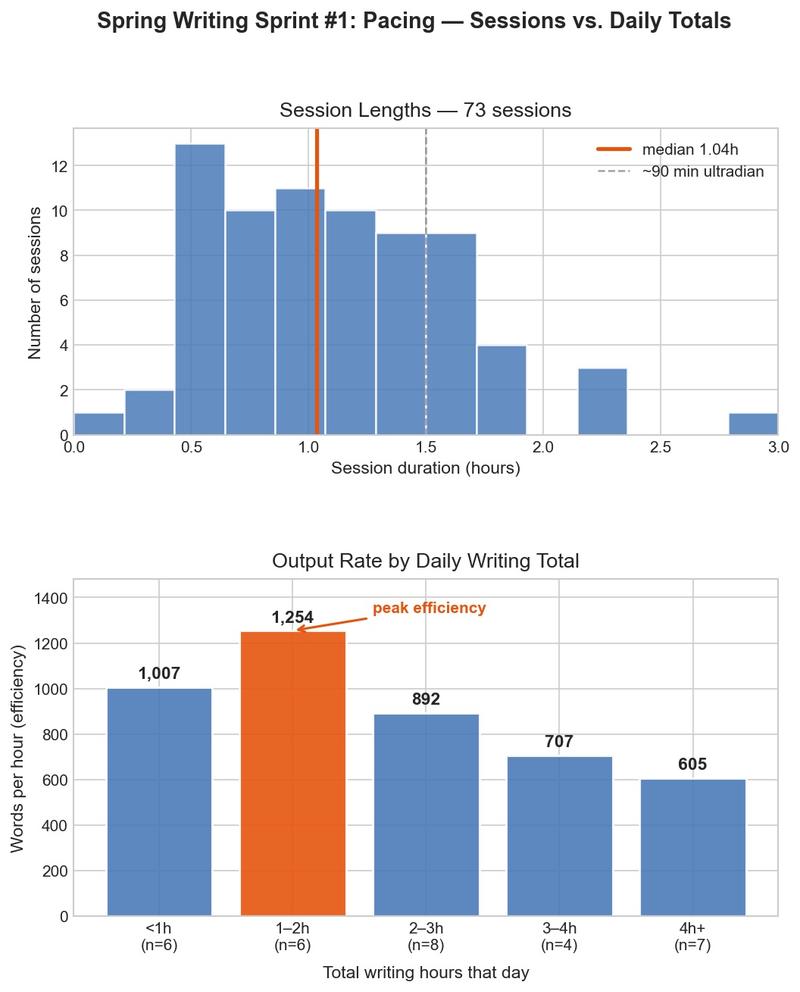
There is a tempo or pace to our daily productivity and cognitive focus. While circadian rhythms describe the well-known phenomenon of our sleep and wake patterns, it was interesting to see in my own data the lesser known pattern called ultradian rhythms. As discovered by the same scientist who co-discovered REM sleep, humans possess a roughly 90 minute window during the daytime of peak executive function, before cognitive resources deplete and we lose focus. Driven by a host of biological mechanisms, ultradian rhythms describe these shorter rest-activity cycles.
When I looked at my data, my individual writing sessions clustered around 1.1 hours — comfortably inside the 60–90 minute ultradian focus window. My body had been self-organizing into hour-long focus blocks without me consciously designing for it. But the real finding was at the day level: peak writing efficiency came on days where I wrote 1-2 hours total (1,254 words/hour). By 4+ hours of total daily writing, my words-per-hour had dropped to 605 — less than half the peak rate.
We often metaphorically describe our focus like an energy reservoir that decreases as we put in more and more work over time. The practical reality is that our creative energy is more like a wave, not a reservoir. Biologically, we can sustain focus for roughly 60-90 minutes. During peak immersion, our brain state changes and we can enter flow, a state of cognitive peak performance.
After this period of peak focus, we enter what is called the ultradian trough. This is the natural and automatic downswing of the ultradian wave. Our nervous system switches from sympathetic (alert, focused, high-Beta) to parasympathetic (recovery, rest, Alpha/Theta). We feel a bit groggy, our attention wanders and we struggle to concentrate. Culturally, we sometimes feel guilty for our inability to focus, and we are tempted to try and power through. Most folks, like me, often crave caffeine, a snack or an urge to switch tasks, check their email or phone.
The practical reality is that you aren’t lazy. Post-focus trough is normal. You are merely a surfer coming down on a natural peak focus period, after the wave crested. Your body and mind are telling you to pause and take a break for recovery and creative incubation. We often don’t heed this signal or call to pause. If you don’t take a break, you incur a recovery penalty, inhibiting your focus and creativity later in the day and increasing your daytime chronic stress. By contrast, a 20-30 min break clears mental fatigue, resets your prefrontal cortex, and enables you to ride the next wave and peak.
For me personally, the biggest shift going forward is giving myself permission to take creative recovery breaks and recognizing when I’ve hit the point of diminishing returns for the day. My sessions are already well-timed — about one ultradian cycle each. What I need to stop doing is chaining too many of them together, filling every available hour with writing and expecting the fourth hour to be as productive as the first. Instead of asking “how many hours can I write today?” I should start asking, “How do I make the most of my one or two peak sessions?” This question led me to my next lesson.
2. Protect the morning block
Intuitively, I’ve long identified that my most productive block of time each weekday falls between about 9:30 and noon. My best mornings follow a natural rhythm: coffee and news by 8:30, some journaling or research notes as a warmup start at 9, then focused writing by 10, and somewhere in that first concentrated hour, I reach focus and flow. This is where I can and should tackle my biggest cognitive challenges of the day, and when do, I get into deep work and flow and produce my best work. Unfortunately, I haven’t protected or honored this block. Even though I can largely do my client and product work later in the day with similar efficiency and output, I don’t. I’ve allowed my mornings to get sucked into “other people’s problems” over the years. My writing output over the last 3-4 years is probably most tied to the loss of consistent morning writing blocks.
For this writing sprint, the main structural change I put in place was scheduling two or three dedicated mornings each week exclusively for writing. No meetings, no quick check-in’s on a client project, no morning review of my growth marketing, and no email. I blocked out 9:30-noon on Tuesdays and Wednesdays as non-negotiable writing sessions in my weekly plan. This was my primary creative constraint. I’d argue that this single move mattered more than any other writing technique I could have tried.
Even though I didn’t know the technical term for it then, this focused morning block aligns well with science of ultradian rhythms and my data showed it too.
My morning sessions averaged 1.2 hours at 874 words/hour across 35 sessions. Afternoon sessions were shorter (1.0 hours average) and slightly less productive (794 words/hour across 31 sessions). Mornings accounted for half my total hours but a disproportionate share of my best output. When I deferred writing to the afternoon, I still wrote, but the difference in depth and quality was visible.
It also seems that starting my day with writing resulted in a habit shift. All parts of my day tended to be centered on writing to think and thinking through writing. In short, writing became not just a scheduled event but a pervasive and habitual cognitive activity.
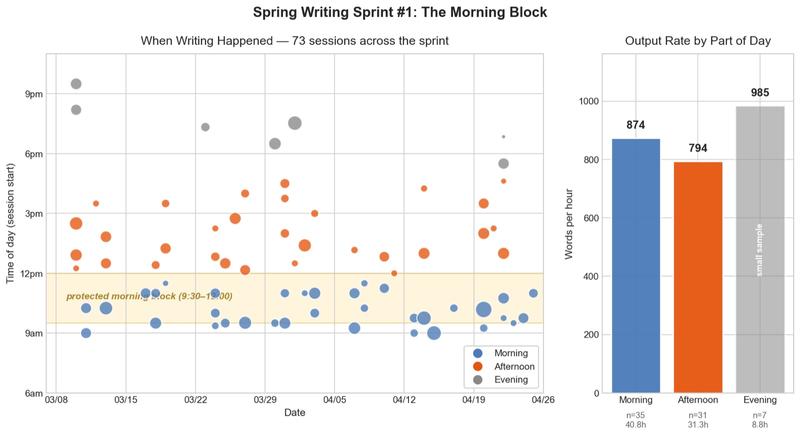
Protecting the morning block isn’t about discipline; it’s about alignment. You’re scheduling your hardest creative work during the core windows where your biology is designed to support it.
3. One post, one day
I have a tendency to let my curiosity get the best of me and end up getting pulled down rabbit holes into topics that seem related to what I’m writing or researching but in actuality are forms of procrastination. This can result in a multiple day forays into new areas rather than finishing an article. My drafts folder is a graveyard of many, many half-finished posts, some of them hundreds or even thousands of words long.
The fix was simple: pick one post and work only on that post for the day.
The clearest evidence for the efficacy of this practice came at the end of the sprint. On Monday, I drafted and published the Quiet Workarounds post in 4.8 hours in one day. On Tuesday, on a low energy day, I did the same with the Feel-Good Productivity review, which start to finish took me 4.7 hours. It worked because I wasn’t half-engaged on several ideas. Each day had exactly one focus and each one got a single post completed.
If you are looking for a guiding framework, I’d suggest following what I recommended for music producers and called Active-List Rule: name the one active thing, park everything else.
Split attention kills momentum. Focused attention means your best energy is directed at your most significant target and what’s closest to done. The key takeaway: committing to a single post per writing day. The two-posts-in-two-days was my proof.
4. Two blogs created natural variety
The main output I wanted to move and unlock was publishing blog posts, articles and a youtube video for my music finishing app, PlaybackPilot.com. I’ve spent months marketing and building it, but I was struggling to tell the story. I hadn’t put enough words down for my audience and for my early users. Frankly, after months of research and building, I had a lot of big and small ideas to process and share about what it takes to help music producers finish more music.
Early on, I elected to write a few posts for markwk.com too. Even though this breaks from the previously stated focus rule of one topic or goal at a time, I knew that I had to harness my creativity and curiosity and leave myself more than one outlet and format to express my thinking. There was also a lot of natural overlaps too. This gave me a space to write more organically on the finishing psychology and how it fits and applies outside of music.
Here is what happened: 5 posts on markwk.com (personal essays + book reviews) and 4 on playbackpilot.com (product research + founder story). I could switch to different types and formats depending on my energy level. On a low energy day or when I needed a quick win, I could write a book review post. On a high energy day, I could work on a research-based post. By having a space for both, I could avoid monotony and could cross pollinate key concepts between the two blogs.
5. Book reviews are the fastest format
Writing is a time consuming and creatively messy affair. One of the data surprises I stumbled into was how dramatically the format or type of post affected the writing time and time-to-publish.
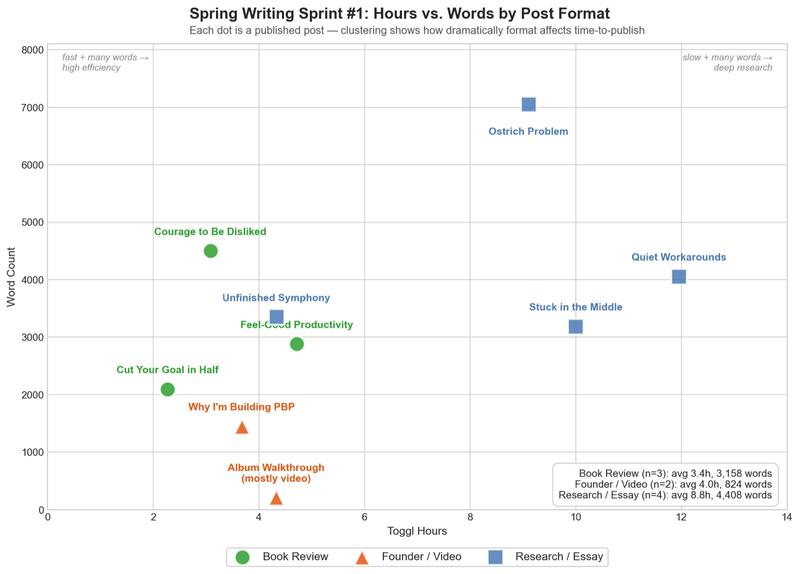
On average, book reviews took ~3.4 hours (~3.2k words). Deep research posts — the Ostrich Problem, Stuck in the Middle, and Quiet Workarounds — averaged ~10.4 hours (~4.8k words). The data-driven survey post (Unfinished Symphony) clocked closer to 4.3 hours, behaving more like a shorter analysis piece. The founder story took 3.7 hours (1,443 words), and the album walkthrough was primarily a video — 4.3 hours of production for 206 words of accompanying text.
Generally speaking, I am not a writer of the mundane. In-depth, data-driven and research-backed posts are where I feel most pulled as an author and thinker. While I can still write decent material in shorter formats (like newsletters and emails), I thrive and grow the most developing and drafting these research posts. I like doing research and synthesizing learnings into my own philosophical essays and science-backed insights. I just need to recognize that these articles and chapters take days or even weeks to produce.
I also need to recognize my available time and energy limits and leave space for shorter forms of writing. For me, book review posts allow me to process key ideas from the books I read — and the data revealed how much prior engagement shapes the speed.
The two fastest book reviews drew on prior thinking, but in different forms. Courage to Be Disliked actually had 2.5 hours of earlier review work logged in late 2024 and early 2025 — the sprint just added the final 3 hours of editing and publishing. Cut Your Goal in Half had clippings from my reading and a single thesis simple enough to draft in one morning (2.3 hours, start to finish). Feel-Good Productivity, despite a stub note from a year earlier, required processing the book’s ideas largely from scratch during the sprint — and took nearly twice as long (4.7 hours) as a result.
The efficiency unlock isn’t the format alone — it’s the depth of prior engagement the review draws on. Notes you’ve wrestled with, clippings you’ve actually highlighted, an earlier essay attempt you can mine from. Reading without engagement leaves you starting from scratch when it’s time to write. Some books are also inherently faster to review than others — a book with one clear thesis (like Acuff’s “cut the goal in half”) writes up faster than one with a dozen interlocking frameworks.
Book reviews offer a palette cleanser, and in the context of a writing sprint, they gave me quick wins, improved my momentum, and blog post numbers in less time than longer research posts.
6. Smart notes are fuel, especially for low-energy days
Whether it’s writing, music or some other creative project, sometimes we just don’t feel like doing our craft or core artistic activity. Sometimes I didn’t feel like writing for one reason or another during this sprint. I might have been feeling low energy, creative uncertainty or something else. Recognizing this feeling and labeling was important, because it meant I could get over my guilt and procrastination and avoid abandoning my craft for the session and instead I could ask myself the question: If instead of drafting a post, what is something else I could do before or instead of writing?
This allowed me to shrink down my expectations for the session and give myself a few options for next moves. I could journal about my feelings, ideas cluttering my mind or just stream of consciousness. On days when I didn’t know what to write, struggled with the throughline, or my energy was low, the shrink move was simple: draft a smart note instead. Review some highlights from a book I’d read. Process a concept I’d been circling. Connect two ideas that hadn’t been linked yet. A smart note was still progress.
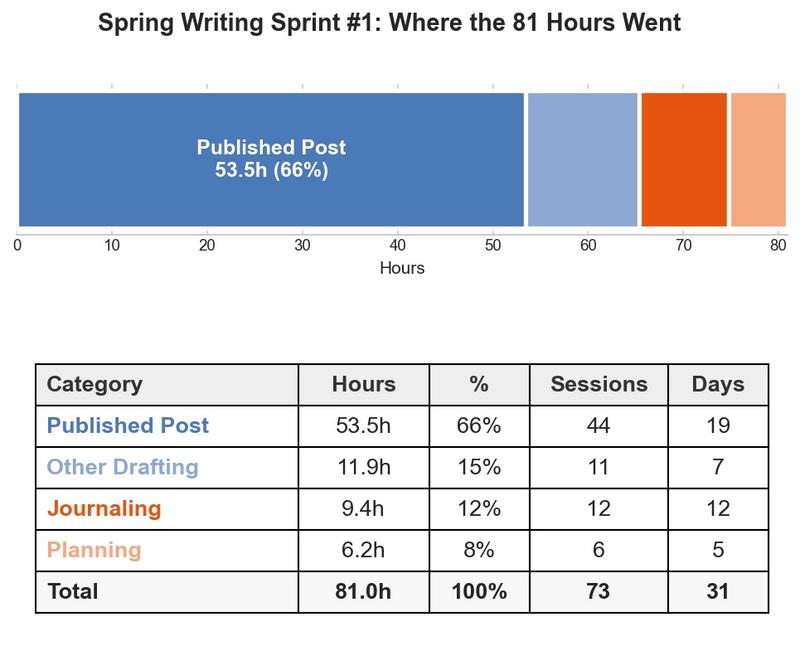
Over the course of 7 weeks, I journaled across 12 dedicated sessions and wrote in my notes app on 37 of 49 days, accumulating roughly 51,000 words — most of which never became blog posts but regularly became the seeds for them. I created 29 new smart notes on topics like constraints, away moves, self-forgiveness, producer workarounds, and the psychology of finishing. I’ve written before about the power of systematic notes, an idea borrowed from Sönke Ahrens that describes smart notes as a preparatory thinking practice that can be reused in whatever you create or write. It’s a practice that was somewhat dormant for me but reemerged organically and proved useful again.
Not every dedicated writing session during the sprint produced publishable prose. Some of my best sessions were spent journaling, reviewing book highlights, or drafting smart notes on concepts I was circling. At the time, these felt like detours and pseudoproductivity. In retrospect, I realize that these were building blocks and stepping stones.
My best writing blog posts and sessions pulled from existing material — journal entries, book clippings, archived notes, previously published posts — rather than starting from a blank page. I have years of notes and hundreds of book highlights. The sprint taught me to treat that archive as raw material and smart notes as fuel to assemble from. For example, when I sat down to draft the Quiet Workarounds post, the hardest conceptual work was already done in the notes. I was assembling, not inventing. It meant a lot of what I wrote about and published came from a related principle: adapt, don’t rewrite.
What I’d Do Differently
Here are a few things I’d change:
-
Just type — Some days I spent a lot of time spinning thoughts. This can be a necessary step towards figuring out what I want to write, the throughline or key novel points, but many times it’s glorified procrastination. Depending on the state of the draft and assuming I have an outline, the best recipe is often just writing stuff down — good, bad or otherwise. Once I got a crappy first draft, a lot of the subsequent writing followed on and came out of that. Most writing is rewriting, as they say.
-
Budget 2x the time — We are terrible at predicting how long knowledge work takes. Unlike a step-by-step process for producing material objects, creative and intellectual work is extremely difficult to pinpoint in advance. I realized this early on and tried multiple ways to cut down what I was trying to achieve. But I still underestimated. If I can’t cut the scope, then I need to budget more time — and not feel guilty about it.
-
Score the sessions, not just the output — For Sprint 2, I’d like to track not just hours and word counts but session quality: what I intended, what I actually did, what stage the draft was in, and whether the session felt productive. Understanding which sessions produce flow and which don’t would help me design better ones.
And perhaps the most important lesson of all: forgive yourself for the sessions that don’t go as planned. Not every day is a peak day. Some sessions produce a smart note instead of a blog post, some produce a rough paragraph instead of a finished section, and some don’t produce much at all. That’s not failure — that’s the rhythm. The sprint taught me that self-compassion isn’t the opposite of productivity; it’s what makes sustained productivity possible. If you guilt yourself about yesterday, it’s hard to show up today.
What’s Next
This sprint has rebuilt my writing habit and given me renewed confidence as a writer again. I haven’t fully tamed my wildly exaggerated expectations. But at least I have evidence for more realistic goal setting and a writing practice to continue to grow.
For my next sprint, I adjusted my targets (50h, 6 posts, 2-3 videos). The new theme is focused on data for finishing. This post is the first act. My new question: Can I add video creation into my creative cadence? And the lingering question: Does my writing habit last?
If you’re thinking about your own writing sprint: pick a duration (6-8 weeks), set modest targets, track your hours, protect your mornings, start with the easiest post, and take notes, reflect and iterate.
Concluding Thoughts
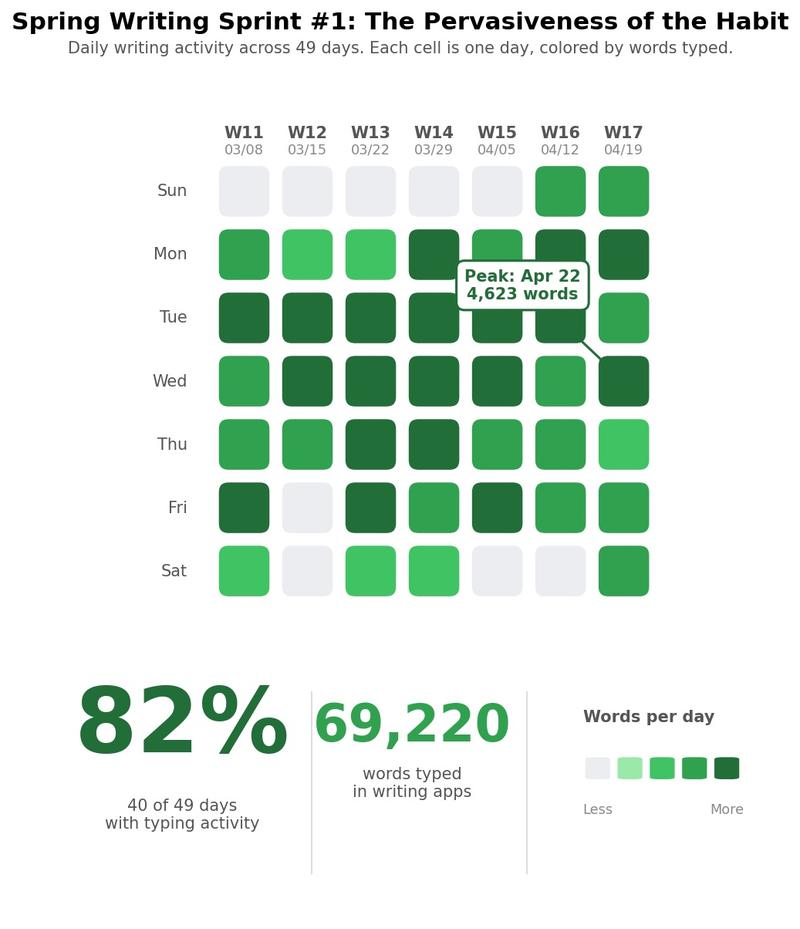
When I started this sprint, I wasn’t sure whether I was a product builder who writes or a writer who builds products. After 80 hours of creation time and 9 published articles — writing on 40 of 49 days — the answer is clearer: I’m both — and neither label matters as much as showing up, putting in the work, and pushing to the finish line.
Through the act of writing itself — and through learning about the psychology of finishing — I discovered a deeper lesson. Finishing anything comes down to a simple loop: notice where you’re stuck, shrink your next move until it’s hard not to start, and forgive yourself when progress looks different than you expected. Track it. Reflect on it. Iterate. Keep going. That’s the whole practice.
Related Reading
- The Ostrich Problem — why we avoid checking progress on goals we care about
- Cut Your Goal in Half — perfectionism as the enemy of finishing
- I Forgive Myself, Now I Can Work — feeling good as productivity fuel
- Stuck in the Middle — midpoint motivation collapse
- 30 Days, 30 Songs — an earlier creative sprint in music
AIDA (AI Disclosure Acknowledgement): This blog post was researched and written by the author based on personal tracking data. AI tools (Claude Code) were used to assist with data work (analysis, organization and charting), structural editing, and clarity.