
I often treat my blog writing and even simple book review posts like they need to be 2000+ word opuses involving research, sophisticated arguments and deep philosophical engagement. The end result is that I have read hundreds of books and amassed 35,000+ Kindle highlights, but only 7 book reviews have graduated to published posts on my blog. That’s a humbling conversion rate of roughly 2%.
What if I cut in half my goal and expectation on what a book review should entail? How might this impact my ability to actually finish?
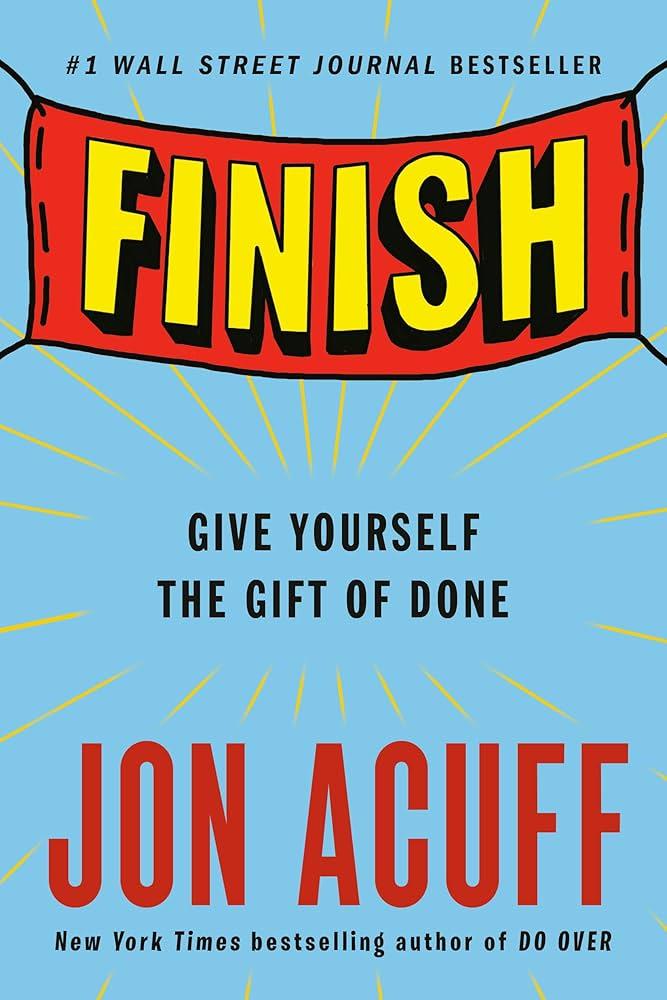
I recently read Jon Acuff’s Finish: Give Yourself the Gift of Done, and the irony is not lost on me. This is a book about finishing things, reviewed by someone who chronically doesn’t finish book reviews. Acuff’s core argument is that perfectionism is the principal enemy of finishing. My 2% graduation rate is a call out that something isn’t quite working.
I could argue that the book reviews I do finish and publish are of the highest quality and tend to be books that move me or matter in deeply personal and important ways. All the same, not all books merit that degree of engagement. Many make one or two strong points and likely only deserve a 300-500 word take, not a 2,000 word treatise. My perfectionism on format has been its own noble obstacle.
So this review is my attempt to practice what Acuff preaches: cut the goal in half, write the thing, and be okay with letting go.
My Quick Take Book Review
- ⭐⭐⭐⭐½ I rated this book a 4.5 out of 5.
- Would I recommend it? Yes, I’d recommend this to anyone who starts more things than they finish (which is basically everyone I know, including me). Especially useful for creators, writers and entrepreneurs who struggle with the messy middle.
- Would I read it again? Probably not. The principles are simple enough to incorporate and remember. The hard part is remembering to apply them.
- What was missing? I felt like the author should have recognized the researcher who helped process his survey responses and incorporated more studies and science on behavior change.
What I Got Out of This Book
“Perfectionism magnifies your mistakes and minimizes your progress.”
Acuff correctly points out that perfectionism is disguised as high standards but operates as a saboteur and blocker to action. He breaks out several forms of perfectionism:
- Your goal should be bigger
- I can’t until…
- You can do it all
The result is that we set goals that are too large, feel embarrassed when we fall short and end up abandoning rather than reframing and adjusting.
His own research backs it up by claiming that participants who cut their goal in half increased their performance on similar challenges by 63% and that 90% reported higher motivation because the goal felt attainable. Personally, I wish he spent more time explaining the background of this research and at least contextualizing it and sharing overall numbers. Regardless, the options, as he puts it, are stark: “Quit the goal because it was too big, or cut it in half and finish.” (p. 25)
I’ve struggled with these demons of perfectionism on several occasions. When I was working on my own goals and self-tracking book, I failed to realize and celebrate the milestones I was hitting, because the book as a whole wasn’t done and the end result was incomplete and awkward. Instead of celebrating the stage and then taking a small pause and adjusting towards writing for the next phase, I gave up.
In some ways, I could argue that tackling a book writing project as a few months effort was a terribly wrong-sized goal. It was a noble achievement that I delivered something, even though it was an incomplete overall mess of a first draft. The better approach would have been to frame and think of it as a book treatment project whose target aim was finishing a book pitch, an intro, one complete chapter and a general outline. Focusing on this step with the timeline I had would have given me something to realistically reach as the deadline loomed. Sometimes you have to aim at finishing something as a stepping stone towards finishing that eventual everything.
“A noble obstacle is a virtuous-sounding reason for not working toward a finish.”
Are you struggling to move forward because of an excuse or a fear?
Acuff distinguishes between what he calls a hiding place — “an activity you focus on instead of your goal” — and a noble obstacle — “a virtuous-sounding reason for not working toward a finish” (p. 75). Both serve the same function: they let you feel productive while avoiding the thing that actually matters.
These are concepts that struck home for me. My classic blocker is that I’ll often assign a precursor to actually doing the core creative activity or task. The “I should do X before I do Y” means I insert conditions to starting or finishing something.
I’ll talk about wishing I had a certain skill in order to actually finish my project or goal. These are all what I’d term an “endearing excuse” or “relatable emotion.” It’s endearing because it seems like it’s true and necessary but it’s a hiding place kind of procrastination. It’s relatable because they sound like solid excuses that artists or working professionals can relate to, nod their heads and allow myself to not do the thing. In any case, they are reasons we tell others or ourselves that hinder us from forward movement and positive momentum. And once the noble obstacle is in place, we often stop checking whether we’re making progress at all — what psychologists call the ostrich problem. The hiding place keeps us from doing the work; the ostrich problem keeps us from seeing that we aren’t.
The “I can’t until…” pattern is a classic noble obstacle: I can’t launch until the business model is perfect. I can’t publish until I’ve done more research. I can’t start until I learn X. We construct hurdles on our own path until the lane is so clogged we couldn’t possibly move or run today.
I’ve seen this pattern play out empirically. When I surveyed 400+ music producers for my app Playback Pilot, one of the top four bottlenecks was sound selection (auditioning presets, scrolling through sample packs, hunting for the perfect drum hit). It accounted for nearly 11% of all responses. It feels productive. It looks like creative work. But it’s a producer’s version of Acuff’s noble obstacle: a virtuous-sounding activity that keeps you from actually arranging, mixing and finishing.
In my own survey, the broader finding was even more striking: 73% of producers attributed their finishing struggles to internal factors — perfectionism, overthinking, self-doubt — not external ones like time or tools. The enemy of finishing, as Acuff might put it, is in our heads, not just out in the world.
Concluding Thought: “Goals you refuse to chase don’t disappear — they become ghosts that haunt you.”
Acuff’s Finish: Give Yourself the Gift of Done is an easy read with clear language and some striking, relatable examples. He offers great labels for our challenges with goal pursuit. But at times I think he misses the core emotional background that hinders us from finishing. He hints at this through a passage from Steinbeck’s Cannery Row.
In Steinbeck’s novel, Henri the shipbuilder spends years building a boat but tears it apart before completion each and every time. A friend understands: “Henri loves boats but he’s afraid of the ocean… So you see, he never finishes the boat — so he doesn’t ever have to launch it.” (p. 172)
Goal pursuits are complex, multiheaded monsters. They can fire us up with excitement and pull at us in a highly engaging and motivating way, but not all goals matter to us in the same way. Some are actually goals we think we should have but don’t actually care for. Even goals we do align with and care about will face obstacles — the lull and swirl we experience when we get stuck in the middle phase.
I don’t think Acuff fully articulates the emotional landscape of goal pursuit, though he does find some early moorings for how complicated humans think and treat their goals. He briefly talks about why we sometimes secretly choose to stay unfinished, because it gives us control over the outcome. For example, we don’t want to finish and still fail or not get the emotional satisfaction we have been imagining (“if I never try, I at least know the outcome”).
Acuff’s counter is simple and hard to argue with: “You’ll never know the unbelievable joy of keeping a promise to yourself unless you finish.” (p. 185)
The producers I surveyed want to finish 7.9 tracks per month; they actually finish 3.7. Those unfinished 4.2 tracks per month are Acuff’s ghosts, accumulating in hard drives and project folders and weighing on us as creators. The data confirmed what I already sensed from my own music making: finishing isn’t a side problem. It’s the problem. And the ghosts don’t go away just because you start something new — they pile up.
Even though I started this review and post with the mantra and principle of cutting the goal in half and finishing faster, it still took me nearly two hours. I’ll take heart that it’s at least one unfinished book review I have finished.
But what about the dozens of other “ghost ships” haunting the harbor of my writing drafts and music catalog? So many ideas I cared enough to start but for one reason or another I haven’t finished piling up from months and even years ago. Reading Acuff, I had to ask myself his hardest question: “What am I getting out of not finishing?” (p. 182). Is it an excuse — I can’t do it until…? A wish for control that the reception will be all positive? Or simply trying to do too much all at once and not moving forward at all? Likely some combination. But unless I start aiming at smaller objectives and actually finishing them, I’ll never find out — because I’ll never finish.
Related Reading
- Slow Productivity by Cal Newport — currently reading
- The ONE Thing by Gary Keller — previously read
- Two Awesome Hours by Josh Davis — on the list
- Stuck in the Middle — my own published post on the psychology of midpoint motivation collapse, which pairs well with Acuff’s framework
Additional Book Notes, Quotes and Key Takeaways
On perfectionism as the enemy:
- “The day after perfect is what separates finishers from starters.” (p. 12)
- “Perfectionism magnifies your mistakes and minimizes your progress.” (p. 14)
- “Perfectionism believes that the harder something is, the more miserable something is, the better it is.” (p. 47)
On right-sizing your goals:
- “Those who cut their goal in half increased their performance on past similar challenges by over 63 percent.” (p. 23)
- “The only way to accomplish a new goal is to feed it your most valuable resource: time. And what we never like to admit is that you don’t just give time to something, you take it from something else.” (p. 33)
- “If you’re unhappy with your progress, you have three different dials you can adjust. The goal. The timeline. The actions.” (p. 163)
On avoidance and noble obstacles:
- “A hiding place is an activity you focus on instead of your goal. A noble obstacle is a virtuous-sounding reason for not working toward a finish.” (p. 75)
- “‘What’s next’ will always look more interesting than ‘what’s now.’” (p. 82)
- “If we don’t examine ourselves mindfully and gently, we may think that our failures to meet our goals are due to our laziness or bad strategy, when in reality they are caused by the secret rules that make our finishes impossible.” (p. 120)
On the fear of finishing — and the joy on the other side:
- “The day before done is terrifying.” (p. 170)
- “What am I getting out of not finishing?” (p. 182)
- “Goals you refuse to chase don’t disappear — they become ghosts that haunt you.” (p. 189)
- “You’ll never know the unbelievable joy of keeping a promise to yourself unless you finish.” (p. 185)
AIDA (AI Disclosure Acknowledgement): This blog post was researched and written by the author. AI tools (Claude Code) were used to assist with processing some of the quotes, proof reading and clarity.