I’ll admit that I sometimes feel guilty when I struggle to be productive. A few days ago, after a rough night of sleep and a productive-but-not-particularly-demanding morning, I struggled to get back to work after lunch. I knew what I wanted to accomplish. But something was off. I elected to take a break, but even after the break I still wasn’t feeling it. What was going on? Just the day before I’d put in nearly 6 hours of focused writing and published one of my strongest pieces in weeks. What was wrong? Why was I struggling to gut it out and push through?
As a tech entrepreneur and software engineer, it can often feel like the path to productive output is constantly grinding. “Do More Faster” was one of the mantras while I worked at Techstars in China, and it seems like the path to greatness, success, and investment requires a life of nearly constant effort and perpetual forward motion. But what do you do when you feel off, burned out, lonely, and frankly not motivated to continue?
On this particular day, instead of continuing to struggle through and feel bad, I realized I needed a break. Maybe I should take the rest of the day off entirely. I had been sprinting on several fronts for weeks. I’d made incredible progress on a host of challenges, and on top of client work, I was also spending most of my weekends working on my next album. My batteries were drained.
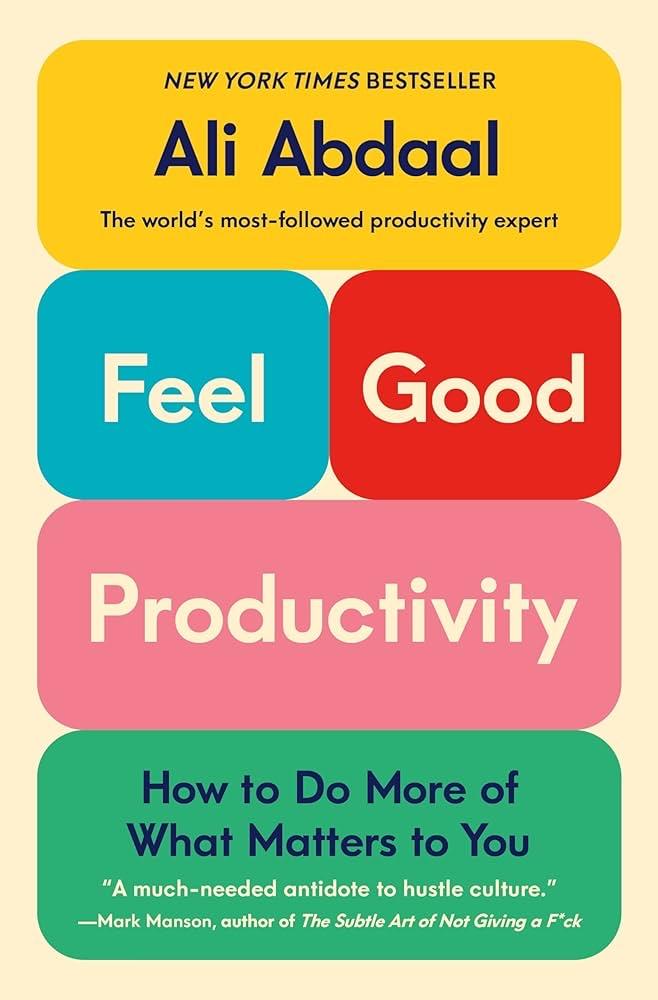
It was in that moment that I picked up Feel-Good Productivity by Ali Abdaal, which I had read a few years ago. As I started re-reading my notes and highlights, I realized I needed to forgive myself. My body and mind were signaling something, and instead of ignoring the signal, I should change course for the day.
What if our productivity and output wasn’t about simply grinding and pushing but truly a function of feeling good and having fun? What if feeling good was the fuel for deep, meaningful work?
Abdaal’s argument is simple and counterintuitive: feeling good isn’t the reward for productive work; it is in fact the prerequisite.
My Quick Take Review
- ⭐⭐⭐⭐⭐ I rated this book a 5 out of 5.
- Would I recommend it? Yes, I’d definitely recommend this book since it offers a lot of “bang for your buck” in terms of key science and thinkers on productivity and well-being in one place. It’s an important counterthesis to willpower and grind as the primary path to reaching your goals. I appreciated that it offered various reflection journeys (like the odyssey plan) for thinking about high-level purpose questions and tactical tools (alignment experiment) for implementing in small changes.
- Would I read it again? No, while this book offers a lot of great material, it felt like a book I would read once.
What I Got Out of This Book
“Success doesn’t lead to feeling good. Feeling good leads to success.”
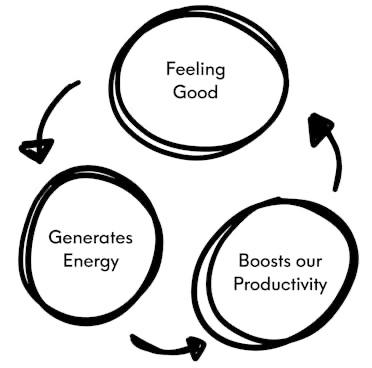
At the start of the book, Abdaal shares his personal story that after multiple years grinding towards becoming a medical doctor, he realized that “Working harder wasn’t going to bring me happiness” (p. 4). We often believe that happiness is the result of hard work and comes after reaching success, but what if we’ve had things reversed? What if feel-good emotions are actually the fuel towards becoming successful?
The central thesis of Feel-Good Productivity can be summarized with the quote, “Success doesn’t lead to feeling good. Feeling good leads to success.” (p. 10). Abdaal’s reversal thesis is grounded in positive psychology and in particular Psychologist Barbara Fredrickson’s research on emotions and how we think and act.
Evolutionarily, emotions shape how we act and focus. Negative emotions (fear, anxiety, stress) narrow our attention and trigger tunnel vision. This is useful and necessary when we need to escape danger: cortisol spikes, focus tightens, enabling us to act fast. But this narrowing comes at a cost. When the threat isn’t a life-or-death predator but a deadline, a half-finished track, or our inbox, the same stress backfires. These negative emotions shrink our thinking when we need it to expand.
Fredrickson’s insight, which Abdaal develops, is that positive emotions do the opposite. According to the Broaden-and-Build Theory, when we experience feel-good emotions and situations, like joy, curiosity, interest, play, our awareness broadens. As Abdaal puts it, “When we’re feeling good, our minds open up, we take in more information, and we see more possibilities around us.” (p. 6). Over time, these broadening moments build up key resources: resilience, creativity, problem-solving skills, social connections, and even improved mental and physical health. And when the positive emotions fade, your resources remain, giving you a key capacity to leverage both now and in the future.
Researcher Teresa Amabile found a similar loop in organizational settings — what she calls the Progress Principle: small wins fuel positive inner work life, which fuels better performance, which produces more small wins. Different research tradition, same virtuous cycle.
I often make music or work on my startup in the evenings, which can be tricky after a day of work when I might feel stressed, tired, annoyed or anxious. Rather than immediately try and force myself to work when I’m not feeling good, I’ll do something active and outdoors, like go for a run, play pickleball, or take a walk. If I’m particularly tired out, I take a rest by watching some YouTube videos or just read a book for fun. By taking a break and doing something fun, energizing and joy-inducing, I’m able to decrease my stress and replace these negative emotions. Once I’m in a better mood, I am able to broaden my thinking, engage with a fresh batch of creative challenges, get into deep work mode.
Fredrickson calls this the Undoing Hypothesis: positive emotions actively undo the physiological and cardiovascular effects of negative emotions.
So if positive emotions are the fuel, what happens when that fuel runs out and we experience burnout from weeks or months of working on something that doesn’t feel right?
“Burnout can happen to anyone when work stops feeling meaningful”
“Burnout isn’t just a thing that happens to overworked people in stressful jobs. It can happen to anyone when work stops feeling meaningful, enjoyable or manageable.” (p. 134)
We commonly think about burnout as simply overwork, typically stemming from doing too much or trying to do too much without time off. The WHO defines burnout as an “occupational phenomenon” characterised by “feelings of energy depletion or exhaustion; increased mental distance from one’s job, or feelings of negativism or cynicism related to one’s job; and reduced professional efficacy” (2019).
While technically accurate, Abdaal argues this is an oversimplification and deprives us of recognizing the causes and knowing possible fixes. For him, there are three types of burnout with differing causes and fixes:
- Overexertion: Doing too much, too fast. Classic form of burnout.
- Cause? You are working all the time and sprinting constantly without an end or boundaries. You are constantly saying yes, instead of no to dozens of things you don’t have time or resources to do now.
- Fix? Take a break and get some rest. Say “No.” Better energy management.
- Tactical Antidote? The Energy Investment Portfolio [See Below]
- Depletion: Insufficient deep recovery.
- Cause? This isn’t just doing too much but instead not giving yourself proper room to sleep, relax and recharge. You might be getting breaks but they are shallow and you aren’t really recovering.
- Fix? Real time off, Reitoff Principle (permission to write off a day without guilt).
- Misalignment: Feeling like you are doing the wrong stuff.
- Cause? This is the most subtle and counterintuitive form of burnout because you can be productive AND burned out if the work doesn’t align with your values. It can also stem from the social environment and work with the wrong kinds or styles of people and support.
- Fix? Unlike the first two types, misalignment burnout requires a deeper look at yourself and what you’re doing. It calls for personal reflection on what you care about and aligning your life and work accordingly.
- Tactical Antidote? Alignment Experiments [See Below]
Let’s look at two antidotes for two of these forms of burnout.
Energy Investment Portfolio: Fix for Overexertion
How much can you actually do at one time? Is your energy portfolio overloaded and preventing you from focusing and meaningfully moving forward on what matters?
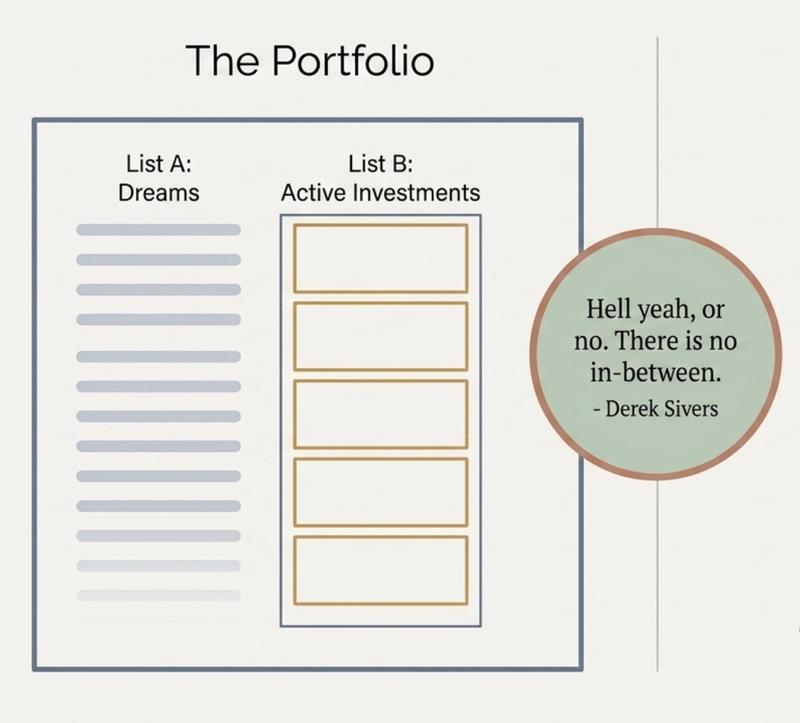
Abdaal’s tactical antidote to the classic form of burnout — overexertion — is having Energy Investment Portfolio and limiting how many active projects you are doing. He recommends having two lists. List A holds your dreams and is basically everything you’d like to do eventually. List B holds your active investments and he suggests having just 3-5 projects that you’re investing energy into in a given week.
How to decide where to put your energy? Abdaal recommends using Derek Sivers’ pithy “Hell yeah, or no” as your filter to decide what goes in or out. If it’s not a hell yeah, it stays on List A. If it’s a hell yeah, then it’s in.
As a music producer, I use a similar move that I call the “parking lot” and wrote about in my Quiet Workarounds post. The problem is that, like most music makers, I have lots of unfinished tracks and it can be hard to focus and make progress on my pile of unsorted demos. In order to deal with this, I dump tracks that aren’t being actively worked on into my parking lot. The tracks or album project isn’t abandoned or dead; they’re just parked for later and can be moved to active when I finish something or have an open slot.
By determining what your priorities are and trimming back your active projects list to 3-5 areas, you’ll feel more relaxed, less stressed by the pile, and more able to act — whether you’re dealing with overexertion, stuck in the middle, or something else entirely. Shrink down what you are focused on and you can often intuitively know what your next move is.
But what if the problem isn’t overexertion? What if you’re putting in the right amount of time and energy on things but it’s actually the wrong stuff for you?
Alignment Experiments: How to navigate when you feel misaligned
What do you do when your form of burnout doesn’t stem from overexertion or lack of recovery but because you are no longer aligned with what you are doing?
It’s easy and obvious to advocate for leading a work and creative life centered on fun and play, but it’s much harder to offer a simple principle or solution when you feel off, uncertain and misaligned. It’s here where I’d argue Abdaal offers his most original and impactful contribution. His response centers on the pursuit of authenticity and navigating the modern challenge of value and purpose alignment.
The research backs how important alignment is to our sense of well-being. Psychologist Anna Sutton trawled through 51 studies with over 36,000 participants and found that when people make decisions aligned with their personal values, they aren’t just happier — they’re more engaged with the tasks before them. (p. 186) Having a job, hobby or life situation aligned with your purpose or identity can feel like a luxury or nice-to-have, but the research would say otherwise. Value alignment and living with authenticity is actually a performance enhancer.
Abdaal offers a two-horizon approach to finding alignment:
- The longer horizon: Abdaal suggests several reflection exercises for exploring bigger purpose questions: the eulogy method (“What would I feel good about someone saying in my eulogy?”), the odyssey plan (write out three 5-year paths: your current trajectory, a completely different path, and a radical path where money and social expectations don’t matter), and the 12-month celebration (imagine telling your best friend about your progress a year from now).
- The shorter horizon: Alignment experiments are essentially small tweaks and iterative changes you undertake to get to the life you want to lead. Abdaal suggests identifying one area of your life where things feel unfulfilling and then change just one independent variable. After, journal about its effects and your learnings, explore alternatives and keep tweaking without committing long-term until it works for you.
Abdaal wonderfully captures the essence of this in the following two questions:
“If you were to change one — just one — independent variable in your life, what would it be? And what effect do you think it would have on your situation?” (p. 191)
As a data-driven self-improver and self-experimenting biohacker, I resonate a lot with Abdaal’s overall thinking and approach here. Over the last year I’ve shifted from working on client work towards my own value-aligned startup and product, Playback Pilot. In my on-going “track everything” experimental blog series, I’ve tried dozens of quantified self and self-tracking methods and small interventions to see what works to improve my productive creative life, my health and longevity. I recently started an experiment to see the impact structured endurance training has on my health (sleep, VO2 Max, biomarkers) using a Continuous Glucose Monitor (CGM) and a wearable. Even this blog post is part of an alignment experiment: “what happens if I write consistently for 7 weeks?”
“The best antidote to doing nothing is simply to do something. You can take action by first defining your next step and then tracking your progress.” (p. 133)
The key idea is that you don’t need to change everything to learn and grow into the person you want to be; just change one thing, pay attention, reflect and let what you discover guide and lead you to your next move. One step at a time with intention and self-awareness.
Concluding Thought: “I forgive myself, now I can study”
One of the most powerful and simplest techniques Abdaal suggests is simply forgiving yourself and moving on. He cites a procrastination study by psychologist Michael Wohl: students who practiced self-forgiveness after procrastinating on an exam not only reported fewer negative emotions but were measurably more productive on the next one. Self-forgiveness allowed them to “move past their maladaptive behaviour and focus on the upcoming examination without the burden of past acts.” (p. 131) The title of Wohl’s paper says it all: “I forgive myself, now I can study.”
That’s what finally clicked on that rough afternoon after lunch. The move wasn’t to push through. It was to stop punishing myself for not wanting to. I set aside my primary task and my client work, pulled up my notes and highlights on this book, and just followed the thread. One simple session with just a step or two to get started. I spun out a few smart notes into my backlog, jotted down fresh thoughts on Abdaal’s ideas, and summarized a handful of his quotes in my own words. Without meaning to, I ended up with the rough start of the draft that became this post. No sprint, no deadline, no guilt over the stalled rest of my day. Just a few steps forward without trying to finish the whole thing. I had forgiven myself, and now I was able to work.
Which is exactly Abdaal’s bigger point: feeling good isn’t the reward for productive work, it’s the fuel. It sounds like a platitude until you’ve spent an afternoon proving the opposite case to yourself. If the whole book compresses into nine words, it’s this one question:
“What would this look like if it were fun?” (p. 24)
Related Reading
- Finish by Jon Acuff — my review — perfectionism as the enemy of finishing; cut the goal in half
- The Courage to Be Disliked by Kishimi & Koga — my review — Adlerian psychology on self-acceptance and contribution
- The Progress Principle by Amabile & Kramer — [review in progress] — small wins as the most powerful motivator; same causal loop as broaden-and-build
- The Ostrich Problem — my post — why we avoid checking progress
- Stuck in the Middle — my post — midpoint motivation collapse
References
- Abdaal, A. (2023). Feel-Good Productivity: How to Do More of What Matters to You. Celadon Books.
- Fredrickson, B. L. (2001). The role of positive emotions in positive psychology: The broaden-and-build theory of positive emotions. American Psychologist 56(3): 218-226.
- Fredrickson, B. L., et al. (2000). The undoing effect of positive emotions. Motivation and Emotion 24(4): 237-258.
- Wohl, M. J. A., Pychyl, T. A., & Bennett, S. H. (2010). I forgive myself, now I can study: How self-forgiveness for procrastinating can reduce future procrastination. Personality and Individual Differences, 48(7), 803-808. https://doi.org/10.1016/j.paid.2010.01.029
- Sutton, A. (2020). Living the good life: A meta-analysis of authenticity, well-being, and engagement. Personality and Individual Differences, 153, 109645.
- Gollwitzer, P. M., & Sheeran, P. (2006). Implementation intentions and goal achievement: A meta-analysis of effects and processes. Advances in Experimental Social Psychology, 38, 69-119.
- Amabile, T., & Kramer, S. (2011). The Progress Principle: Using Small Wins to Ignite Joy, Engagement, and Creativity at Work. Harvard Business Press.
AIDA (AI Disclosure Acknowledgement): This blog post was researched and written by the author. AI tools (Claude Code) were used to assist with processing some of the quotes, structural organization, and overall clarity.