How do you sustain creative output without burning out? How do you create high quality work and art at a sustainable pace?
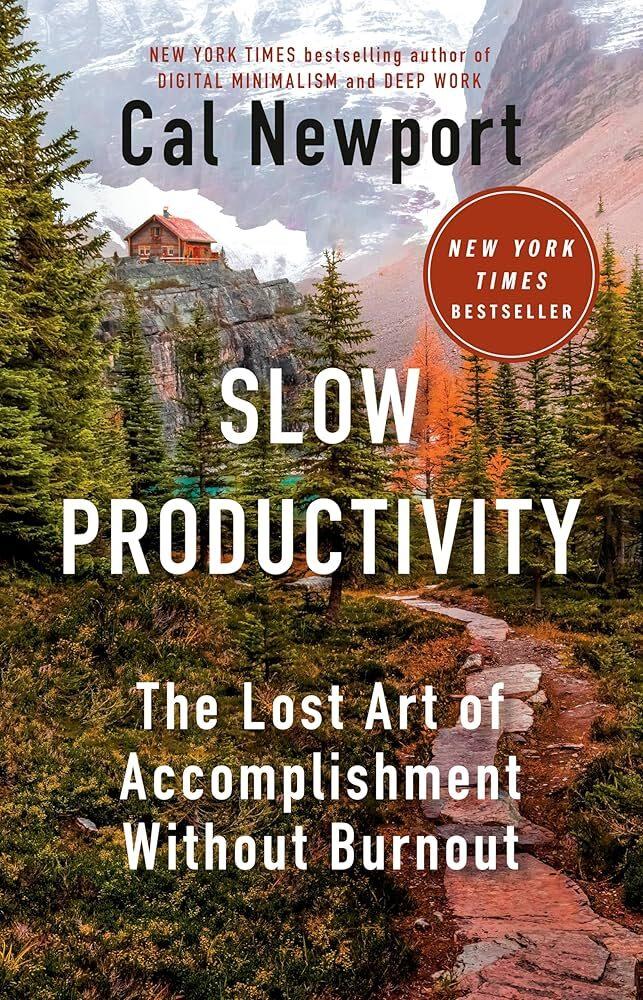
It’s mid-May, my activity level has been running hot on multiple fronts for months, and I recently finished Cal Newport’s Slow Productivity, a book on how to do less and still have meaningful, high-impact output. There is a certain personal irony in reflecting on this book’s core concepts when I spent 212 hours of computer time in a single month and have 4-5 active projects in the queue.
Newport’s earlier books, Deep Work and Digital Minimalism, are obvious arguments — most knowledge workers will nod and agree. Slow Productivity is doing something harder: making a case for the productive artist working in a crowded space of competing interests, and pushing back against the grind as the only path to meaningful output.
My Quick Take Review
- ⭐⭐⭐⭐⭐ I rated this book a 5 out of 5 on Goodreads.
- Would I recommend it? — Yes, definitely would recommend this book since it offers meaningful ways to reframe how you pursue goals over the long haul.
- Would I read it again? — I don’t plan to re-read this, since I feel like the big ideas were obvious and intuitive in a single read and there weren’t a ton of templates or reflection activities worth revisiting.
- What was missing? I felt like Newport could have been a bit more vulnerable and shared a bit more of his own journey with burnout, pseudo-productivity and even what he struggles with as a writer and professor.
What I Got Out of This Book
In April 2026, I logged 212 hours of computer time or 7h per day including the weekend. Was I being productive or just busy?
Diagnosis: The Pseudo-Productivity Trap
Historically, it has been straightforward to quantify productive output with input, especially when output is defined by a tangible outcome and obvious step-by-step process. In manufacturing, Ford’s Model T production line defined a process, iterated on each step, and oriented around the measurable goal of units produced per hour. Agriculture requires the visible activity involving tilling, planting, weeding, etc., which results in the visible material output defined by bushels per acre.
By contrast, the productivity of knowledge work is difficult to objectively quantify. The work product itself is variable. The creation process rarely is repeatable nor definable in any step-by-step manner. So, how do you measure and signal you are productive when your input and output are no longer intuitive and obvious?
The visible-activity heuristic has become the proxy for perceived productivity by both managers and workers alike. When you can’t measure output cleanly nor define what it takes in terms of steps and time input, looking busy becomes the proxy for being viewed as valuable and productive. The rise of communication and project management tools, like email, Slack, etc, has made it possible to “visibly signal your busyness with minimal effort” (Newport, p. 18), which has further entrenched this tendency.
The central issue or villain in Newport’s book is Pseudo-Productivity which he defines as: the “use of visible activity as the primary means of approximating actual productive effort.” (p. 18).
Pseudo-Productivity becomes a trap on multiple levels. Performing work and doing the actual work gets decoupled. Companies end up in an “always on” urgency-based, performative work culture that assumes more hours lead to better results. Talking about work in endless chat threads, meetings and email chains seems to matter more than the work itself or what we produce. Over time, companies and their employees end up with exhausting overload and burnout, partially attributed to the need to be seen as present and busy, while we become misaligned from our actual priorities and what’s most important in our jobs. We become burdened by more maintenance overhead, make less meaningful progress, and ship less impactful work.
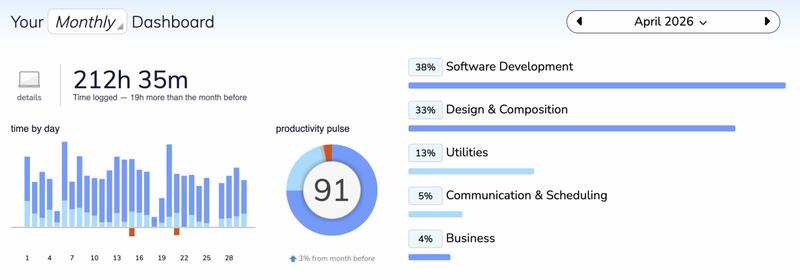
In my own work and creative life, I’m fortunate to have very little busy work or time spent in meetings, chat or email. In fact, of April’s 212h, a mere 5% was on Communication & Scheduling while a remarkable 38% was on Software Development and 33% on Design & Composition (including music). 71% of my computer time was actual building and making.
By the standard measure, I have avoided the pseudo-productivity trap. I’m productive and focused. I’m not burned out by the busyness but instead I’m an entrepreneur and builder running close to the ceiling of my actual productive cognitive capacity, both in terms of time input and potential creative output. So why am I still feeling overloaded, facing borderline burnout, and increasingly misaligned and cluttered? Because I’m trying to work on too many things.
Newport’s Prescription: Slow Productivity in a Nutshell
Newport’s definition of Slow Productivity is a “philosophy for organizing knowledge work efforts in a sustainable and meaningful manner.”
Against the backdrop of pseudo-productivity and even my own productive overload, he offers three principles as the prescription:
- Do fewer things
- Work at a natural pace
- Obsess over quality
Each is load-bearing by itself while together they form a coherent answer to the trap of pseudo-productivity and can aid us in navigating a meaningfully productive life at a sustainable pace and load.
The Four Words I’m Carrying Out
But here are the four words I’m actually carrying out of this book:
Do Fewer Things. Higher Quality. Finish. Don’t Overthink.
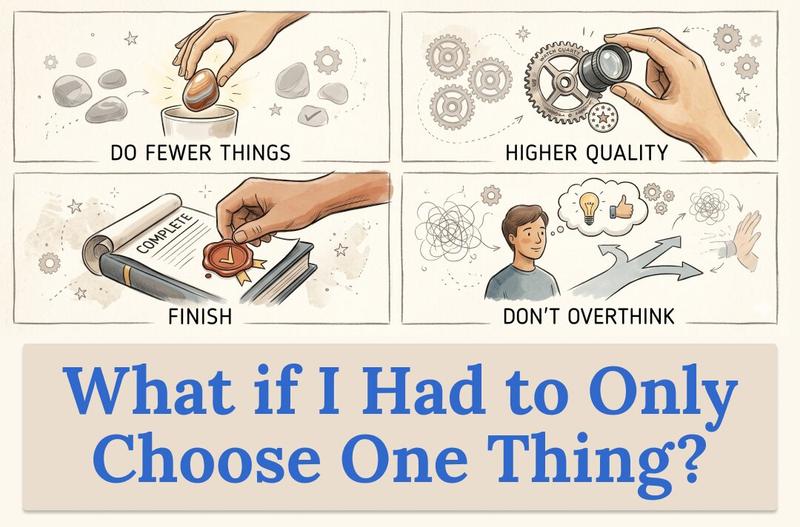
Two of these are Newport’s specific wording, while the other two are what he’s pointing at without quite saying.
Do Fewer Things
“Working on fewer things can paradoxically produce more value in the long term: overload generates an untenable quantity of nonproductive overhead.” (p. 73)
For Newport, doing fewer things entails a principle of structural reduction. He argues that we should be limiting at three different scales — missions, projects and daily goals. We should also reduce our expectations and load to the point where you can imagine accomplishing your work with time and energy to spare.
His cited example is Andrew Wiles, a professor and academic who installed specific rules, like no conferences, work from home, and trickling out of completed work to maintain perceived academic cadence, while at the same time he maximized his attention, effort and time towards his mission of solving the mathematical puzzle of Fermat’s Last Theorem.
My pseudo-productivity problem isn’t about busyness nor chat, email or meeting overload. It was largely about having too many projects. In April, 38% of my project time was spent on Playback Pilot (my startup product), 33% on writing and music, plus client work layered underneath. Each area was genuinely productive and important to me. But the total allostatic load has become nearly unsustainable.
A few days ago I sat with the question in my morning journaling, What if I had to only choose just one thing to focus on?. Here was my response:
Pursuing all of these equally is not totally working… If I try to do one thing more than another, time gets squeezed and an area gets neglected. I was really happy with my recent writing campaign and what it unlocked, but it cost me on the music finishing side and app development too…if I had to pick one thing it would be finishing that piece of software [Playback Pilot]
This connects to Oliver Burkeman’s Four Thousand Weeks, where he argues that time itself is the existential limiter — “We must make profound and possibility-limiting choices with our time.” Importantly, Newport’s do fewer things isn’t offering resolutions we must follow, but rules that might guide us forward and help us navigate.
Admittedly, doing fewer things can feel hard for me. It’s challenging to say “no” when the core things I’m doing are in the “hell yeah” category. In the past my response might have been to grind and work long hours. But recognizing the longer time horizon needed on certain projects and striving to pursue a more natural pace for entrepreneurship and creativity means enacting several moves here:
- Themed days > scattered tasking. Rather than trying to work a little bit each day on all of these areas, I actively prioritize and block out certain mornings or even days. This allows me to be fully focused, find momentum, and make tangible progress.
- One meaningful piece advances each week. Tracking my focus hours, while important, is not as important as achieving a concrete output that moves the mission forward.
- Trust the cadence. “Gotta just keep going” is the mantra. The pace IS the mindset, the strategy, the process.
The forcing function of recognizing and accepting my one thing for this current season means I’m moving a meaningful piece forward each week and pushing back against asking myself, “Why am I not there yet?” Cut the goal in half and slow output are fine, because I just gotta keep going.
Higher Quality
Obsessing over quality is a cornerstone of Newport’s approach. As he puts it, “Once you commit to doing something very well, busyness becomes intolerable.” (p. 135)
As an expert in any field can tell you (and likely something each of us has experienced), learning and improved technical skills can make it hard to look at our previous art or work. Once a perceptual capacity is built, our old work stops sounding the same. Some artists describe this recognition as a form of grief. For example, in building critical listening skills as a musician and audio engineer, I now can no longer unhear certain issues in my songs in progress and the songs I’ve already released.
This is the working artist’s bind that Ira Glass, via Newport, names: “Your taste can guide you toward the best work you’re capable of producing at the moment, but it can also fuel a sense of disappointment in your final result.” (p. 140) Pursuing higher quality has costs — missing short-term opportunities, a slower pace, a form of perfectionism that can look like procrastination. Newport points to Jewel, the musician, who accepted a lower record advance to keep her artistic control intact. Her motto: “Hardwood grows slowly.” (p. 129)
I’m feeling the live version of this right now, finishing my seventh album. Even though a week or so ago I had declared that I was nearing the end with tracked hours at 151.2/160.0 (94%) and had set my pencils-down date at May 17, several changes are forcing me to reevaluate. Both of my core collaborators have contributed fresh recordings (vocals and trumpet). While working with a pro mixer, leveling up my mixing skills and doing reference track analysis, I’ve started to hear what I want the album as a whole to sound like.
The pursuit of higher quality as an artist and music professional means I’m no longer “done” and there is still work to do. The finish line has to be moved. It’s the kind of moment I’ve written about before — finding myself back in the messy middle, where the project isn’t quite where I thought it was.
Finish (at a natural pace)
The book’s central character is John McPhee, an American author whose examples bookend the book. McPhee spent his career at The New Yorker producing meticulous long-form journalism, sometimes spending years on a single piece. Newport opens with him lying on his back, thinking hard about how to make something wonderful, and returns to him at the close with the line:
“Put a drop in the bucket each day. Because if you put a drop in a bucket every day, after three hundred and sixty-five days, the bucket’s going to have some water in it.” — John McPhee, via Newport (p. 166)
McPhee’s discipline of small daily effort over very long timelines is the practical heart of slow productivity and dovetails with Newport’s middle principle, work at a natural pace. Newport’s point is that “Working with unceasing intensity is artificial and unsustainable. A more natural, slower, varied pace to work is the foundation of true productivity in the long term.” (p. 94)
I’d argue that natural pace and finishing are the same discipline from different angles. During my 7-week writing sprint, my pace wasn’t frantic or running hot every day. My effort and focus varied over the period, but it still produced steady drops in the bucket. The drops accumulated, and I delivered 9 posts.
As Newport puts it:
“Grand achievement is built on the steady accumulation of modest results over time. This path is long. Pace yourself.” (p. 100)
Seasonality Reframe: A closing thought
How do I say “no” to things that are good for me and I care about, but just don’t fit this season?
The core conflict I often face as an artist and goal pursuer is that I feel like I have too many things I want to do and achieve in this life and never enough time to fit it all in. I resonate with Newport’s philosophy and framing, especially his mantra to “Do Fewer Things.” Newport himself and many of the examples he cites work on fewer epic projects and obsess over quality at a slower pace over long periods of time — but with one humanizing nuance: seasonality. Seasonality includes both dedicated pause periods and “temporary periods of maximum intensity.” Slow and intense alternate.
My productivity satisfaction hasn’t been failing because I’m doing the wrong things, but because of existential time limits. I can’t do everything right now — for this season. This season is FOR pushing on Playback Pilot (software to help music producers make progress on music) as my main target, finishing Album 7 on a longer timeline, and accepting writing on a lighter cadence. This is just a moment of self-awareness and personal alignment I have to accept — for now. Eventually I’ll finish one of these things, my priorities will shift, and other goals can slot in.
Each season has its core activities and fruits to be harvested. Parking the goals that don’t fit isn’t quitting them. It’s recognizing that one thing wins for now, and the others wait their turn. Seasons change. Priorities can shift.
Unfortunately, there is no perfect or tidy answer to the question I started with: how do I say no to things I care about but just don’t fit this season? For now, naming the season — and what fits within it — is the best answer I have. Neither Newport nor any other writer on productivity, even one with a philosophical bent, can give you the framework to answer life’s compass questions.
What’s the one thing you’ll pick to prioritize for your current season?
Related Reading
- Cut Your Goal in Half: Book Notes on Finish by Jon Acuff — Acuff’s argument is that perfectionism, not laziness, is what kills finishing; cutting the goal in half is the move that lets you actually ship. A practical companion to Newport’s do fewer things at the individual-project scale.
- Time Management as Life Philosophy: Book Notes on Four Thousand Weeks by Oliver Burkeman — Burkeman’s case that you get ~4,000 weeks in a human life, and any meaningful work requires making “profound and possibility-limiting choices” with that finite time. The existential frame underneath Newport’s first principle.
- I Forgive Myself, Now I Can Work: Book Notes on Feel-Good Productivity by Ali Abdaal — Abdaal flips the usual logic: feeling good isn’t the reward for productive work, it’s the fuel. A useful counter-read to Newport, who is largely silent on the emotional side of sustainable output.
- Stuck in the Middle: Why Motivation Collapses Halfway to Your Goal — Behavioral research on the predictable midpoint slump on long goals, and design moves to climb out of the valley. The hidden tax on natural pace once a project runs long.
- The Ostrich Problem: Why do we avoid checking our goal progress? — The research-backed habit of avoiding progress information on goals we care about. The personal mirror of pseudo-productivity: visible busyness can quietly mask whether real work is moving.
- 80 Hours, 9 Posts: What a 7-Week Writing Sprint Taught Me — Debrief from my own 7-week sprint. Live evidence for McPhee’s “drop in the bucket” principle — varied, sustained effort accumulating into real shipped work.
AIDA (AI Disclosure Acknowledgement): This blog post was researched and written by the author. AI tools (Claude Code) were used to assist with processing some of the quotes, proofreading and clarity. The four-panel graphic was generated using Google’s Gemini.