
What if a well-tracked life doesn’t add up to a well-lived one?
I am a long-time advocate and practitioner of the quantified self and self-tracking in general. Over the years, I have tracked dozens of areas of my life and accumulated millions of data points. I started a blog series entitled “Track Everything” with 100+ articles, and I built an open source project for aggregating and visualizing personal data.
As a hardcore self-tracker, I have to confess that I’ve also fallen victim to worthless tracking: measuring things I never changed, and putting faith in the premise that a well-tracked life would lead to a well-lived life. We can’t simply buy a wearable, measure something and expect miracle changes.
In Hacking Life: Systematized Living and Its Discontents, Joseph Reagle argues that life hacking, especially the optimizing kind, leads to tunnel vision: “like donning a set of horse blinders … the more optimal the hacking, the more narrow and distant the vision tends to be.”
Quantified self practitioners, biohackers and life hackers often collect data towards idealized goals of self-improvement and construct oversimplified models and metaphors about living. This overdependence on monolithic systems thinking and the mentality of “if you track it, you can change it” can limit how we see and interact with the world around us. It can result in seeing ourselves in reductionist and biased ways. Essentially life hackers can disappear into their systems and data.
Reagle lands harder than most critics of life hacking because he isn’t an anti-technology luddite, nor is he writing from an academic ivory tower. In fact, he acknowledges that he tracks his own daily word counts, records his writing hours, and feels a certain pull towards life hacking too.
In reading Reagle, I recognized a critical gap I had already half-written back in 2019: “we often fail to take the time to engage with the data we are collecting.” We simply collect and hope for the change to come. But self-tracking and data collection are just the starting point.
My Quick Take Book Review
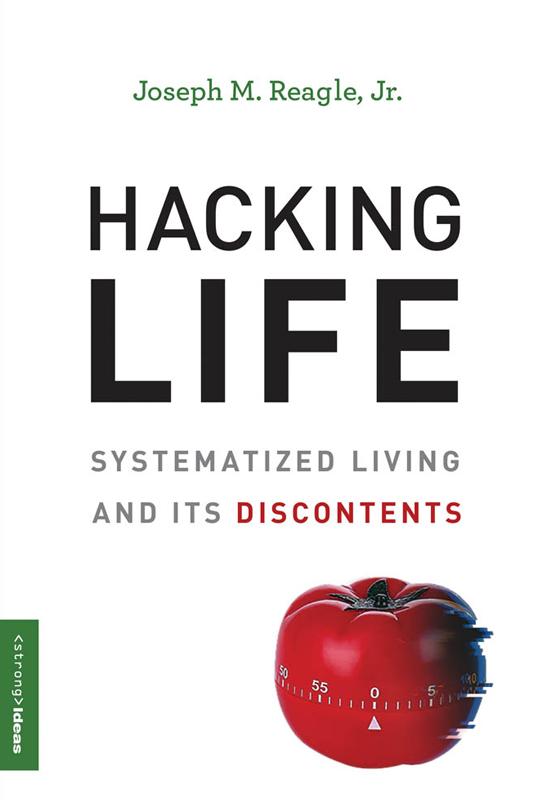
- ⭐⭐⭐⭐⭐ I rated this book a 5 out of 5 on Goodreads.
- Would I recommend it? Yes, this book lands a critique that many tech-centric self-trackers and biohackers likely haven’t considered but should. It isn’t monolithic and looks at many angles of “life hacking.” Even reading just the intro and one chapter will give you the heart of the critique, while individual chapters give it depth and nuance.
- Would I read it again? Yes, I’ve picked up this book a few times to look at certain chapters and parts.
- What was missing? I found some of the examples rather extreme, especially on relationship hacking. Much of the critique landed on gurus or extreme cases of self-tracking and life hacking. In places these land as strawman arguments. Reagle does name the ordinary case — the average, normal or modest life hacker who is more representative of personal ownership and self-experimentation across their health, productivity, creativity and beyond — but then builds most of the book on the extremes.
What I Got Out of This Book
“Self-knowledge through numbers”
2007 was a massive technological inflection point in Silicon Valley. Steve Jobs unveiled the first iPhone in January, and Apple released it in June. Google introduced Android, an open-source mobile operating system and iPhone rival. Facebook’s growth exploded beyond college campuses and hit a $15 billion valuation. Though founded the year before, Twitter witnessed a breakout moment at SXSW.
Alongside the dramatic rise of mobile computing and social media, two Wired editors, Gary Wolf and Kevin Kelly, co-founded Quantified Self and held their first meetup in 2007, drawing about thirty people. The movement that grew out of it ran through the same orbit of tech writers, software engineers, designers and founders — people like Chris Anderson, then editor-in-chief of Wired and later founder of 3D Robotics, and Stewart Brand, who created the Whole Earth Catalog, both of whom were tracking their own lives in those years. These weren’t people selling a system. They had built the magazines, the catalogs and the tools that told everyone else what technology was for, and they turned that same instinct on themselves.
The movement’s tagline was “self-knowledge through numbers.”
This is a bigger claim than it looks at first glance. The pursuit wasn’t about data through numbers nor insight through numbers. Instead the aim was self-knowledge, the classic search philosophers had been after for centuries. Socrates declared the unexamined life not worth living, and now quantified self practitioners believed it was reachable by counting.
The format they landed on at that first meetup made the promise concrete. As Wolf recounted, a late-comer turned out to be a graduate student in human-computer interaction (HCI) who had been tracking detailed data on how he spent his time during the year he was writing his dissertation. He walked up to the front of the room, opened his laptop and showed a graph of what he had collected. Wolf and Kelly were stunned. That talk became the template for every QS meetup that followed: show what you tracked, how you tracked it, and what you learned.
That third question is worth sitting with. It isn’t a question about the data. It asks what you did with it, what you uncovered and why it mattered.
Wolf is honest about the trade-offs involved. “We tolerate the pathologies of quantification — a dry, abstract, mechanical type of knowledge — because the results are so powerful,” he writes. “Numbering things allows tests, comparisons, experiments.” Once you have data, you can make changes and see whether they work.
Elsewhere he conceded something harder to defend: “there’s a compulsion, a curiosity, that seems to operate in advance of any particular use.” As a quantified self practitioner myself, I have run numerous tracking experiments that centered on this addictive pull to quantify some aspect of myself, even without an obvious need or even an upside. I just wanted to get that area of life into data and see what I’d see.
“Self-tracking proved to be a near enemy of self-knowledge.”
About nine years after that first Quantified Self meetup, one of the most committed trackers in that orbit quit.
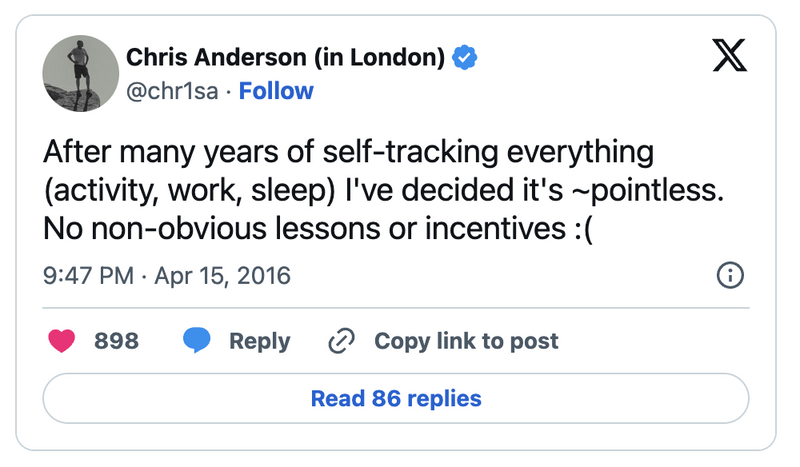
As Chris Anderson put it on Twitter in April 2016, “After many years of self-tracking everything (activity, work, sleep) I’ve decided it’s ~pointless. No non-obvious lessons or incentives :(“ When asked in a comment why he had kept at it so long, he put it bluntly: “Wanted to believe.” The comments in that thread spanned a range of responses, including some admitting to the futility of quantification, others still hoping it would help and a handful looking at it from the perspective of art and creative data visualization.
He wasn’t alone that week. Three days later, MIT Technology Review covered the same thread and pointed to another defector, a far heavier one. Gordon Bell had quit too. Born in 1934, Bell led the PDP and VAX work at Digital Equipment Corporation before moving to Microsoft Research. He was the man behind MyLifeBits, the project that took up Vannevar Bush’s 1945 Memex vision and tried to digitize an entire human life — every paper, every photo, a wearable camera recording as he went. If anyone had the standing to defend lifelogging, it was Bell. Lifelogging, he told Computerworld, “wasn’t something that was bringing a lot of value to my life.”
Not everyone agreed. Stephen Wolfram, who had been logging his own data since the late 1980s, was quoted in the same piece: “I can’t imagine I’ll stop.” This could be a confession of a self-tracking addiction or a comment on how he has found usefulness and value in his own approach.
For years, I had read the blog posts and followed a host of self-trackers and quantified self enthusiasts, and I found some traction in my self-improvement journey using personal data collection, but I also had what I might call a blind or empty belief in the “movement” too. I really wanted QS to lead to lasting changes, better health and heightened creativity. In a couple of experimental periods, I had tried to “track everything,” and the tracking became borderline compulsive with marginal gains.
When I first read Reagle’s book, I admitted that “I had fallen for certain ways of framing the expected benefits behind many of the systems I create and think about.” Reading the book was a hard pill to swallow at certain points, especially “Chapter 6: Hacking Health,” which carries the book’s most direct critique of QS. In the end, I was hyper-optimizing and largely seeking — or, in some cases, creating — signal in the n=1 noise.
Reagle puts it simply: “Self-tracking proved to be a near enemy of self-knowledge.”
Borrowing from Buddhist philosophy, compassion has an obvious opposite in animosity, which could be called the far enemy. A near enemy is a close cousin of the virtue or behavior you are pursuing, one that masquerades as the virtue while lacking its true ethical orientation and intentionality. Examples include, to quote Reagle, “pity as compassion, dependence as love, indifference as equanimity. These are near enemies.”
In seeking self-knowledge, I had fallen for the near enemy of the very thing I was chasing.
“Ferriss is not a typical life hacker. He is a guru.”
We often seek out experts, self-help books and gurus on the premise and promise of a wholesale system we can use and leverage. Try my X to solve your Y.
Reagle offers a straightforward distinction between a guru and a geek. A “guru” offers a grandiose system, a prescription, advice to follow. They are selling something, a lifestyle, a way of thinking and doing, a program to purchase. By contrast, a “geek” is an enthusiast trying to do or change something on a mundane or quotidian level. As Reagle himself writes, “aside from the gurus, most life hackers are ordinary geeks attempting to improve their lives.” He is also clear about where the real trouble lies: “self-help universalizes its advice, especially when the experiences of the successful and wealthy are presented as worthy and capable of emulation.” That’s the guru’s move; it isn’t the geek’s.
Reagle draws the line and describes the geek, but the book then walks past it. Most of its pages go to the first kind: Ferriss, the relationship hackers, the people counting everything. Ferriss is the most famous and notorious of them, and his books, podcasts and, to some extent, his movement sell universal solutions or “hacks” under the guise of science and practical self-help.
Like Wolfram, I can’t imagine living and pursuing goals without some form of self-tracking. Self-tracking alone doesn’t give you the answer but having certain data can help you probe questions, explore changes in your life over time, and experiment. I built my data collection pipelines to empower my weekly reviews and goal setting, and to bound my efforts with how I spend my time, my health and more. It’s helped me balance a portfolio of pursuits and life challenges, including just regular exercise and sleep. Quantified self helps me think through and navigate the ordinary challenges of a digital professional life.
There are seemingly endless apps, tools and ways to track a life and, by extension, hack it towards your objective. A life overburdened with new tools and AI makes everything seem possible, and as if everything should be optimized and improved to the limit. The question is whether a given thing helps, hinders, or just swirls your thinking and doing. Some things shouldn’t be tracked, especially time-consuming ones with minimal upside.
To quote Reagle:
“The nominal hacker wants to be a good enough swimmer to safely enjoy the water, the optimal hacker wants to be the best at racing upstream.”
Life isn’t all about being the fastest swimmer you can be (unless you are a professional swimmer). I’d rather be a good enough swimmer who enjoys the water.
“Not all mirrors are windows.”
Was Chris Anderson wrong to want non-obvious lessons from self-tracking, or perhaps wrong to think that’s what tracking was for?
Among the replies to Anderson’s tweet was one from Stewart Brand, and it says a good deal about what both of them had expected self-tracking to give them.
“Being lazier than Chris, I only lasted a few months self-tracking. Not all mirrors are windows.”
Brand didn’t want to spend more months on something with so little upside. Neither of them found what they came for.
Brand’s line cuts deeper than the complaint, because it names what they had been expecting. They had hoped self-tracking would be more than a mirror — that it would open onto something they couldn’t otherwise see. But a mirror only shows you what you already knew you looked like. Both men wanted a window, and rejected a mirror for not being one.
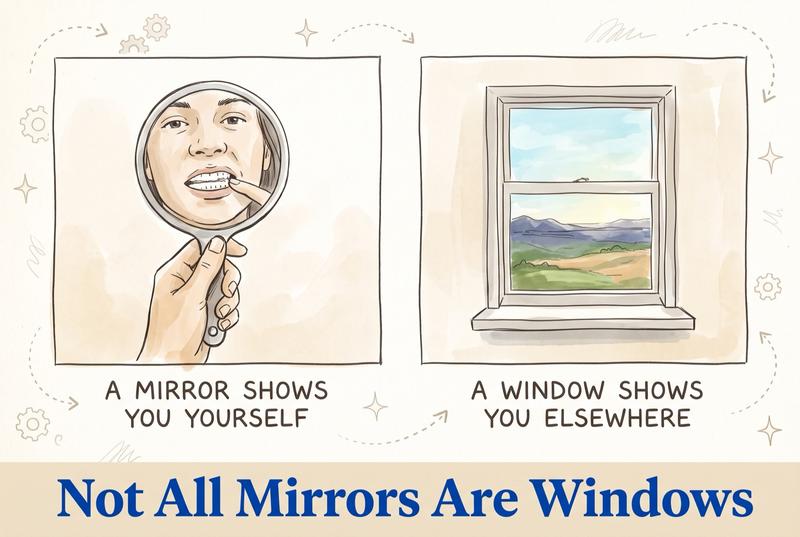
A mirror isn’t a failed window. It’s a different instrument. A mirror helps you see things you normally can’t, like your own back, or notice something specific, like spinach in your teeth or a pimple on your chin. A mirror is for checking and adjusting. It’s ill-suited to revelation or capital-T Truth, but it is often the best and only tool for certain jobs.
For example, using my Oura wearable, Apple Watch and apps like Strava I am able to collect data on my sleep, HRV (stress proxy) and exercise. While I often want to use these to tailor workouts and optimize my performance, in reality they have become better suited to helping me notice changing patterns. It’s less about peering into my inner self and facilitating an optimal state and more about how I approach a moment in my day or organize my week ahead.
Mirrors don’t offer insight; they offer us specificity and make self-deception harder. Rather than a vague “I slept poorly,” I can check the logs and see a pattern: “5h20 nightly sleep average for the last 10 days.” I can dig further and see a workload that has ballooned, computer usage late into the night, and skipped workouts. I can set some intentions and make changes. These are in many ways obvious answers surfaced by a mirror built for uncomfortable accuracy about what actually happened, even when we would rather avoid and ignore these signs, like an ostrich burying our heads in the sand.
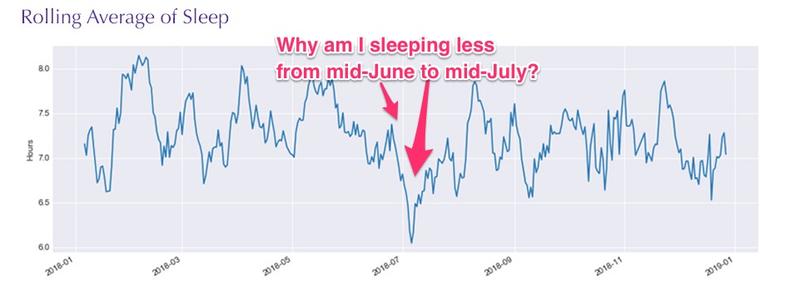
My 2018 sleep, from A Year in Data: 2018. The mirror flagged the mid-June dip; the answer was obvious once I looked: the World Cup, later nights and a few more beers.
These numbers didn’t teach me anything; they helped me surface an irrefutable pattern, own it, and make a correction. Non-obvious lessons were never on the menu. The obvious ones, made undeniable, were — and that was the whole point.
Concluding Thought: “There is no destination, per se, only how you traverse the path.”
A data-driven, well-tracked life doesn’t add up to a well-lived one. It was never supposed to, and it was never going to.
The Quantified Self stumbled into that at the start. The format from that first meetup asked three questions. The first two — what did you track, and how did you track it? — have answers. You can finish those parts and state plainly what tools you used, your instrumentation, the data you captured and what the trends looked like. But the third question — what did you learn? — is categorically different and never finishes.
More than two millennia earlier, Socrates had offered a parallel in his much-quoted “The unexamined life is not worth living.” While the later dialogues in Plato’s voice offer systems and operate more like treatises, the early dialogues closest to the historical Socrates showcase how and why he remains such a radical thinker. Socrates doesn’t promise that an examined life will deliver anything. Not happiness, not virtue, not even insight. He offers instead a practice without ready-made answers where, at its purest, the examining is the worth.
The culture of life hackers, quantified self practitioners, biohackers and others has kept the first two questions and focused on tracking and tooling while largely letting go of the third. That is the part we ignored when we quietly assumed self-knowledge was reachable by counting.
That’s the near enemy. It takes self-reflection to grow, transform and reach lasting change (as well as a dash of self-forgiveness).
Reagle grants that in life hacking there are “clever techniques to be discovered and shared, as well as useful frames for making sense of life.” Midway through, in the chapter on meaning, he reaches for the Serenity Prayer:
“To riff on the Serenity Prayer, life hackers seek the cleverness to hack what can be hacked and the Wisdom 2.0 to know and accept what cannot.” (Ch 8, “Hacking Meaning”)
In my original reading I called that a bit waffling. Like many critiques, Reagle’s doesn’t provide a clear-cut way out or even much of an alternative. Nor does the book end on acceptance. It closes where it opened, on blinkers: “even those who once embraced blinkers realize that they can chafe, especially when you have to don them first thing in the morning.”
I’d rather end on continuing to ask. There could never be a single answer to what we learned, because examining a life never ends.
Related Reading
More from me on self-tracking and self-reflection:
- Gordon Bell and The Epic Quest to Digitalize Everything — The long version of the story above: the most ambitious attempt anyone has made to turn a single life into data, and the man who eventually walked away from it.
- The Ostrich Problem: Why do we avoid checking our goal progress? — The failure on the other side of this post: not checking the mirror at all, because checking might mean bad news.
- Quantified Self and Self-Tracking Mind Map — My attempt to map the whole landscape of self-tracking, drawn from inside the movement Reagle is critiquing.
- The First Quantified Self Tracker: A History of Weighing Scales — Santorio Santorio weighed himself and everything he consumed, every day for thirty years, and found his way to the concept of metabolism. A mirror that did become a window — at the cost of thirty years.
- I Forgive Myself, Now I Can Work: Book Notes on Feel-Good Productivity — Where the dash of self-forgiveness comes from.
Additional Book Notes, Quotes and Key Takeaways
On what life hacking actually is:
- “Life hacking is self-help for the creative class.” (Ch 9, “Blinkered”)
- “QS is the measurement-obsessed wing of life hacking, with a significant focus on health.” (Ch 6, “Hacking Health”)
- “Hackers are happy to invest time and energy up front if they end up with a system to use in the future.” (Ch 6, “Hacking Health”)
On the near enemy, and where a virtue and its imitation come apart:
- “No one wants to be incapable or incompetent, but being efficient is not the same as being effective. We decry materialism, but being precious about minimalism is not the same thing as living unfettered. No one likes being sick, but compulsively checking health statistics is its own sort of illness.” (Ch 1, “Introduction”)
- “To put this in terms of Maslow’s Hammer: if you have an optimized hammer, it will serve brilliantly for pounding a screw into drywall. The problem is that when you stand back to enjoy the picture you just hung, the screw is not likely to hold.” (Ch 7, “Hacking Relationships”)
- “Apophenia is the human tendency to discern patterns in randomness, to perceive signal in the noise.” (Ch 6, “Hacking Health”)
On not throwing it all out:
- “However, unlike Salerno, we ought not dismiss all of self-help (and life hacking) as a sham. There are clever techniques to be discovered and shared, as well as useful frames for making sense of life.” (Ch 9, “Blinkered”)
My own notes from a first reading, 2021:
- “It’s about heuristics or shortcuts rather than systems.”
- “Cults require absolute adherence while life hacking is very much about individualistic personal fit.”
For context, Gary Wolf on what made the Quantified Self possible:
- “First, electronic sensors got smaller and better. Second, people started carrying powerful computing devices, typically disguised as mobile phones. Third, social media made it seem normal to share everything. And fourth, we began to get an inkling of the rise of a global superintelligence known as the cloud.”
AIDA (AI Disclosure Acknowledgement): This blog post was researched and written by the author. AI tools (Claude Code) were used to assist with structural editing, quote verification, fact-checking and proofreading. The mirror and window graphic was generated using Google’s Gemini.