The books I read each year often unfold like maps and trails—shaped by the places I visit, the questions I’m wrestling with, and the stories that find me along the way.
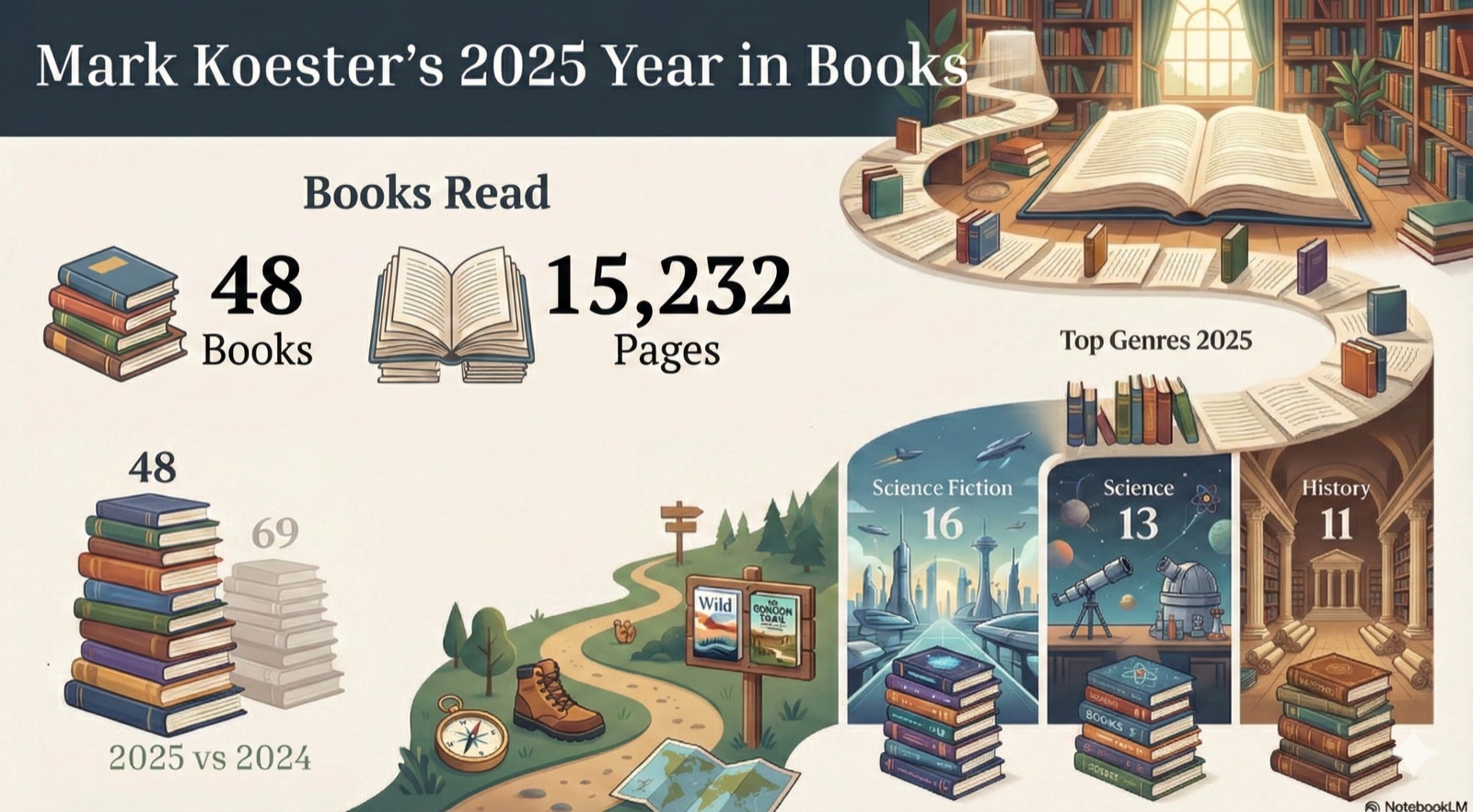
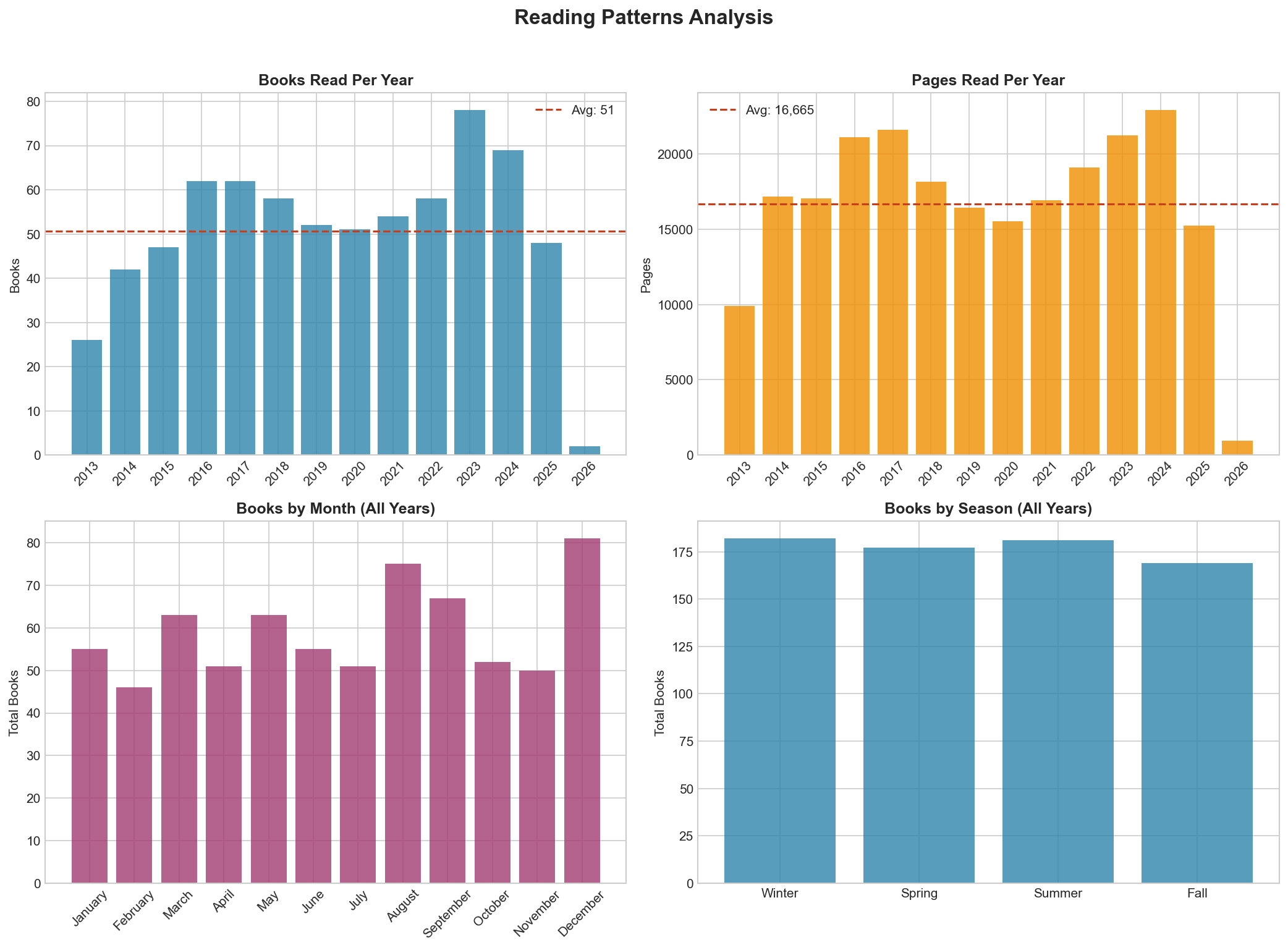
2025 was a year of movement. The Los Angeles fires in early January were a massive disruption, and the subsequent air quality pushed me to spend a month in Costa Rica and several weeks in Kansas City. I eventually spent nearly half of 2025 away from home, including a 3+ month road trip through Oregon, Washington, and Northern California. Somewhere between building apps, hiking Pacific Northwest trails, and working from temporary homes, I read 48 books.
It wasn’t just where I read that changed but what I have been reading has changed too. My reading history logs date back over a decade. Looking back, I noticed several shifts. Most notable was a shift from self-optimization and personal development to exploration. For years, as I honed my skills and developed my craft as a product-thinking software engineer, my reading was heavily utilitarian: business books, productivity systems, psychology research, self-improvement.
This year, fiction reached near-parity with nonfiction for the first time. Science fiction became a primary lens for thinking about technology and the future. As my feet and eyes were exploring the outdoors, trail narratives started to dominate my book reading and passages I was highlighting.
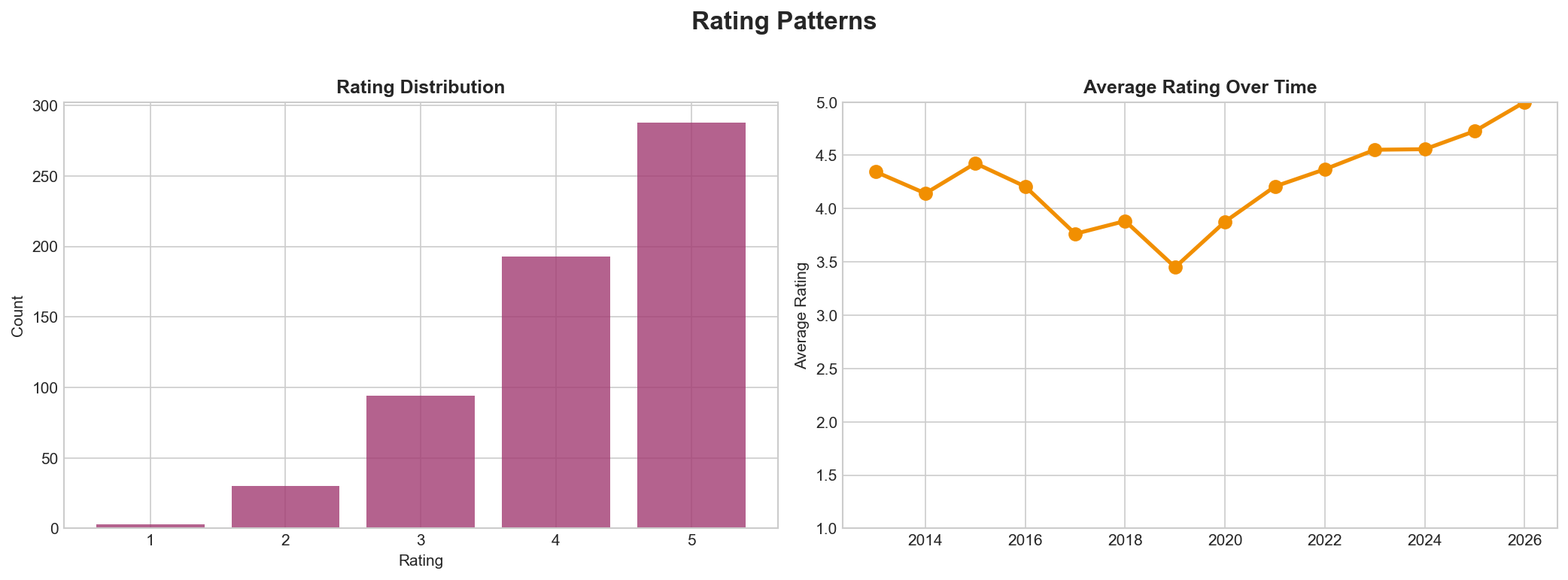
Interestingly and somewhat surprising to me was that my average rating on Goodreads hit an all-time high. I may have become a softer critic, but I also think it was because I got better at abandoning books that I wasn’t enjoying. If you don’t like a book, don’t force it; just stop reading it and start reading something else.
The data tells part of the story: fewer books (48 vs. 69 in 2024), but higher satisfaction (4.73 average rating, with 79% receiving 5 stars). Fewer highlights (1,156 vs. 3,056), but a deeper engagement with narratives and plots rather than extractable facts and topics I should learn and master.
For the past five years or so, I’ve published an annual reading review as part of my “year in data” series. In this post, I’ll share my favorite books from 2025, explore the patterns in my reading data, and reflect on what these shifts in my reading history might mean. I’ll set a few intentions for the year ahead. Hopefully you’ll find a few books worth adding to your own list.
The Numbers: 48 Books and 15,232 Pages
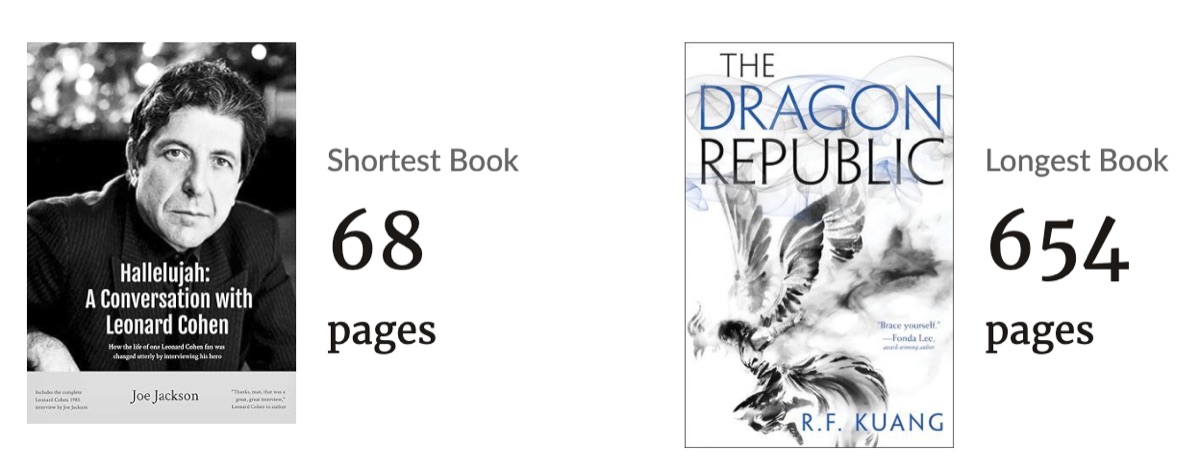
In 2025, I read 48 books totaling 15,232 pages. I averaged about one book per week and roughly 317 pages per book.
- Longest Book: The Dragon Republic (654 pages)
- Average book length: 317 pages
- Highest rated year ever: 4.73 average rating
- 79% of rated books received 5 stars
Year on Year Changes: 21 fewer books compared to 2024
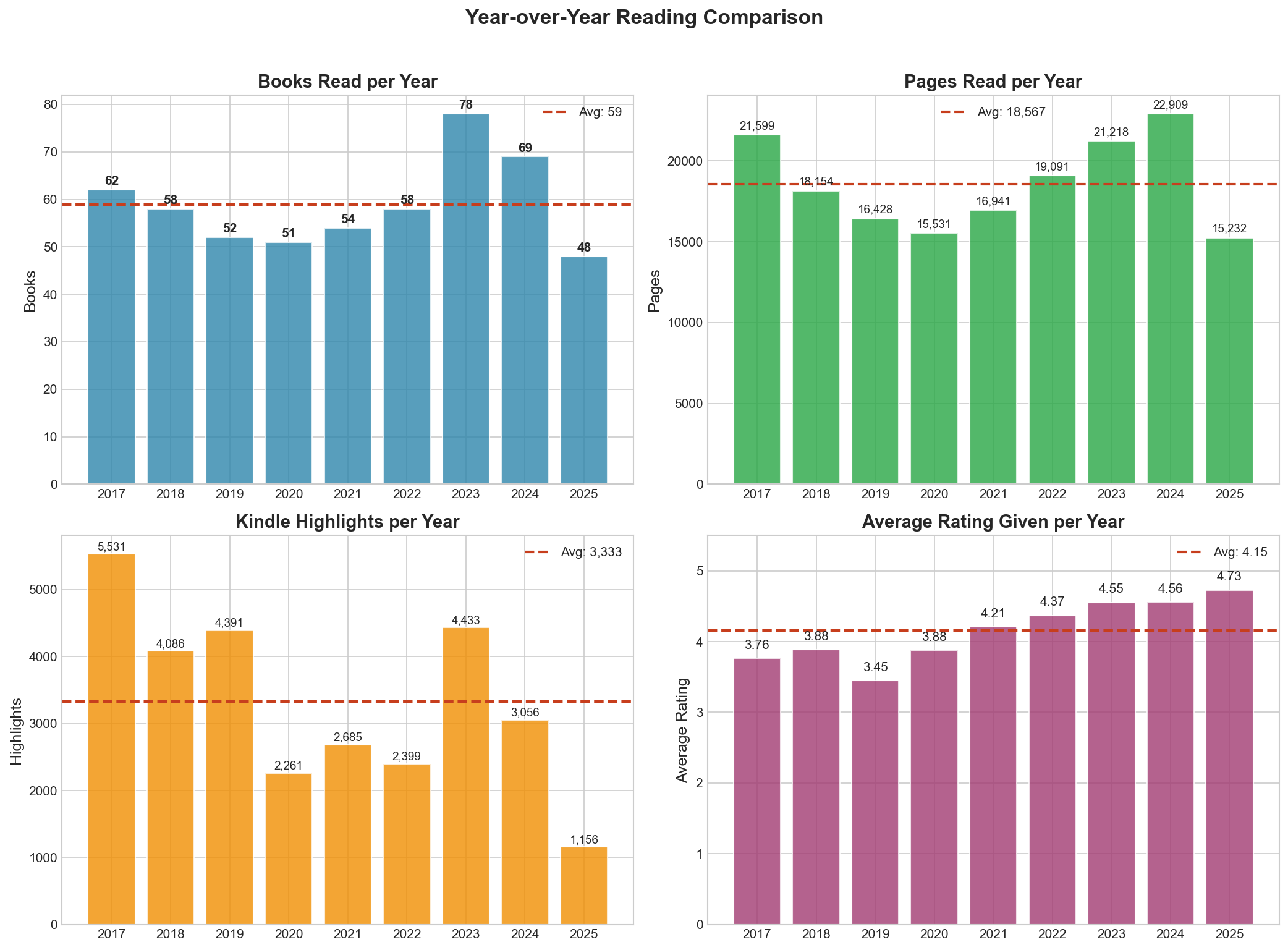
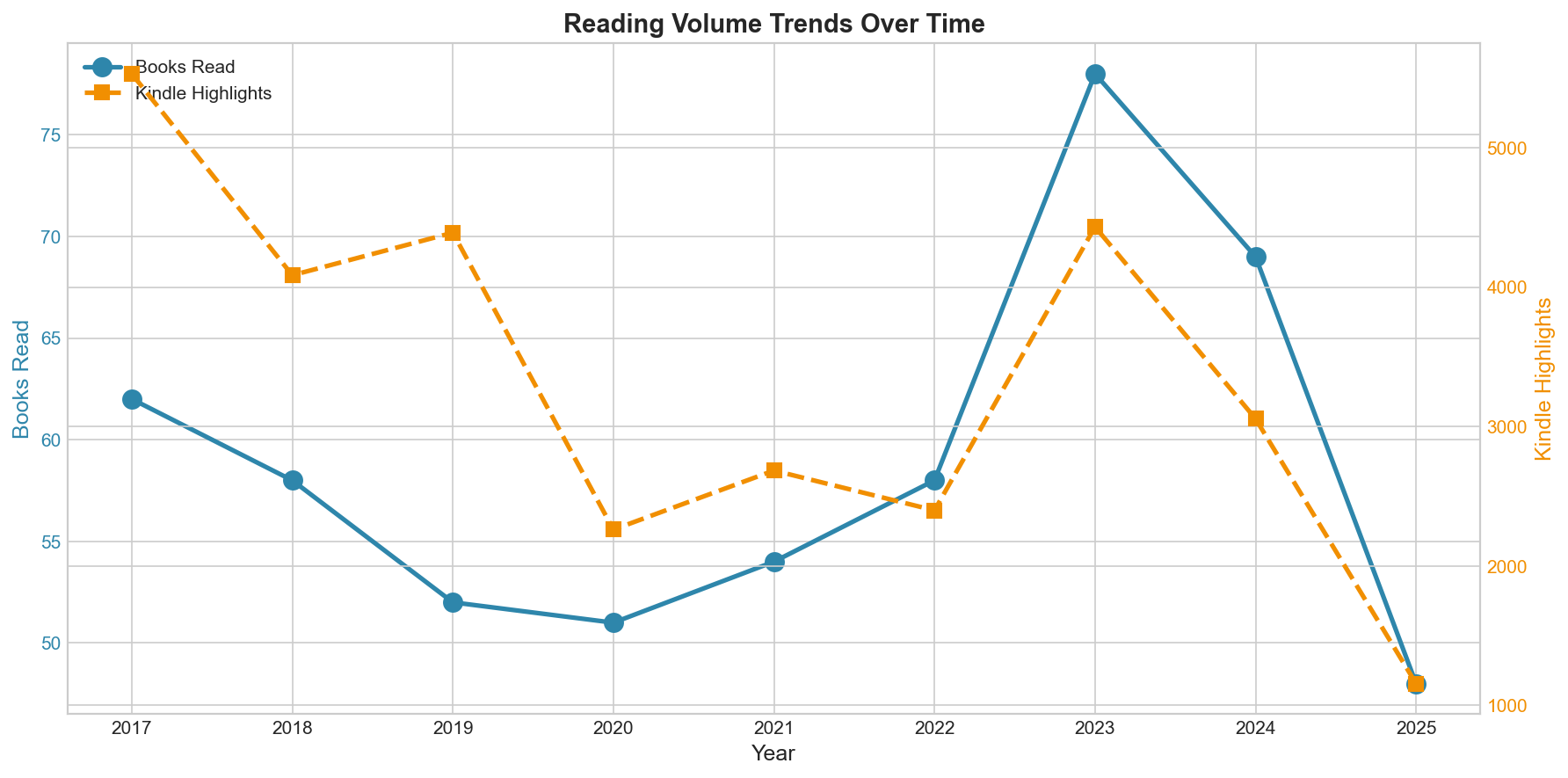
For a host of reasons, 2023 and 2024 were huge years of reading for me, and I was unlikely to come anywhere close the previous year’s 70 books per year count. For 2025 I had set the reasonable goal of a book a week or 52 books per year, and, in spite of a slow start in January, for most of the year I was on pace to hit that target.
As my workload increased professionally and I went deep into software development and “vibe” coding, my late night book reading time got supplanted by app development. Being immersed in building was amazing, and I felt less and less of a pull towards new topics and explorations and more and more into building. Generally travel is a great time for me to read, but since a large part of this year’s travel involved driving, I overall spent less time on my kindle. When I did read, especially at the end of the year, it was mostly fiction aimed at relaxing and exploring immersive future, sci-fi worlds.
The Patterns:
Rise of Fiction Reading: Shift in Genre Preferences
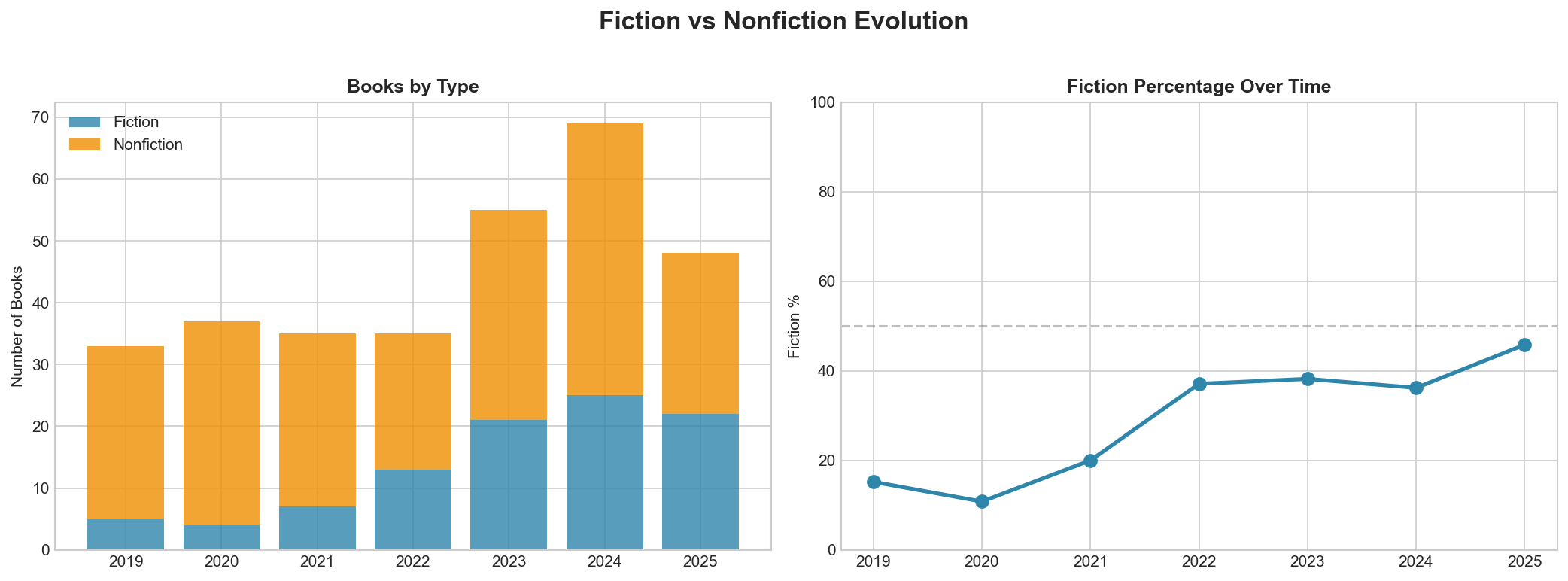
One of the most striking patterns I noticed in my book reading this year and over the past couple years was the continued shift towards reading more and more fiction. In fact, in 2025, 46% of my books read were fiction which marks the highest percentage in my recent documented reading history dating back to 2013.
Here is the breakdown:
| Year | Fiction % |
|---|---|
| 2019 | 15% |
| 2020 | 11% |
| 2021 | 20% |
| 2022 | 37% |
| 2023 | 38% |
| 2024 | 36% |
| 2025 | 46% |
There are a host of factors likely contributing to this change. Between 2015 and 2020, my reading and timelogs show a marked focus on learning and personal development. This coincided with a change in my non-computer screen time and YouTube usage too. Over time I have decreased my time spent on learning overall and less and less time reading nonfiction, which is likely a byproduct of increased daytime work and project commitments.
Here is the breakdown:
| Period | Fiction % | Context |
|---|---|---|
| 2019-2020 | 11-15% | Almost exclusively nonfiction |
| 2021 | 20% | First signs of shift |
| 2022-2024 | 36-38% | Steady increase |
| 2025 | 46% | Near parity |
2025 marks the first time where I’m reading nearly the same amount of fiction as nonfiction. I attribute some of this shift to maturity of work skills and personal life management skills. I’m less and less in need of these so-called “self-help” books to guide, orient and aid me figuring out my core purpose, habits and time management.
Though it’s a separate topic, I also think my learning has shifted into using and leveraging AI to explore new topics and accelerate how and what I learn, leading to less need for seeking out books for most of what I learn. Interestingly I’m also starting to use AI (in particularly Google Gemini’s Guide Learning Mode or NotebookLM) as a companion while I read certain history books, enabling me to contextualize and dive into parts of stories a book may not cover, are confusing or simply I wish to revisit and refresh my memory.
Book reading can be a portal to exploring self and society. Overall, with nearly 13 years of reading history, I am definitely due for a deep dive and some data analysis into the changes in my reading history and other data points, along with hopefully a public blog post.
Top Genres in 2025: Science Fiction, Science, History and Biography/Memoirs
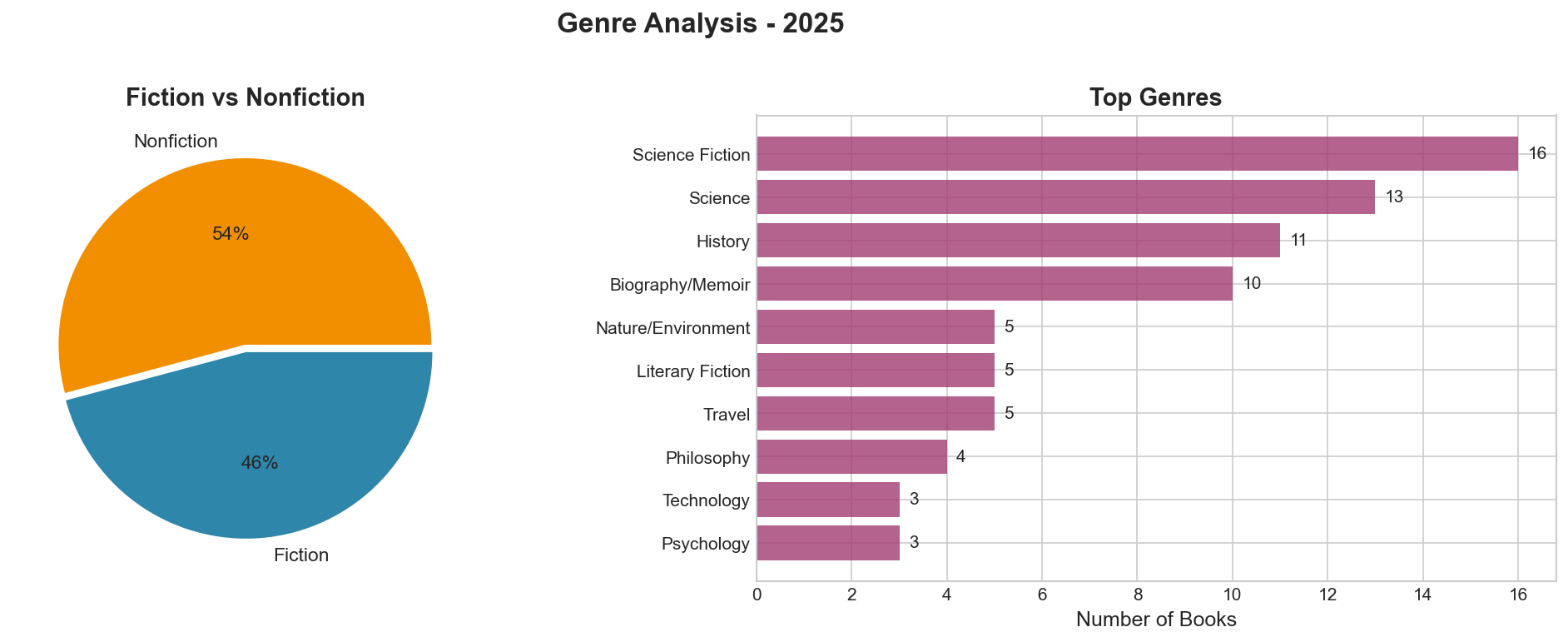
I’m a strong believer in reading widely and across multiple genres. One my intentions each new year is to ensure I read a wide variety of genres. I also try to read female authors and international writers too. I try to read at least a few books on history, philosophy and science every year as well as a mix of books on productivity, habits or mental health.
Over the years, on the nonfiction side, I tend to read a mix of genres spanning philosophy, science, history and more. During previous years, I left like there were a ton of books on habits, goals, brain and psychology that I just had to read, but over last couple years I feel like I somewhat “graduated” from some of those books, since a lot of those books tend to use the same studies and core ideas but in slight different configurations. I wouldn’t exactly say I am burned out on “pop psychology” books per se, but I am definitely more selective.
Interestingly, this year saw marked increase in travel books, especially hiking related travel books. This isn’t surprising in view of how much travel, hiking and camping I did last year, including three months in the Pacific Northwest and long treks in and around the Pacific Crest Trail and Cascade Mountain Ranges.
I generally believe this shift in genre preferences wasn’t so much a conscious decision. It emerged organically as I found myself drawn more and more towards science fiction’s big questions and to novels that explore the human condition. This feels especially true and necessary in view of how rapidly certain areas of technology have been changing so quickly in past couple years due to the rise of Generative AI and Agentic tools.
Book Reading Highlights: 1,156 Total in 2025
Even though I finished 48 books, I actually “nibbled” on many other books and collected highlights in 57 total books. This higher count of books highlighted than books read is indicative of a willingness to try a bunch of books as well as being ok with not finishing too. As a primarily a Kindle ebook reader, I collected a total of 1,156 highlights in 2025, which was a significant decrease from 2024’s 3,056 highlights.
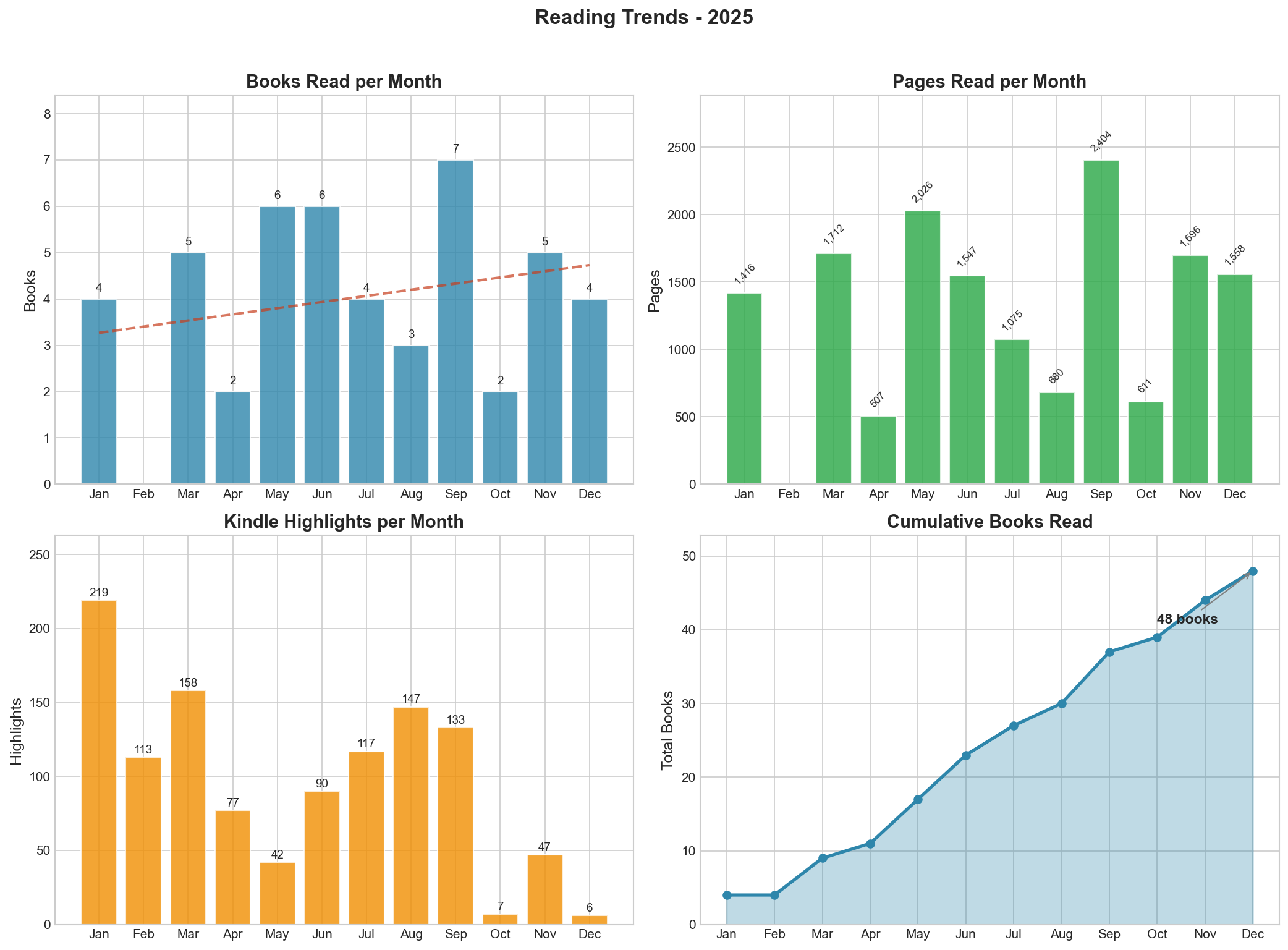
Interestingly I started the year in January with a lot of nonfiction books and lots of highlights, but overall the year saw a slow decrease. I had a two-month peak in August and September, which lined up with travels in the Pacific Northwest. October to December saw a dramatic drop that coincided with a big product development push and an increase in fiction reading. This was tied with an end of the year push to try and finish as many books as I could to hit my 52 books read yearly goal (which I missed by 2 books this year!).
Top Numbers:
- 20.3 average highlights per book
- 96.3 monthly average
- 219 most in a month
- 6 least in a month
Top Highlighted Books:
- 129 in Rethinking Consciousness
- 102 in A Thousand Brains
- 82 in The Origin of Buddhist Meditation
- 78 in A River Lost
- 67 in Why Greatness Cannot Be Planned
- 58 in The Oregon Trail: A New American Journey
Such a dramatic decrease in highlights year-on-year begs the question of what changed? Was I less engaged with what I was reading? Highlights have historically been a strong proxy for me about my engagement on a topic and its importance for my personal development. In past years, I heavily highlighted books on running, training and sleep, which were indicators of topical importance to me on a health and training level. Like I hinted at early, I’d attribute this shift to a change in genre preferences and reading more for enjoyment as well as my increased utilization of AI for learning and discovery. As I’ve shifted more towards fiction, it makes sense to see less and less highlights.
All things considered, in view of how important learning and thinking is during this period of change, I likely want to integrate personal development and thinking books into my 2026 reading list. I view book reading and a few books in particular as highly formative and even transformative in my life.
Thematic Threads: Trails and Consciousness
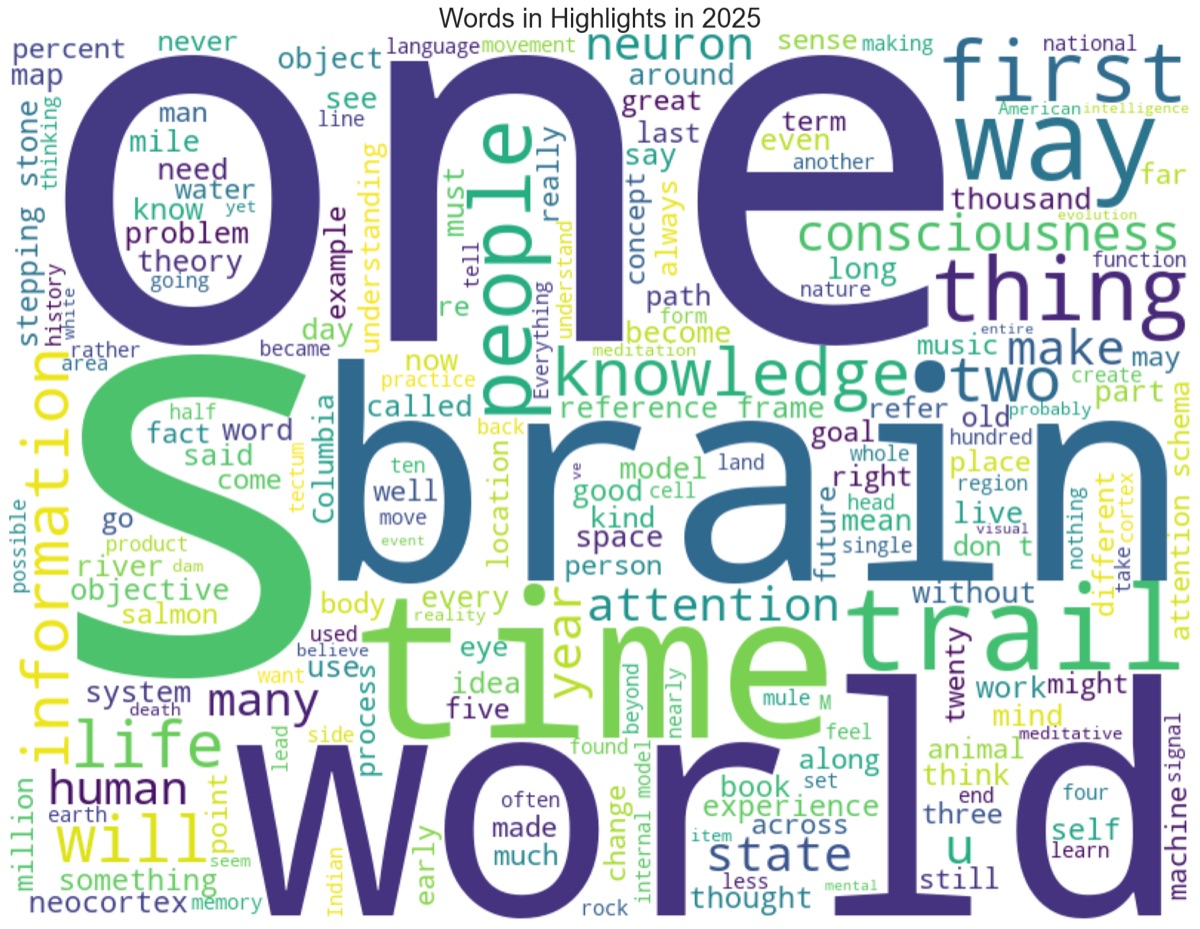
Looking back at 2025’s reading, two themes kept emerging across multiple books:
Thematic Thread #1: Trails and Journeys
I definitely didn’t set out in late 2024 or early 2025 to read about trails, but this was clearly one of my top recurring themes in 2025: pioneer trails, hiking trails, the trails animals make, and even the neural pathways that form our thoughts. For example:
- The Oregon Trail (Rinker Buck)
- Wild (Cheryl Strayed)
- Grandma Gatewood’s Walk (Ben Montgomery)
- On Trails (Robert Moor)
- Pacific Crest Trail guides
As I was exploring Oregan and experiencing transcendent moments hiking in Catalina Island, Northern California and especially in Washington State’s Cascade Mountains, the idea and presence of trails were a big part of my world. Trails essentially connect two different places and, for both humans and animals, generally form for pragmatic needs, including connecting resources, communities and places. The Oregon Trail was the primary conduit in the migration to the Western edge of the United States. Technology amplifies the speed and practicality of these connected places through roads and even information superhighways.
Over time, the nature of trails has become less about practicalities and more about immersing us and connecting us with nature. As society got increasingly urbanized and less and less physically active and connected to nature, trails and trail building emerged as a counteracting force. It led to this return to nature, and hiking trail serve as a way to experience nature through movement. I feel incredibly grateful for the time I spent last year on a host of trails and for trail builders and maintainers that make it possible. I’m excited to hopefully hike and visit more trails around the world in the months and years ahead.
Thematic Thread #2: Consciousness and Mind
If you asked me to recommend one book or even a class of books that I think would be most transformative, I’d recommend you read books on neurology and brain sciences. As brain-bound humans, understanding how our brains work and function can have a profound impact on personal development and even our biologically bound lived experience.
While I read more books on the brain in 2024 than 2025. Several “consciousness” books, both nonfiction and fiction, all approached the same question from different angles: What is awareness, and why do we have it?
Several books tapped into this theme for me:
- Blindsight and Echopraxia (Peter Watts)
- Rethinking Consciousness (Michael Graziano)
- A Thousand Brains (Jeff Hawkins)
- Bewilderment (Richard Powers)
While science books on consciousness were the most grounded, science fiction books like Blindsight,Echopraxia, and Bewilderment pushed me the most to think and imagine the nature of our brains at the intersection of technology and even alien intelligence. For example, what if intelligence in the universe lacks consciousness or even language but can still achieve technological superiority? What if our human form of knowledge and consciousness doesn’t “win out”?
Books That Matter: My 2025 Book Recommendations
Top Writers of 2025:
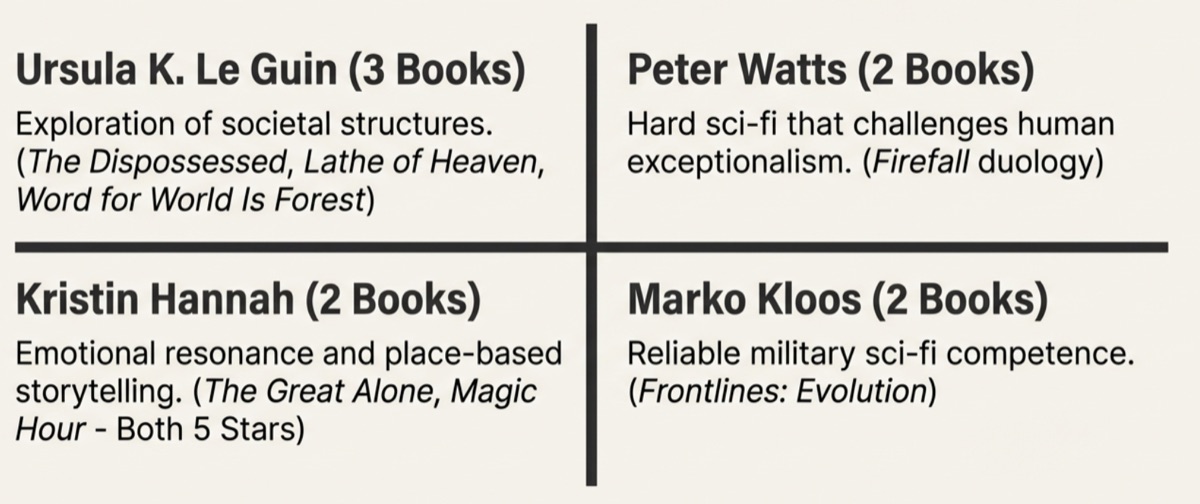
Check out Goodreads for a list of all of the books I read in 2025. Below are a few recommendations on my favorite books with quotes and thoughts.
(If you are interested in more book recommendations, check out my Recommended Books page where I keep a running list of my all-time favorites.)
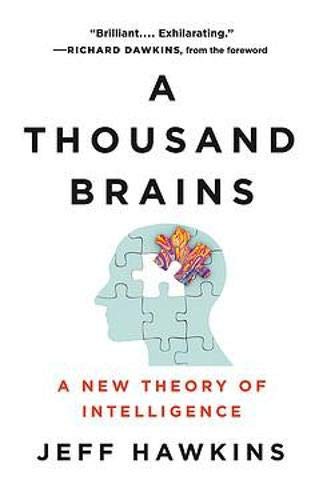
Favorite “Made Me Think” Nonfiction Book: A Thousand Brains by Jeff Hawkins
“The cells in your head are reading these words.”
Why doesn’t your brain get overwhelmed when you’re at a noisy party? How is it that so many competing signals resolve into one coherent world rather than a cacophony of competing interactions and interpretations?
In A Thousand Brains, neuroscientist and former tech executive Jeff Hawkins makes a compelling case for a conception of the brain that includes thousands of “mini-brains.” At the center of this story is the the neocortex, which he describes as “the organ of intelligence” and possessing “[a]lmost all the capabilities we think of as intelligence—such as vision, language, music, math, science, and engineering.” Inside the neocortext, Hawkins present a compelling theory of the brain built from thousands of nearly identical “columns,” each containing a complete model of the world.
A sample of thought-provoking quotes:
- “Only thing in the universe that knows the universe exists is the three-pound mass of cells floating in our heads.”
- “The brain’s model of the world includes a model of our self. This leads to the strange truth that what you and I perceive, moment to moment, is a simulation of the world, not the real world.”
- “If you connect a cortical region to eyes, you get vision; if you connect the same cortical region to ears, you get hearing; and if you connect regions to other regions, you get higher thought, such as language.”
- “We realized that the brain’s model of the world is built using maplike reference frames. Not one reference frame, but hundreds of thousands of them.”
This book and theory behind is paradigm-shifting reading into how our intelligence works and likely how future intelligences including AI work too.
👀 Check out my personal review and summary in How Intelligence Emerges from a Thousand Brains: Jeff Hawkins’ Model of the Neocortex.
Favorite Sci-Fi Book: The Dispossessed by Ursula K. Le Guin
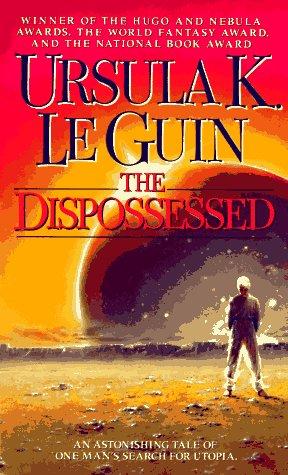
“It’s always easiest to let yourself be governed.”
Can a piece of world-altering technology be used to change a political system? Or reinforce an existing world order?
Ursula K. Le Guin is one of my favorite fantasy and sci-fi writers. The Dispossessed: An Ambiguous Utopia, published in 1974, is a fascinating and immersive read that offers a modern and thought-provoking take on what it means to live together and how technology or a scientific breakthrough might alter a political order. The main protagonist Shevek is a physicist in an anarchist society attempting to develop a revolutionary and paradigm-shifting theory of temporality.
The story takes place on Anarres and Urras which are twin inhabited worlds of Tau Ceti and are markedly different political and societal structures. The moon, Anarres, is a harsh environment and operates a anarchist society with a deep collective, worker-centered community. By contrast, Urras is an capitalistic, technologically and materially advanced society but is also a largely patriarchal and even authoritarian system. As he develops his work, Shevek finds himself blocked by the sheer challenge and by rivals, and he must travel and bridge these two worlds as well as connect with the greater universe of space-faring societies beyond. The tension between Shevek’s ideologism and ego/drive towards achievement particularly resonated with me.
This book is political philosophy embedded in a page-turning wok of science fiction and is part of Le Guin’s Hainish Cycle, a loosely associated group of books based on the premise that humans didn’t evolve on Earth but from the peaceful and ancient planet Hain that now surveils and guides other civilizations. I’ve read nearly all of the books in Cycle and especially recommend this book along with Left Hand of Darkness.
Selected Quotes:
- “To be whole is to be part; true voyage is return.”
- “If you can see a thing whole, it seems that it’s always beautiful. Planets, lives…. But close up, a world’s all dirt and rocks. And day to day, life’s a hard job, you get tired, you lose the pattern. You need distance, interval. The way to see how beautiful the earth is, is to see it as the moon. The way to see how beautiful life is, is from the vantage point of death.”
- “We’re ashamed to say we’ve refused a posting. That the social conscience completely dominates the individual conscience, instead of striking a balance with it. We don’t cooperate—we obey. We fear being outcast, being called lazy, dysfunctional, egoizing. We fear our neighbor’s opinion more than we respect our own freedom of choice.”
- “But really, it is the question of ends and means. After all, work is done for the work’s sake. It is the lasting pleasure of life.”
- “Revolution is our obligation: our hope of evolution.”
2nd Favorite Sci-Fi Book: The Humans by Matt Haig
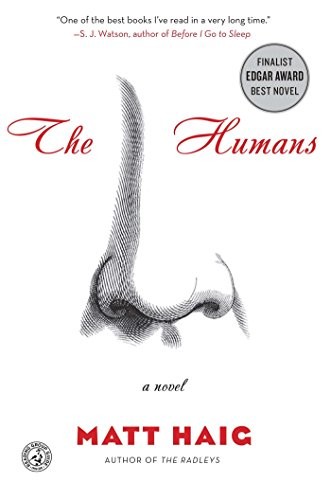
“To be a human is to state the obvious. Repeatedly, over and over, until the end of time.”
This is a strange, perspective-shifting novel about an alien who was transported into and takes over a human body. Tasked with an important objective, this alien-embedded-human slowly learns to appreciate and understand what makes humanity beautiful, interesting and unique, in spite of all its contraditions and limitations. This book is more fantasy than traditional space-faring sci-fi and takes a heart-felt exploration of what is means to find what is meaningful and true, even when it isn’t your “home”.
Selected Quotes:
- “We’re all lonely for something we don’t know we’re lonely for.” – David Foster Wallace
- “Life, especially human life, was an act of defiance. It was never meant to be, and yet it existed in an incredible number of places across a near-infinite amount of solar systems.”
- “The problem lying behind the lack of human fulfilment was a shortage not just of time but of imagination.”
- “The single biggest act of bravery or madness anyone can do is the act of change.”
- “There is a sunset, stop and look at it. Knowledge is finite. Wonder is infinite.”
Honorable Mention Sci-Fi Favorites
“What’s the difference between being dead, and just not knowing you’re alive?” — Blindsight
“Ye shall know the truth, and the truth shall make you mad.” —Aldous Huxley
- Blindsight by Peter Watts - Hard SF exploring consciousness and stretched my ability to follow some definition-breaking formations of what is life and what an alien life might look like, act, etc.
- Scorpio by Marko Kloos (Book 1 in Frontlines: Evolution Series) - Super fun read involving a distant colony and their quest to survive underground as supersized aliens take over their planet.
- The Toll by Neal Shusterman - Lovely third and final novel in Neal Shusterman’s Arc of a Scythe trilogy where humans have ended death and given most control and power to a benevolent AI.
- The Word for World is Forest by Ursula K. Le Guin - A bit dated at time, this book has quirky archeological, neocolonial edge.
- Same Bed Different Dreams by Ed Park - One of the more fantastical books I’ve read in years. This book spans multiple countries and time periods in this Korea-based genre bender.
- August Kitko and the Mechas from Space by Alex White - Fun read about the near end of days and rise of a piano-playing human turned battle robot driver.
Favorite Novel/Fiction: The Great Alone by Kristin Hannah
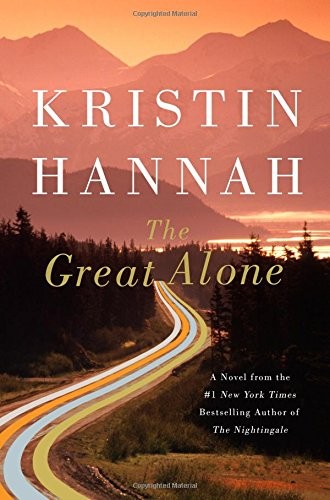
“In the vast expanse of this unpredictable wilderness, you will either become your best self and flourish, or you will run away, screaming, from the dark and the cold and the hardship. There is no middle ground, no safe place; not here, in the Great Alone.”
This is another “instant classic” for me from Kristin Hannah with beautiful writing and imagery. The main female protagonist and her family move to Alaska to escape the husband’s past and mental health challenges. They must learn to adjust and survive in Alaska’s harsh climate and unique neighbors.
This book stands out through its vivid imagery of Alaska through the seasons, a core plot and the overall evolution of a sleepy town into a tourist hub.
Selected Quotes:
- “Everyone up here had two stories: the life before and the life now. If you wanted to pray to a weirdo god or live in a school bus or marry a goose, no one in Alaska was going to say crap to you.”
- “All this time, Dad had taught Leni how dangerous the outside world was. The truth was that the biggest danger of all was in her own home.”
- “She lifted her camera and minimized her view of the world. It was how she managed her memories, how she processed the world. In pictures. With a camera, she could crop and reframe her life.”
- “Books were only a reflection of real life, not the thing itself.”
Honorable Mention: Magic Hour by Kristin Hannah - mute girl arrives myseriously at a remote town and two sisters (police chief and psychologist) must heal her and uncover what happened to her.
2nd Favorite “Made Me Think” Nonfiction Book: On Trails by Robert Moor
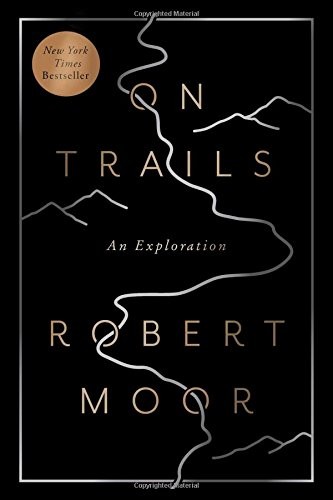
“To put it as simply as possible, a path is a way of making sense of the world. There are infinite ways to cross a landscape; the options are overwhelming, and pitfalls abound. The function of a path is to reduce this teeming chaos into an intelligible line.”
In year spent immersed in nature and trails, Robert Moor’s philosophical exploration of trails was one of those books that made me think and see the world differently. I originally thought this book was centered on trail builders, but in fact this book takes a very expansive view looking at trails from Ediacaran traces dating back 500 million years ago to modern hiking paths. The book weaves in stories from his hikes along the Appalachian trail and shares an inspiring look at why animals and humans have used trails and where trails exist now.
Selected Quotes:
- “On a trail, to walk is to follow.”
- “The trail had taught me that good designs—like age-old tools and classic folktales—are trail-wise: They fulfill a common need by balancing efficiency, flexibility, and durability.”
- “The reality of how most trails form—collectively, organically, without the need of a designer or a despot—has been increasingly apparent to scientists for centuries, but has remained invisible to most of us for far too long.”
- “Why do we, as animals, uproot ourselves rather than maintaining the stately fixity of trees? Why do we venture into places where we were not born and do not belong? Why do we press forward into the unknown?”
- “‘Truth has no path,’ [Krishnamurti] wrote. ‘All authority of any kind, especially in the field of thought and understanding, is the most destructive, evil thing.’”
Favorite History Book: Grandma Gatewood’s Walk by Ben Montgomery
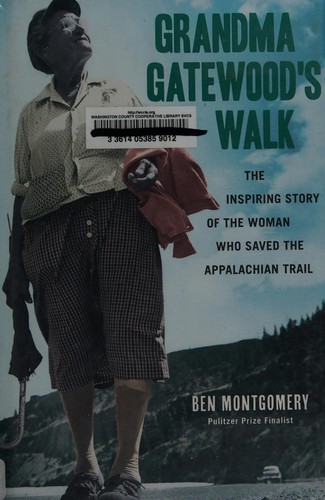
“The forest is a quiet place and nature is beautiful. I don’t want to sit and rock. I want to do something.”
In a year spent hiking and camping and reading several books and memoirs on the topic, this biography of Emma Gatewood, a 67-year-old grandmother who became the first woman to solo thru-hike the Appalachian Trail, was one of the most inspiring. Estranged from abusive husband, Grandma Gatewood spent her whole life working and caring for her family but was also seeking chances to go on long hikes and treks. After stumbling upon a National Geographic magazine on the newly “finished” Appalachian trail (AT), Gatewood decides to try and complete the entire 14-state, 2000-mile trail. Originally conceived as largely multi-day or day hikes, AT at the time proves less finished and more challenging than she expected. Equipped with a simple rucksack and basic tennis shoes, her tale is filled with courage and misadventures as she traverses from Georgia’s Springer Mountain to Maine’s Katahdin. Inspiring stuff.
Selected Quotes:
- “Why? Because it was there, she’d say. Seemed like a good lark, she’d say.”
- “Not lost, Emma said. Just misplaced.”
- “Most people today are pantywaist.”
- “Friedrich Wilhelm Nietzsche said, ‘Only those thoughts that come by walking have any value.’”
- “Anthropologists estimate that early man walked twenty miles a day.”
- “She planted her seventh pair of tennis shoes on the rocky top of the precipice, alone. She had lost thirty pounds. Her glasses were broken; her knee was sore.”
Honorable Mention History Books
- The Oregon Trail: A New American Journey by Rinker Buck - Another modern pioneer spirit, Rinker Buck and his brother retrace the Oregon Trail by mule.
- From The Oregon Trail: “The exodus across the plains in the fifteen years before the Civil War, when more than 400,000 pioneers made the trek between the frontier at the Missouri River and the Pacific coast, is still regarded by scholars as the largest single land migration in history.”
- “Two great impulses of the American experience—moving from farm to farm along the frontier, and building canals—resulted in the mythic prairie wagon that opened the West.”
- A River Lost: The Life and Death of the Columbia by Blaine Harden - Traversing the border between Oregon and Washington and snaking north to Idaho, a history of the Columbia river’s transformation from wild to tamed powerhouse
- Krakatoa by Simon Winchester - page-turning history about a volcanic eruption that changed history and theory
Fantasy/Literary Fiction Favorite: Bewilderment by Richard Powers
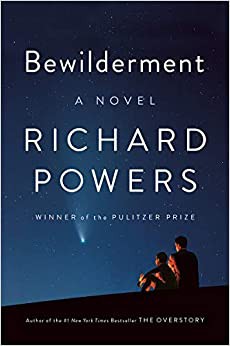
“The universe is a living thing, and my son wants to take me for a quick look around while there’s still time.”
Mixing astronomy, neuroscience, and the simple act of imagining other worlds together, Richard Powers writes pointedly about a father and son coping with grief and their changing world. Set to the backdrop of Earth falling apart due to ecological disasters and climate change, the pair navigate each other and these changes highlighted by camping trips. At its core his a boy struggling with himself and his mind, and a father desperate to help, even seeking the most cutting edge technologies and doctors. The story is both personal and planetary as we see tragedy unfold throughout. Wonderful, poetic read.
Selected Quotes:
- “Those who contemplate the beauty of the earth find reserves of strength that will endure as long as life lasts.” —Rachel Carson
- “We live suspended between love and ego.”
- “Earth had two kinds of people: those who could do the math and follow the science, and those who were happier with their own truths. But in our hearts’ daily practice, whatever schools we went to, we all lived as if tomorrow would be a clone of now.”
- “Sagan: We make our world significant by the courage of our questions and the depth of our answers.”
- “Only pure bewilderment kept us from civil war.”
Absent Categories: What Didn’t I Read? What should I read more of?
All-Time Top Genres:
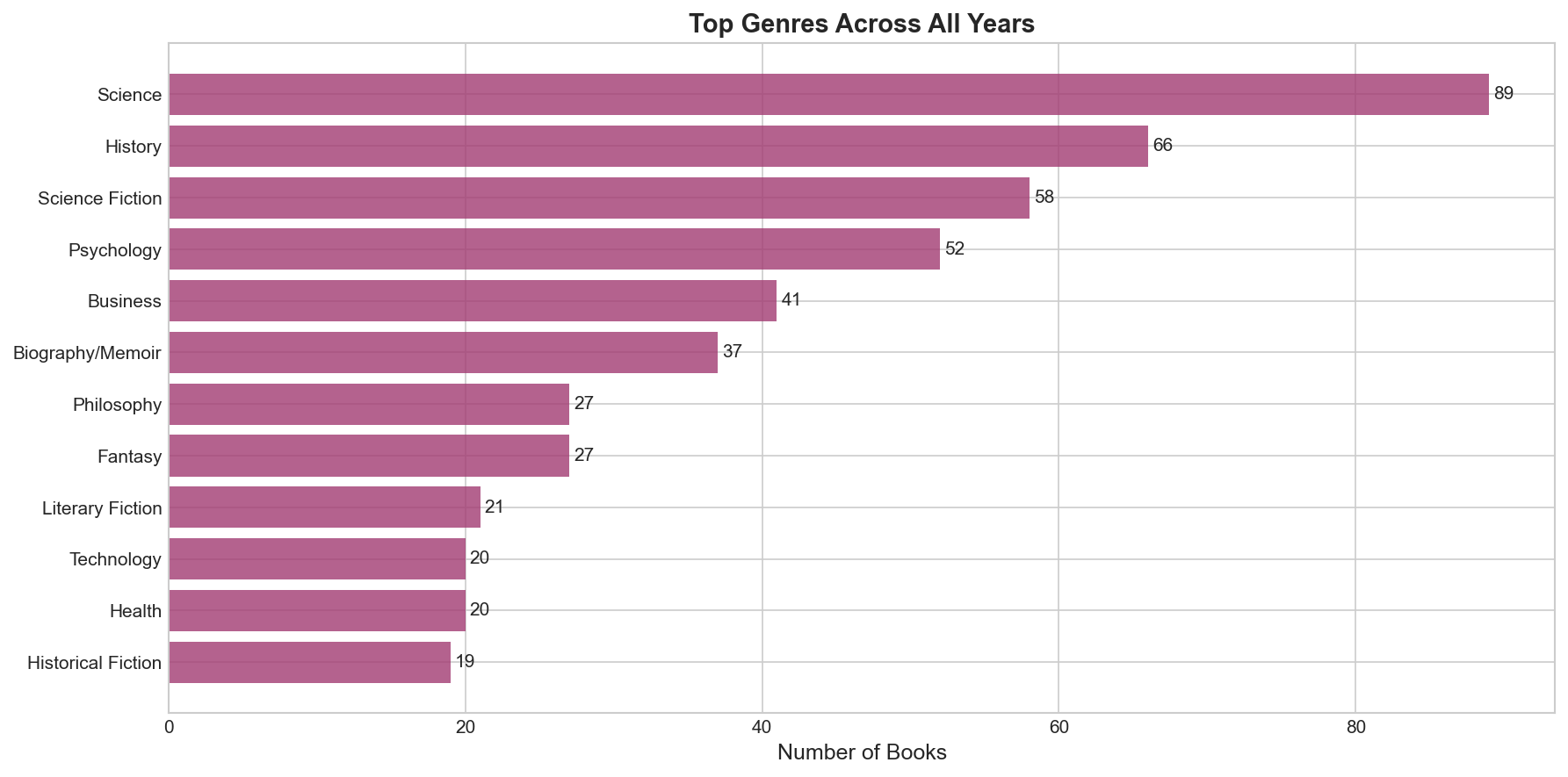
Compared to my 2024 book review, I found it notable some favorite categories that were absent in 2025, including:
- Creativity – No standout books on creative process or artistic practice
- Philosophy – While I read four philosophy-adjacent books (including Why Greatness Cannot Be Planned), none captured my attention the way previous years’ philosophy reads did
- Startup/Business/Economics – A category that dominated my reading from 2016-2019 was almost entirely absent, though you could argue the biography on Sam Altman would likely fit here.
- Health Science – After years of deep dives into sleep, nutrition, and performance optimization, this category went quiet and likely a category of books I should increase soon.
These weren’t intentional gaps. Looking back, I think the “explorer” mode that defined 2025 naturally pulled me toward narrative—fiction, trail memoirs, regional history—and away from the instrumental reading that characterized earlier years. When you’re hiking through the Columbia River Gorge or reading about pioneer wagons on the Oregon Trail, productivity and organizational frameworks are not generally the topics you turn to.
But I’ll admit that gaps reveal something. The absence of creativity books during a year when I was actively building apps and making music suggests I was doing creative work rather than reading about creative work. The absence of health science during a physically active year of hiking and travel might reflect the same pattern. Academic and theoretical studies just can’t replace lived experience and embodied practices theoretical study.
Still, in view of wanting to consciously weave these topics back into my life and thinking, they are categories I wish to bring back in 2026. The goal isn’t to return to full-on optimization or life hacking but to invite curiosity and exploratory reading into core fields in my life, like health, creativity and venture-building.
Conclusion and Reflection
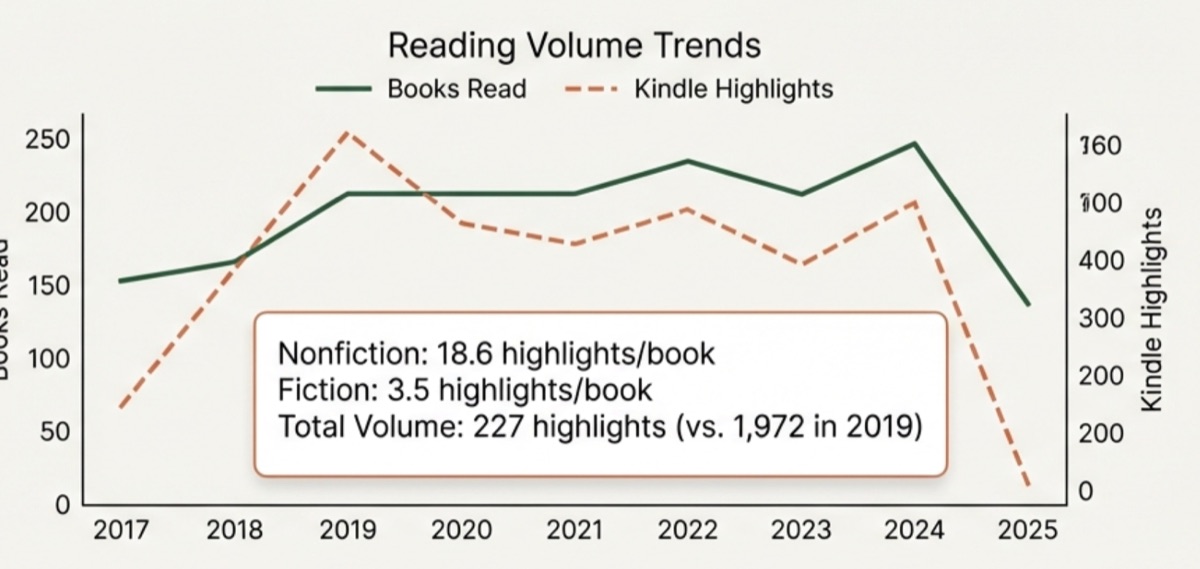
Along with empowering me to explore and immerse myself in a host of worlds and landscapes, my 2025 book reading exposed me to many new topics and ideas. Looking back at 2025’s reading, I see less “optimization” and more exploration. Fewer business books, more fiction. Fewer highlights, and, to some extent, more reading for pure enjoyment. The longer-term shift from 11% fiction (2019) to 46% fiction (2025) further reveals how my relationship with reading has evolved.
After 48 books, what stays with me isn’t necessarily the nonfiction takeaways I highlighted (though Hawkin’s Thousand Brains Theory comes close), but the fictional worlds I inhabited: Le Guin’s anarchist moon, R.F. Kuang’s shaman-powered medieval China, Watts’ nightmare spaceship, Hannah’s frozen Alaska, and Moor’s ancient trails.
Interested in reading more? The best reading advice I can give: read books about topics that interest you, abandon reading books you aren’t enjoying, carve out an end-of-day reading habit (to replace phone or screentime).
Best of luck and happy reading!
What was your favorite recent read? Or what’s another book I should read based on the ones here?
Got a comment? Send me an email.
FYI – If you are interested in more detailed data logging and tracking practices, I log my reading with Goodreads, Kindle and Instapaper. Core data collection and visualization powered by QS Ledger.
AIDA (AI Disclosure Acknowledgement): This post was written by me with the aid of AI tools. I leveraged an AI system (Claude) for help on data processing, analysis and visualization of Goodreads and Kindle clippings as well as an initial outline and top quotes. I used an AI system (Google’s NotebookLM & Gemini) to generate visual elements which I edited and refined.